Author: admin

  • Tallinn – Vabamu Museum of Occupations and Freedom

    Tallinn – Vabamu Museum of Occupations and Freedom

    20250208_120630

    There will be more to follow on some of the individual exhibits that interested me in this museum, apparently the first structure built in the country for the purpose of being a museum. This is one of the museums I didn’t get to last time using the Tallinn Card and I thought it would be one that I engaged with as I’m more than a little interested in the period under communism. This is a theme explored by numerous museums in Poland and it’s an intriguing story.

    20250208_115021

    Reading through the reviews, there are a few people who had a similar experience to me, but we’re in a considerable minority as most reviewers seem to really like the museum. I couldn’t engage with it at all though and I got fed up with how the museum had been curated and gave up after thirty minutes.

    20250208_113325

    This is the reason I struggled to engage, most things are audio based in the museum and the technology wasn’t very robust in terms of how it jumped thinking I had moved room. I like walls of text with the option of audio rather than what felt like walls of audio with minimal text. Even though the museum was relatively quiet, there was a logistical issue that visitors were clumping together in the same spot, so it was hard to see the exhibits. Unlike with text, where it’s possible to go to another room and read the information there before returning, the technology wasn’t set up to work like that here. A few people have said they would have preferred if the audio speed could be made faster, which would have been useful as I routinely listen to podcasts at either *1.5 or *2 speed in order to get through them quicker. Maybe TikTok has reduced my concentration span somewhat.

    There weren’t that many exhibits on display, so the museum was very much dependent on its audio guide to tell the story of the Soviet occupation from the perspective of eight individuals. I did want to listen to a couple of these audio stories outside of the museum, but they’re not on the web-site even in an abbreviated form. I suspect that the stories were really very interesting, but the presentation of them didn’t work for me, but it evidently does for the majority of visitors. Perhaps on a more important point (or to me), the museum did seem to try and tell visitors what they should be thinking and although I agreed with the sentiment of the whole institution, I’d rather be told what the facts are rather than what told what I should be thinking.

    Anyway, a few photos of some of the exhibits to come now in this riveting blog. As an aside, this reminds me that I must revisit the Museum of Occupation in Riga, Latvia as they had a similar set-up (although it was text rather than audio, so I got on better there) as they’ve now opened up their new site and permanent exhibition.

  • Tallinn – Fotografiska Tallinn

    Tallinn – Fotografiska Tallinn

    20250208_102028

    This is the Tallinn Fotografiska, a combination of art gallery, shop, restaurant, cafe and events space. I got in free of charge with the Tallinn Card but otherwise it’s quite a punchy £15 or so to get in, which feels a bit too much to me for Tallinn. Having noted that, the target audience they’re aiming for is probably not entirely price sensitive although most of the negative reviews are about the cost and not the contents. There are two floors of exhibitions and these are rotational, with the three exhibitions in early February 2025 being:

    Peegel Pildis
    Feng Li
    Shepard Fairey

    20250208_105454

    The whole atmosphere is laid back and welcoming, with the signage being clear and well laid out. I can see the interest in coming back regularly as the exhibitions are ever changing, but I can’t see many people spending more than about an hour here. I was glad that I popped along, it’s located near the city’s main railway station and the Shepard Fairey exhibition was the one that I enjoyed the most. And, visitors are allowed to take photographs, although it be an awkward situation for the gallery to try and stop them.

  • Tallinn – Fotografiska Tallinn (Peegel Pildis)

    Tallinn – Fotografiska Tallinn (Peegel Pildis)

    20250208_104814

    The third exhibition at Fotografiska was about sport, marking that this year Tallinn is the European Capital of Sport. It’s based around the work of Lembit Peegel and Pildis is Estonian for “in the picture”.

    20250208_104833

    This reminds me of my friend Dave Morgan on one of his walking exploits, not least one of the Spine Races that he’s just completed. He’s that bit braver than I am, although I know that I set the bar really high.

    20250208_105013

    20250208_105145

    Perhaps inevitably, I’m not really going to have a close interest in Estonian sports from the 1970s to the 1990s, but the imagery is human and shows the personality of the sportspeople. There was a freedom for Estonian photographers specialising in areas such as sport and culture, as they didn’t have to get too caught up in journalistic limitations that the Soviet influenced regime might have placed on them. There is quite a lot of raw emotion visible in a number of the photos and the exhibition explains the important role that he had in the newly independent Estonia in the 1990s and forging that new national identity. I was more intrigued by this exhibition than I expected to be, it’s an interesting way of seeing the evolution of sport in Estonia and it gave the collection a real purpose. And good luck to Tallinn in their year as the Capital of European Sport, I hope that they concentrate on the toughest and most challenging of all sporting endeavours, namely long distance walking.

  • Tallinn – Fotografiska Tallinn (Feng Li)

    Tallinn – Fotografiska Tallinn (Feng Li)

    20250208_104157

    Following on from Shepard Fairey’s Photo Synthesis (which is on reflection a really rather good name for an exhibition), the next exhibition I meandered to at Fotografiska was photography by Feng Li.

    20250208_104523

    It’s all very lovely, but I didn’t really find much to engage with here, although I like the collection of street art from around China. This felt to me like one of those exhibitions that would perhaps have a deeper meaning if shown in forty or fifty years time, being something of a snapshot of the era. There are some powerful street scene images of New York from the 1970s and 1980s that now seem to encapsulate the period rather well, but I couldn’t really get the irreverent excitement here.

    20250208_104609

    I think it’s all a bit decadent for me, just a bit too jazzy. Unfortunately, there was no-one else visiting this exhibition for me to watch and see how they were engaging with the photos. It’s a nicely laid out space though, the lighting is at an appropriate level and there was information about the artist and the concept. But as I’m not an art critic, that’s as much as I can usefully put (and claiming any usefulness might be pushing things). I suspect that Bev and Susanna would have liked this.

  • Tallinn – Fotografiska Tallinn (Shepard Fairey)

    Tallinn – Fotografiska Tallinn (Shepard Fairey)

    20250208_102338

    I feel like I’ve only just finished writing up my last little adventure in Tallinn with Steve, Bev, Ross and Susanna. Anyway, I’m back in the city but on my own this time and that’s an opportunity to work through all the places that we didn’t have time to visit before. I received a discount of 20% off for filling in a survey about the Tallinn Card and so I’ve bought another one as they do represent decent value for money, so that’s three days of museums and galleries coming up.

    20250208_102615

    There are two floors of exhibitions and they change every few months, so there’s no permanent exhibition here. I didn’t check in advance what was on display, but the first exhibition was from Shepard Fairey who I confess that I haven’t heard of. I’m not really very artistic, but new perspectives and all that.

    20250208_104050

    I do though know one of the most important images of the Obama campaign and this was one of Fairey’s works.

    20250208_104029

    If only. Just verging into politics for one moment, I looked at the on-line news edition of a couple of Estonian newspapers and I think I was surprised that there was nothing about the Trump administration, it was very focused on the Russian threat and other national and European news. All somewhat different from the UK news at the moment.

    20250208_103729

    One in the “these sunsets are to die for” series by Fairey. It’s based around the old Soviet propaganda posters and uses a rather dark humour to bring awareness to pollution damaging the landscapes. The punchy message might be that pollution needs to be stopped and quickly, but there’s another one which is more that the environment is so damaged that it’s best to enjoy what we can now if it’s all going up in flames.

    20250208_103936

    A beautiful ocean scene, with an oil rig.

    20250208_103716

    There’s a lot of artworks with bold imagery going on.

    20250208_103705

    The OBEY series is one of Fairey’s longest running themes, about questioning norms.

    20250208_103550

    Fairey is American, but I can see why these Russian style images have a resonance in Estonia.

    20250208_102615

    This wasn’t the best attended art exhibition that I’ve ever been to, but I rather liked it as it had a political edge which gives some meaning to arrangements. There were some documentaries playing about Fairey’s work, but they didn’t tackle his little issues with copyright over recent years and I only discovered that from subsequent reading up on him.

  • Briningham – St Maurice’s Church : Grave of John Frankpitt Woolway

    Briningham – St Maurice’s Church : Grave of John Frankpitt Woolway

    20250202_154015

    This is the Commonwealth War Grave of John Frankpitt Woolway, located in the graveyard of St. Maurice’s Church in Briningham.

    John was born in around 1889 and he got married to Clara Beatrice Laycock in Colchester on 8 June 1911 and at that point he lived at 68 Paris Street in Exeter. At the 1911 census, image above, he lived at 3 Water Tower Cottages, Kirby, Frinton On Sea, Essex where he was a boarder and working as a bookstall manager.

    John signed up on 9 December 1915 and at that time he still worked as a bookseller. He served in the 7th Battalion of the Royal West Kent Regiment, soldier number 241352 and his military record is one that survives. He was stationed in the UK between 29 April 1916 and 11 September 1917 before being sent overseas with the British Expeditionary Forces (BEF) from 12 September 1917 until 11 October 1918. He had a period back in the UK on leave between 12 October 1918 and 24 October 1918, before being sent back out to the BEF on 25 October 1918 and then back to the UK once more on Armistice Day, 11 November 1918. For those who like this sort of thing, the battalion’s military diaries are on-line, it’s sobering to see the officers writing down the battles and troop movements they were having, it makes it feel rather real.

    John died on 26 November 1918, likely as a result of his war injuries as he’s been given a war grave. His next of kin was his widow who lived at 9 Clifton Terrace on Manchester Street in Southampton and they didn’t have any children. John’s parents were James William Woolway and Alice Woolway who at the 1891 census were both running the Post Office in Briningham. On the night of the census, John was at his grand-parent’s house down the road in Burgh Parva. This then explains why he’s buried here, he’s buried with his parents. His widow married Harold Snook in early 1920 and she was living with him in Woolwich at the 1939 register and she died in 1957.

    This really is a life lost to the war. It seems likely that he might have had children if he had survived, or at least stayed with his wife for some decades to build a career and life together. Instead, she had to find someone else to live her life with, but at least John came home and is laid to rest with his parents.

  • Briningham – St Maurice’s Church (1903 Newspaper Article)

    Briningham – St Maurice’s Church (1903 Newspaper Article)

    This article was published in the local newspaper in 1903 and I rather liked the little snapshot into the history of the village, although it gives details of the work which had been done to St. Maurice’s Church.

    “BRININGHAM.

    The ancient church of St. Maurice has during the past decade been undergoing a gradual process of restoration in perfect conformity with its time-worn architecture. A few years ago, chiefly through the munificence of the lay Rector, the late Captain S. H. Brereton, R.A., the walls were strengthened, the nave and chancel re-roofed, and the windows re-glazed with stained glass. During the incumbency of the present Vicar, the Rev. Herbert J. Foyster, strenuous efforts have been made to beautify and make commodious the interior. The church has been heated and lighted by the fixing of a large tortoise stove and handsome cathedral lamps. Some eighteen months ago it was discovered that the tower was unsafe; so critical indeed was the condition found to be that it was deemed advisable that the bell should remain silent. The Vicar set to work, and, by means of subscriptions and donations from friends far and near, raised the sum of £71 3s., and the work has been completed. The entire cost, with incidentals, will be about £140, so that there is an approximate deficiency of about £70. For the reduction of this debt, the Vicar and his co-workers determined upon holding a bazaar. Mrs. Henry S. Brereton placed the grounds of Briningham House at the Vicar’s disposal. The following is a list of stalls with vendors:—

    Fancy Stall—Mrs. H. Brereton-Foyster, Miss Foyster, and the Misses Constance and Edith Foyster, the Misses Maroon and Martin.

    Tea Stall (indoor)—Mrs. Henry Brereton and Mrs. Parkinson.

    Tea Stall (outdoors)—Mrs. Alfred Clarke, Miss Kate Colman, Mrs. Groom, the Misses A. E. and M. Groom, Mrs. Jarrett, Miss A. Jones, E. Oliver, Mrs. and Miss Smorthwaite.

    Jumble Stall—Mesdames Clements, Dewing, Everett, Kaye, E. Matthews, F. Matthews, H. Sheringham, and Watling.

    Provision Stall—Mrs. B. Burwick, Brereton.

    Bran Pie—W. Henry Beane, jun.

    The Briston and Melton Constable Band played popular airs. In addition to the bazaar, there was a horticultural show, with exhibits from the labourers and workmen on the Briningham estate. The following is a list of the successful competitors, the judge being Mr. Samuel Dewing, of Swanton Novers:—

    Collection of vegetables—1 William Daplyn, 2 Benjamin Colman, 3 Jacob Colman. Potatoes—1 William Daplyn, 2 Jacob Colman, 3 Thomas Dack. Cabbages—1 William Daplyn, 2 Jacob Colman, 3 Thomas Dack. Onions—1 William Daplyn, 2 John Watling, 3 Benjamin Colman. Bread—1 Mrs. George Quinan, 2 Mrs. Jacob Colman, 3 Mrs. Clements. Cottage gardens—1 William Daplyn, 2 Benjamin Colman, 3 Jacob Colman and Thomas Dack (equal). Neatest cottage—1 Mrs. William Daplyn and Mrs. David Watling (equal), 2 Mrs. Benjamin Colman, and highly commended, Mrs. Jacob Colman.

    Notwithstanding the very unfavourable weather the proceeds amounted to nearly £50.”

  • Briningham – St Maurice’s Church

    Briningham – St Maurice’s Church

    20250202_152057

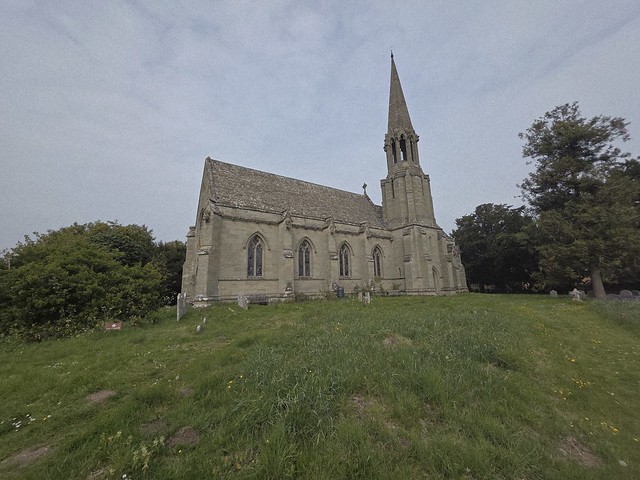
    St Maurice’s Church at Briningham is one of the rare situations where the church tower is off-set to the nave for reasons not relating to space. The reason that the church history gives is simply that it’s likely just how the architect and mason constructed it as that was their preferred style. There’s certainly no shortage of space here that would have required them to be creative with where the tower went, but no-one is entirely sure of the reason. The village dates back to the Anglo-Saxon era and its name means “the homestead of the people of Brina”, although it confuses Google as it thinks that I’ve mistyped Birmingham.

    20250202_152018

    The church is reached by walking across the garden of the neighbouring rectory, which is likely handy for the security of keeping the church safe if nothing else. There’s been a church here since at least the Norman period, with the north wall likely being a survivor from that time.

    20250202_152116

    The porch and I always wonder about all the people who have walked through this door over the last few centuries.

    20250202_152142

    The nave.

    20250202_152147

    I was pleased I didn’t have to climb this ladder arrangement. It would be the getting down that would particularly confaddle me, there’s not much to hold onto.

    20250202_152220

    The font is perhaps plain and more focused on its function, but it dates to the fourteenth century so it’s seen a fair number of births over the centuries.

    20250202_152657

    The end window in the nave is oddly oversized.

    20250202_153055

    It’s evident that this seems out of place, perhaps it was the window for the end of the chancel that never got to be put in. It seems unlikely that this would be for lack of funds, more likely a lack of labour and so perhaps that dates this to around the Black Death period.

    20250202_152712

    Looking back to the main door, it’s an airy and minimalist church, not much has changed here in the centuries and I rather liked that. Although there’s a long article from 1903 which details all the work that was done modernising the building, which I’ll post separately.

    20250202_152733

    The altar, all neat and tidy.

    20250202_152746

    20250202_152757

    The wooden figures are modern replacements for the ones that would have stood in these niches until they were destroyed in the Reformation.

    20250202_153320

    The chancel and there’s no evidence of any rood stairs, but I imagine they would have had a nice rood screen going across here at one stage. More recently, they had a plasterboard screen across here until it was removed in the late twentieth century.

    20250202_153510

    And some sweets, which I think Richard really wanted to eat, but I was able to stop him.

    20250202_153714

    The exterior of the church. There’s an image taken by George Plunkett from around this spot in 1986 and I’m pleased that they’re removed that foliage from the building since he took that photo.

    20250202_153801

    The outside of the chancel.

    20250202_154031

    The church from the other side, it all feels well proportioned if ignoring that shed type construction shoved on the side (or the vestry as they would probably call it). This feels like a slightly forgotten about church on-line, there aren’t the same number of photos and documents that are usually available, I can’t even find a photo of inside from before 2000 of just to look at the plasterboard arrangement.

  • Melton Constable – St. Mary’s (Burgh Parva) Old Church : Grave of Arthur Charles Gibson

    Melton Constable – St. Mary’s (Burgh Parva) Old Church : Grave of Arthur Charles Gibson

    20250202_135716

    This is the war grave of Arthur Charles Gibson who is buried at St. Mary’s church in Burgh Parva, located near to Melton Constable. I’ve never seen a war grave with the words “buried elsewhere in this churchyard” on it, but in this case it’s because Arthur wasn’t listed on the Commonwealth War Graves Commission list, but in 2015 he was added to the United Kingdom Book of Remembrance.

    Arthur’s record at the 1911 census when he lived on Gordon Road in Melton Constable. He lived with Walter Stangroom’s family, with Walter being his brother-in-law, and he worked as a telegraph operator. They also lived with Arthur’s mother, Ellen Gibson, who had been widowed. His military records note that he signed up voluntarily on 3 January 1912, but he was discharged on 19 July 1916 due to ill health. I’m not sure if he was injured abroad, or whether he was injured whilst working at the Melton Constable railway works, which was an important industry for the war effort. It seems unlikely to me that he was serving abroad, as otherwise he would have been more likely to have been listed on the Commonwealth War Graves Commission list. His military number was 1586 and he was a Private in the Norfolk Regiment, dying in London on 23 February 1917 at the age of 21, with his death certificate noting he died of empyema. He doesn’t seem to have a headstone of his own from the time, with his stone being added here in 2015.

  • Melton Constable – St. Mary’s (Burgh Parva) Old Church : Grave of HWT Stimpson

    Melton Constable – St. Mary’s (Burgh Parva) Old Church : Grave of HWT Stimpson

    20250202_135756

    Located at St. Mary’s church is the gravestone of Henry William Thomas Stimpson, the son of Henry Thomas Stimpson and Deborah Stimpson.

    Henry was born in 1891, but wasn’t baptised until 18 October 1894 when he lived in Briston. He signed up to the military in 1911 when he was 18 on a 4 year territorial force contract, when he was still living in Briston but he was working as a coach painter at the railway works. Above is the 1911 census record for the family.

    As he reached the end of his territorial contract, he was discharged from the military on 14 January 1916 when the documents note him to be 24 years old and 5’6″ tall. He lived at 5 Gordon Road in Melton Constable and he worked as a coach painter at the railway works. His character was noted to be “steady and sober”, but he wasn’t sent overseas to fight as it was noted he was serving at home from 5 August 1914 until 14 January 1916, I assume on what was defined as war work. He committed some minor offence on parade in Dereham on 30 November 1914 and was fined one day’s pay. He joined the National Union of Railwaymen in 1916 at the age of 24.

    He served as a Private in the Norfolk Regiment, with service number 1385. I’m unsure how he died, but I’m going to take a guess that it was at the railway works as his body is located here and he doesn’t seem to have travelled overseas at any stage during his military career. I might well be wrong, I often am…..

    According to his grave, he died on 13 November 1918 at the age of 28, although I’m really not sure that age is correct as it doesn’t fit in with the other dates and the death register notes him at 27 which seems correct.