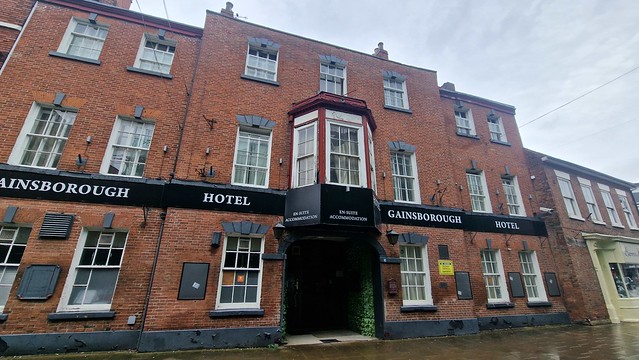
This rather charming hotel seems to have had an interesting few years. It has a long history since it opened in the eighteenth century, but the police and licensing authorities shut it down in 2018 following a series of drug incidents and violent disorder. The owner was a former councillor, so the local media seems to have had a field day reporting that. It was known as the White Hart, but was rebranded after the closure as the Gainsborough Hotel to try and give it a new lease of life. It now appears to be closed and locked up, a sub-optimal situation for the owners. I can’t see anything in the local media as to why it’s closed, or whether it’s reopening again soon, although the reviews suggest that it has had a troubled couple of years. It’s a shame that it’s closed though, the building is beautiful and in its prime it must have been an important part of the local community. The cost of renovating a hotel such as this would be substantial though, especially as it’s a Grade II listed building.
Author: admin
-

Gainsborough – 40 Day Capital of England
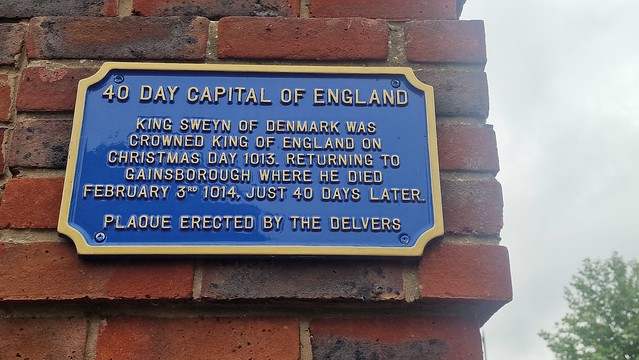
Back on Christmas Day 1013, Sweyn Forkbeard (the son of Harald Bluetooth) swept into England and pronounced himself as King. He arrived in Gainsborough by sailing up the River Trent, then legend states that his forces spread across the country and everyone became supporters. That might perhaps be aspirational, but it’s clear that he took control of some significant parts of England and he established himself in Gainsborough to plan his new empire. He then, rather inconveniently for his new nation, died on 3 February 1014, but it’s not known for sure how his death occurred. It did mean that 50-day Liz Truss did manage to outlast at least one leader, although I think it’s fair to say that when her forces spread across the country not many people became supporters. Anyway, I’ve digressed into politics.
Æthelred the Unready, which actually is perhaps a name that Liz Truss could have used (the Unready bit, I’m not sure Æthelred would have suited her, but I’ve very quietly digressed again), took over the country after Sweyn’s death and Gainsborough’s brief period as the national capital came to an end. History might have been somewhat different if Sweyn had managed to live just a little bit longer, perhaps Gainsborough might have become a regional powerhouse. But, instead, it’s a useful fact that local tourist officials have tried to make something of.
This blue plaque was erected by the Delvers, a local history group in Gainsborough, who seem to do much good work in the area promoting the town’s heritage.
-

Gainsborough – Thoughts of Pevsner
Sir Nikolaus Pevsner is my favourite architectural historian. Actually, he’s the only one that I can name, but he is such an authority and his judgement always seems sound to me. I was interested to read what he thought about the Lincolnshire town of Gainsborough, but he really wasn’t that keen. He describes it as:
“One of the dreariest of the Midland red brick towns. The factories are all red brick, and those in the centre cannot for a long time have been proud of the appearance of their buildings. Neither the manufacturers nor the council seem capable of thinking of their town in post-Victorian towns.”
Pevsner writes interesting walks, or perambulations as he called them, of towns, but he says about Gainsborough:
“A perambulation around Gainsborough is not necessary nor advocated.”
Ouch. I actually suspect he would have been less impressed at how it is today, as the council of the 1960s demolished some of the interesting heritage buildings in their road expansion obsession.
-

Gainsborough – All Saints Church
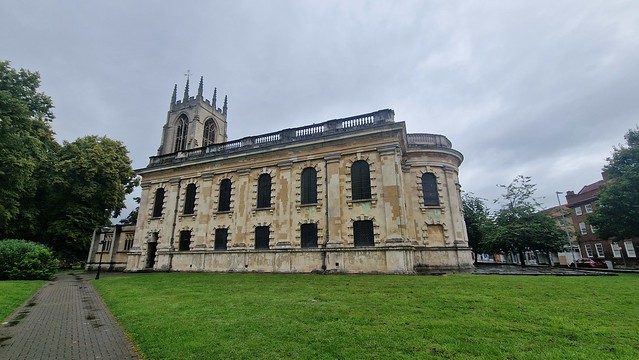
This church looks a little out of proportion as the nave and chancel were entirely rebuilt between 1734 and 1744 when the previous structure was thought to be too dark and dingy, but the tower, which dated from the fifteenth century, was kept. After three years of construction, the new church opened on 16 September 1744 and it reminds me of how some of the slightly later churches in the United States, such as Old North Church in Boston, look.
The church is kept locked, but you can request the key from the cafe on-site, which I did. It’s well proportioned internally and I can imagine the excitement when it opened, with its two levels of seating and plenty of space. It’s certainly bright, which would have been in contrast to the previous building.
Looking back to the organ. The chandelier is a survivor from the previous church.
The pulpit, which was installed in 1869.
It’s spacious and would have been able to cater for several hundred worshippers. The National Churches Trust notes that:
“The architect of the present building was Francis Smith of Warwick (1673-1738) who was greatly influenced by James Gibbs, the designer of St Martin in the Fields, Trafalgar Square.”
The height of the box pews were reduced by 12 inches in the 1860s.
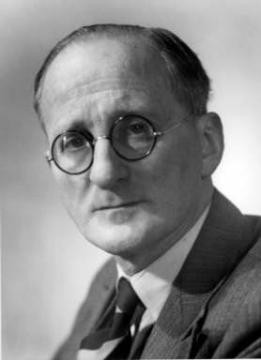
Alan Stephenson, who served as the organist here for twenty years between 1913 and 1933. He was also the last organist to play at Coventry Cathedral before its organ was destroyed during the 14 November 1940 air raid.
The eighteenth century benefactors.
The memorial to Francis Elliott, who had served as the District Commissioner of Jubaland. He was the son of the Rev. Canon J. R. Elliott, M.A., of 1, Greenstone Place, Minster Yard, Lincoln and Francis died at the age of 35 on 2 February 1916. He’s buried at the Mogadishu African War Cemetery where there are 182 burials, but the Commonwealth War Graves Commission is currently unable to access the site. Unfortunately, the site has been desecrated and the graves destroyed and vandalised, there’s more at https://adeclewlow.com/2018/11/07/discovering-the-commonwealth-war-graves-cemetery-in-mogadishu/.
The entrance to the church.
What I assume is the entrance to the bell tower.
The tower, which I think is the most magnificent part of the structure. The authorities had to raise money in 1871 for the church’s protection as they were worried about bits of it falling down, which was considered sub-optimal. Also, a local cabinet maker, Mr. Knighting, had been walking across the church yard on a dark Sunday evening and a slab gave way and he nearly plummeted three feet down into a vault, located near to the base wall of the tower.
The graveyard, stripped of all its gravestones. There has been some controversy about this and the idiotic decision was enacted in 1961, stripping the area of its historic relevance and interest. They said at the time that it tidied the area up as it had become overgrown and gravestones were damaged. I mean, perhaps repair the gravestones and cut the grass? Anyway, it’s a memorial garden now.
Richard Rollett’s gravestone was saved as it was thought to be of interest as he was the master sail maker on HMS Resolution, which Captain James Cook captained. The Captain Cook Society has more information on the life of Rollett at https://www.captaincooksociety.com/cooks-life/people/cooks-officers-and-crew-and-contemporaries/richard-rollett-1750-1824. Although that’s it, the rest of the stones and their memories have gone.
It’s a wonderful example of eighteenth century church architecture, although there’s surprisingly little history here to see beyond that. They’ve knocked the old church down, the tower is inaccessible and the gravestones have been removed. Pevsner was very rude about Gainsborough, but he didn’t make any personal comment on his thoughts of the church’s architecture.

-

200 Years Ago in Norwich : Norwich Pedestrian With Stones

And the next in my series of posts from the Norfolk Chronicle of 200 years ago this week is all about walking…..
“Monday last, Townshend, the pedestrian, undertook to pick up with his mouth from the ground, in Finch’s gardens, 300 stones, placed one yard apart, and to deposit the same in a basket, in 11 successive hours, being a distance of 51 miles and 540 yards. In this undertaking, the pedestrian put his mouth to the ground 300 times, turned 600 times and stopped 600 times. The feat was performed 16 minutes within the time allowed. We understand that Townshend has undertaken to walk 40 miles backwards in 10 hours, on the same ground, on Monday next”.
This is the time to say that I’ve walked 100 miles, I might not have mentioned that…. Actually, I’d rather repeat that than walk over 50 miles and pick up stones with my mouth. This is certainly a challenge that I’m not sure would take off today, even with the TikTok generation demanding new content styles. The walker in question is, I think, John Phipps Townshend, who wasn’t a local man as he was born in Lewes, but he did do these pedestrian events around the country. He referred to himself as the “The Champion of Living Pedestrians”, although I would humbly suggest that David Morgan of the LDWA would be a contender for that title today….. There are adverts from the time relating to Finch’s Ranelagh Gardens, so I’m guessing that this was the location of Townshend’s exertions, more of which at https://colonelunthanksnorwich.com/tag/ranelagh-gardens-norwich/.
-

200 Years Ago in Norwich : 3,000 People Watch Fight in Poringland

In the Norfolk Chronicle 200 years ago, there was an article about how 3,000 people turned out to watch a fight in Poringland. I suppose these were in the years before people could watch TV and go on-line, but it’s quite a fascinating article. It reads:
“A pitched battle was fought near the Dove in Poringland between Fenn and Camplin, two Norwich men. It is supposed that not less than 3,000 persons assembled to watch this battle, which after 76 rounds, during which very little science was exhibited on part of Camplin, who fell after every first blow, terminated in favour of Fenn. A countryman and a dyer afterwards amused the spectators for some time by milling each other at a desperate rate till at length both discovered that they were making sport at rather too dear a price, and they mutually agreed to put an end to the fun.”
Firstly, 76 rounds!!! And, relating to that, the Marquess of Queensberry Rules weren’t introduced until 1867, so it’s likely that this was bare knuckle boxing. I can’t say that I’m in awe of boxing, I’ve never quite understood physical violence, but each to their own I suppose. Despite attempts by Watney Mann brewery trying to close the pub in 1969, the Dove is still trading to this day.
The boxer in question was John Camplin who was a Norwich blacksmith and city weaver, although I can’t work out with Fenn was. I also can’t find out when Camplin died, the only possible death with that name was someone who lived in London.
I had to remind myself of the exact definition of what “milling” was, but the answer of ‘moving around in a confused mass’. Sounds reasonable as an after-fight fight…..
-

Carcassonne Day Three : Return Home on Ryanair
I confess I’ve managed to take rather too long to post the final segment in this riveting blog series, my two loyal readers must have given up. Anyway, here it is…..
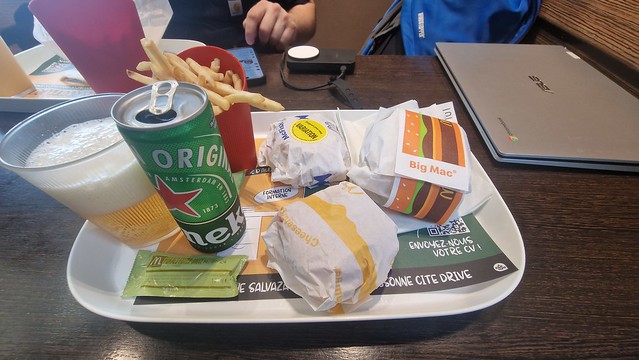
Not travelling nearly full-time has meant I’ve got a little behind with technology, so I was reliant on McDonald’s for my device charging requirements. I accept the Heineken is sub-optimal, but one day McDonald’s will stock the finest craft beer instead. Every major battle is won one step at a time. Not that I’m equating craft beer to a war, I’d better add that now.
After hours of walking, it was just a few minutes to get from the McDonald’s back to Carcassonne Airport. We cut it fine and only arrived three hours before the flight.
It’s not exactly Singapore Changi Airport with the number of flights leaving the airport.
Lovely weather, although it hadn’t been too bad on our traipse back to the airport as we didn’t want to pay for a bus. Thrifty.
As usual, as I worried about missing the flight home, I made Liam rush to the seating area in case all the seats were taken. It transpired that my rushing about was perhaps unnecessary, but Liam didn’t say anything.
At least we were early. The boarding process with Ryanair is nearly always efficient and stress free, with this journey being no exception. I’m sure that there’s a lot other airlines can learn from the simplicity of the queueing arrangement which minimises faffing around.
It’s all happening now. The seat Gods were favourable, once again, to Liam and I. We didn’t pay for seating but were given aisle and window seats again.
The aircraft was G-RUKN, a Boeing 737, which they’ve been operating since 2010 meaning it’s one of the older planes in their fleet. The flight was nearly full, but boarding was fast and none of the passengers annoyed me, so that was another result.
I never really tire of flying over London, although the photos are a little grainy as the aircraft’s windows weren’t exactly sparkling and I’m also not exactly David Bailey (who I just checked and he’s still alive, he’s doing well).
And safely back into London Stansted. This last post has been something of an anti-climax given I have nothing exceptionally interesting to note, but sometimes it’s best to not have too much adventure.
Many thanks to customer Simon who kindly picked us up from the airport and took us back to the pub, all very much appreciated. And a very lovely weekend, even though it has, as usual, taken me months to finish writing about. We agreed that we must do this again 🙂
-

Carcassonne Day Three : Nazi Atrocities
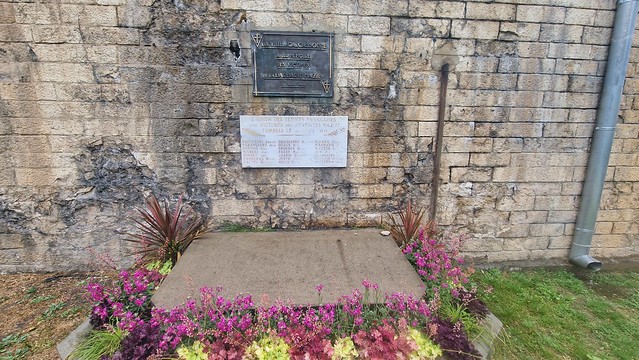
We noticed this plaque on our canal walk and it relates to the massacre of 21 people during the German withdrawal from Carcassonne on 20 August 1944. It seems a cruel way for an innocent person to die, so near to the liberation of the area and it also seems that it has taken some determined locals to get this plaque to be located here. There’s more about the whole incident at http://musiqueetpatrimoinedecarcassonne.blogspirit.com/archive/2013/08/19/le-20-aout-1944-quai-riquet.html.
-

Carcassonne Day Three : Canal Walk
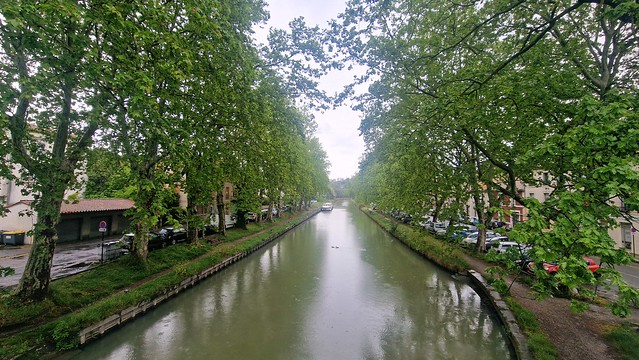
We felt that we had, in part at least, completed Carcassonne and so we thought we’d better do some walking to see a little more of the city. We opted to walk down the Canal du Midi which seems to have the suitable amount of low-level adventure to it. When it was constructed in the seventeenth century it was known as the Canal Royal en Languedoc, or Royal Canal, but the French Revolution saw an end to that arrangement and it took its current name. It’s now a UNESCO World Heritage Site and it’s an impressive piece of construction.
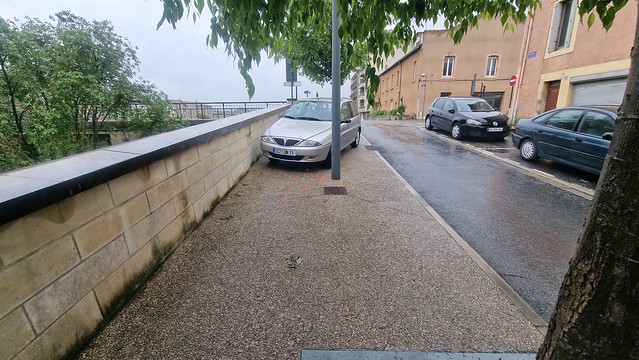
The start of the walk didn’t look entirely decadent.
But the canal itself was beautiful and after Liam momentarily tried to walk us along the Amazon side of the canal, we switched to the rather more sedate paved side. We weren’t intending to clamber through too much shrubbery, not now I’m over 30 years old.
It soon became a peaceful walk, although as Liam pointed out, we were walking away from the airport and that was already an hour’s walk from the city centre. But, being brave, we continued with the mission. It’s not exactly a straight line mission as I like watching on YouTube, but I don’t claim this blog offers cutting edge adventure entertainment. Well, maybe one day.
The head navigator.
An engineering board. As Liam is a civil engineer I took particular interest in this to show my engagement.
Our head navigator successfully led us miles out of the area. I was very brave and didn’t panic once.
It started to rain, which I considered to be sub-optimal.
Some sort of pleasure boat drifting down the river.
And then we started the walk back.
The head photographer in action. It was a most pleasant way to spend a couple of hours and was at least some exercise, as I need more of that at the moment.
And to show the scale of the project, the canal a little further down.