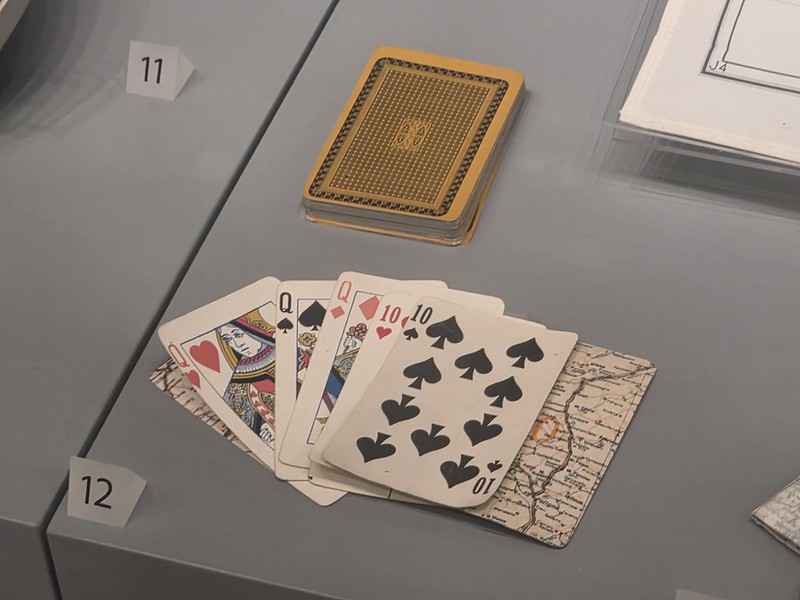
During the Second World War, playing cards were slipped into prisoner of war camps because they looked harmless enough, but hidden inside them were escape maps, allowing captured airmen and soldiers to peel apart the layers and reveal useful geography once the card game was over.
I do wonder how opposing military authorities failed to spot this little arrangement, especially given that wartime censors were not always generally known for their relaxed attitude to suspicious parcels. Perhaps the cards looked too banal to deserve much scrutiny, or perhaps someone simply saw a pack of them and thought that prisoners deserved at least one modest pleasure before returning to the business of attempted escape.
Either way, I like the ingenuity and the museum thinks that these were produced around 1943. The International Spy Museum in the United States notes:
“To date, decks of these cards are said to have helped at least 32 people escape from Colditz Castle and prompted some 316 escape attempts.”
There were some very careless military authorities amongst the German troops letting this lot through.
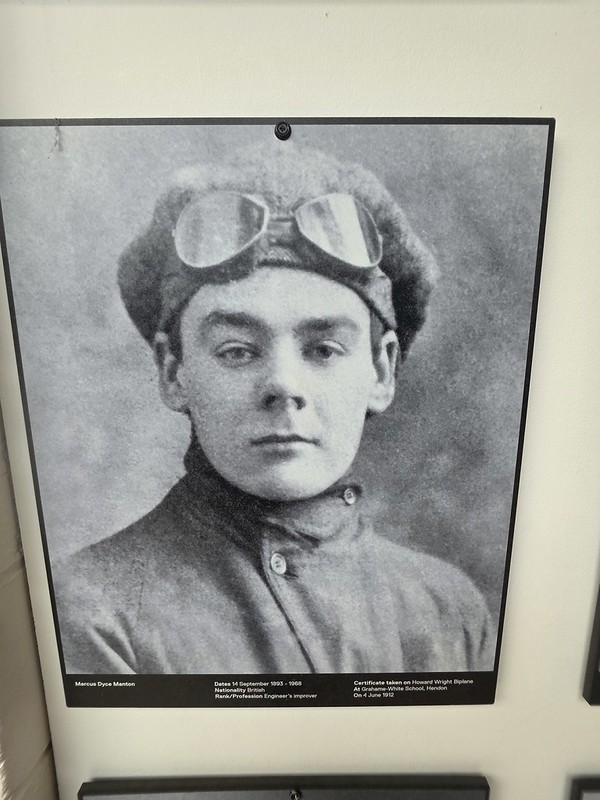
This is one of the photos on display at the Royal Air Force museum and it’s in the section which honours those who received a Royal Aero Club Aviator Certificate. To achieve this, the pilot had to complete two 5km flights and one 50m altitude flight.
In the photo is Marcus Dyce Manton (1893-1968) who was born in Sheffield on 14 September 1893. He obtained his Aviator Certificate on 4 June 1912 and I have to comment on just how brave that must have been. It’s all very easy on a scheduled Wizz Air flight to find flying really quite interesting, it was slightly less decadent in 1912 and the risks were real and high. He obtained the nickname of the ‘Boy Looper’ and completed hundreds of ‘loop the loops’ which excited and delighted many at air shows. This all seems like a rather unusual relationship with danger as early aircraft did have that sub-optimal habit of falling out of the sky.
It was no surprise that Manton was an important part of what was then known as the Royal Naval Air Service, being appointed as the Head Pilot Instructor at Hendon (where the museum is now based) at the start of the First World War. Until 1918, there were separate divisions which were the Royal Naval Air Service, which was the air arm of the Royal Navy, and the Royal Flying Corps, which were part of the Royal Army.
After the end of the First World War, he worked as a test pilot for Samuel White and English Electric, later becoming involved in gliding through the London Gliding Club. During the Second World War he served with Armstrong Whitworth as a Service Liaison Officer, and afterwards worked with Hawker Siddeley. Manton managed to get a fine in 1941 for not having a current driving licence which seems an omission for someone who had a licence to fly aircraft.
Manton died in April 1968 in Dorset, having seen aviation progress from fragile early contraptions to the jet age, something which must have given him endless excitement over the decades. His son, Graham Ashley Leonard Manton (1910-2005), also became something of a hero in the air force during the Second World War.
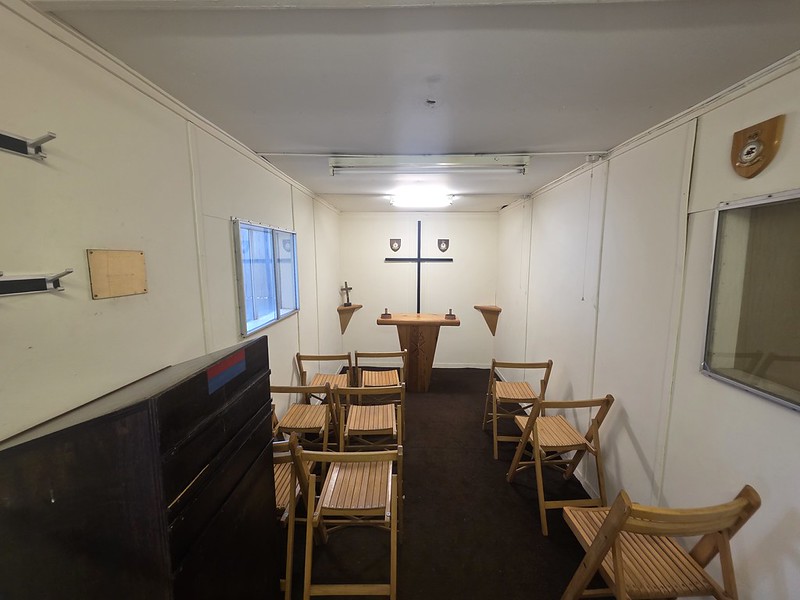
This is quite a powerful exhibit, it’s the chapel that was at RAF Stanley in the Falkland Islands. Initially a tent had been used as the chapel, but the General Engineering Flight converted this shipping container to create something more appropriate by adding a door and two windows.
Inside the chapel, with the altar made out of wood off-cuts and spent shell cases.
Badges.
The chapel was dedicated by the Rev. Philip Sladen (?-2003) on 27 July 1983 and it remained open on the islands until 1986. It was then returned to the UK and has now been moved to this museum.
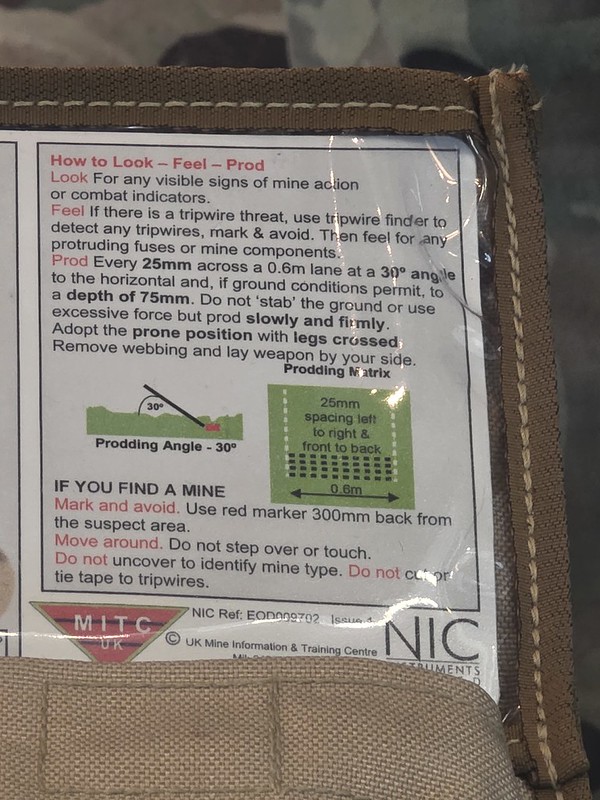
This is what the Royal Air Force museum calls a personal mine extraction kit. It’s a little collection of objects to ensure that lives can be saved by finding landmines, all something of a contrast to the large bits of military aircraft located nearby.
These are the instructions and I have to note that using these little bits of stainless steel prods to try and find land mines sounds like a sub-optimal way to spend an evening. I get annoyed at cryptic crosswords, so I can’t imagine the amount of patience and bravery must be involved to be crawling about in the sand somewhere trying to prod for mines.
I liked that the museum had made these little notes visible that were an aide memoir into the use of the kit, it made it seem really rather more real.
I’ve been meaning to visit this museum for a little while after having seen it from the train when travelling between Luton and London. The museum is free of charge and asks visitors to register online, but I don’t think it’s essential.
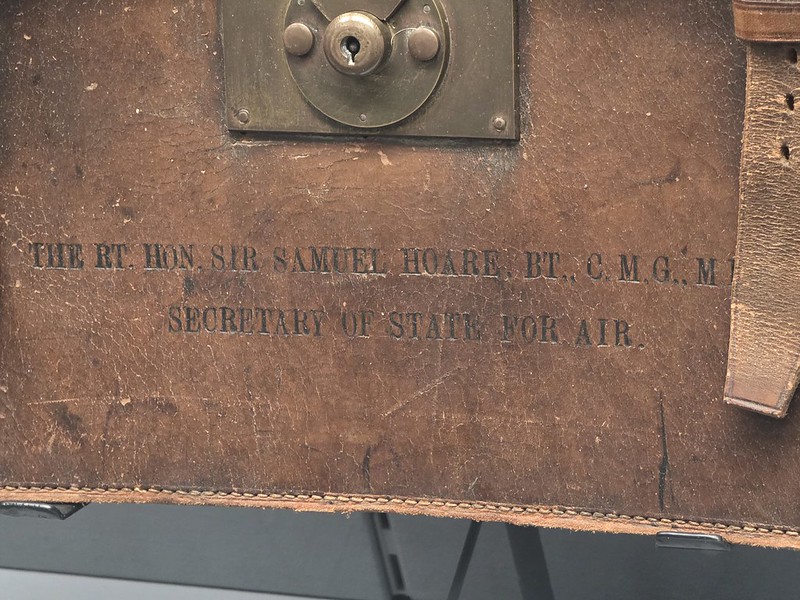
This exhibit is a briefcase from the 1920s that was owned by Sir Samuel Hoare, the 1st Viscount Templewood (1880-1959), who was a pivotal figure in the development of British civil and military aviation during the interwar period. Serving as the Secretary of State for Air on three separate occasions throughout the 1920s, he became a tireless advocate for the ‘imperial air routes’ that sought to connect the distant corners of the British Empire. Hoare was not merely a desk-bound administrator; he famously took to the skies himself, embarking on a landmark 10,000 mile flight to India in 1927 alongside his wife to demonstrate the safety and potential of long-distance air travel. In reality, at this time, air travel wasn’t entirely safe, but it was certainly right to make others aware of the potential.
In a different world, Hoare could have easily become Prime Minister and he remained one of the most important and influential Cabinet Ministers in the late 1930s and early 1940s. Unfortunately for him, Churchill didn’t like him and threw him out of Government when he became the wartime Prime Minister.
Hoare was one of the most important Ministers during the twentieth century in terms of the evolution of air travel. I like exhibits such as this as they’re a personal connection to a very different time during history and it’s something of a contrast to the huge bits of aircraft that are dotted around the rest of the museum.
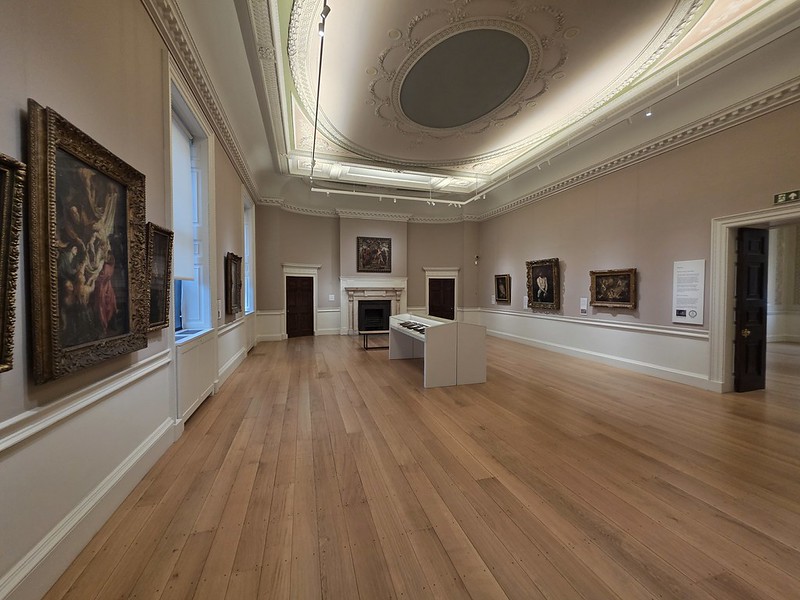
One thing that I really rather liked about the Courtauld is that they’ve got information in each room about how the space was once used. Today, this is Room 6 which is used to display the gallery’s collection of works by Peter Paul Rubens. The plasterwork on the ceiling is by Thomas Collins, who also completed work in other rooms at Somerset House.
However, it was once the Council Room of the Society of Antiquaries, which was created in 1707 to study ancient monuments. Their first meeting was at the Bear Tavern nearby on the Strand and they moved into Somerset House in 1780 and remained there until 1874. They moved at that point to Burlington House on Piccadilly and they’re still there today.
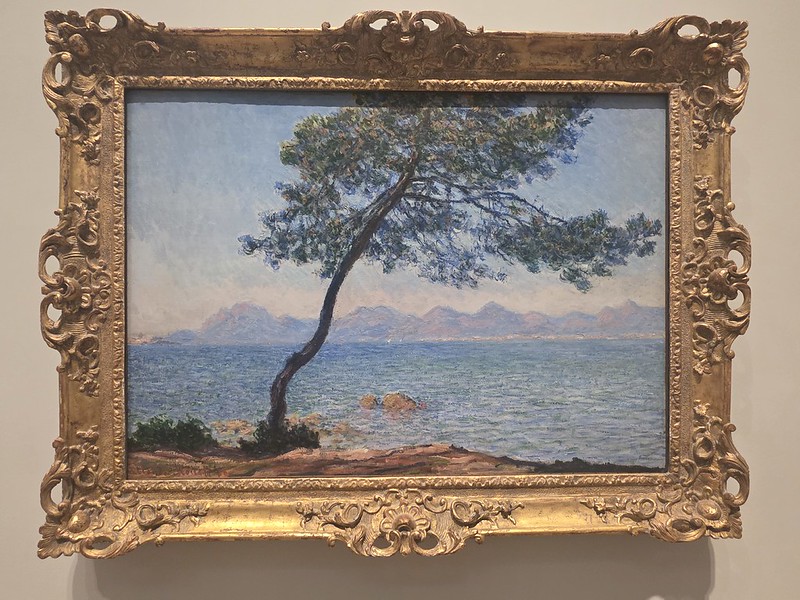
When Claude Monet (1840-1926) arrived in Antibes, on the Mediterranean coast of France, in January 1888, he was not just looking for fresh subject matter he was in pursuit of something far more elusive, namely, light. I don’t know very much about artwork, but every guide to this painting talks about the importance of light. Lovely as it is, it was the history of the painting’s ownership that particularly interested me, but more of that in a moment.
Monet himself said “one must repaint a single subject three times, four times, even twenty times”, which I would say is the amount of effort that I put into this blog, although that might not be entirely true. Anyway, there’s one maritime pine in the painting and we’re supposed to look at that and then dwell on the beauty of the light from the water, the sky and from the mountains.
One thing I like from gallery websites, which I think is all too rare, is seeing the provenance of an artwork. This one is listed by the Courtauld, namely:
“Bought from the artist by Boussod & Valadon, June 1888; (?) with Georges Petit, 1888; Mme Vve Barbedienne, Paris, 1894; sold Hôtel Druout, Paris, 24 February 1894 (lot 39); bought Paul Durand-Ruel; Decap, Paris, 1894; Bernheim-Jeune, Paris, 1907; Baron Caccamisi, Paris, 1907; Mrs Blanche Marchesci, London, c.1910; Paul Rosenberg, Paris; M. Knoedler & Co., London; purchased by Samuel Courtauld, August 1923; Courtauld Bequest, 1948”.
I wondered why a hotel, namely the Hôtel Drouot, had purchased a painting like this, but then I checked and have realised that it’s actually a large auction house in Paris which is still trading. This auction house was implicated in the sale of looted Jewish artworks and Paul Rosenberg, who was a Jewish art collector who owned this artwork for a while, later had some of his collection stolen. It was then purchased by Samuel Courtauld, who ultimately gave it to the gallery which bears his name. Although, if Rosenberg hadn’t of sold it, then it might well have later been part of the collections that were stolen by the Nazis. And on that theme, the son of Blanche Marchesi, namely Leopold Popper-Podhragy, was sentenced to death by the Nazis although he managed to avoid that and lived until 1986, but his artwork collection was also taken.
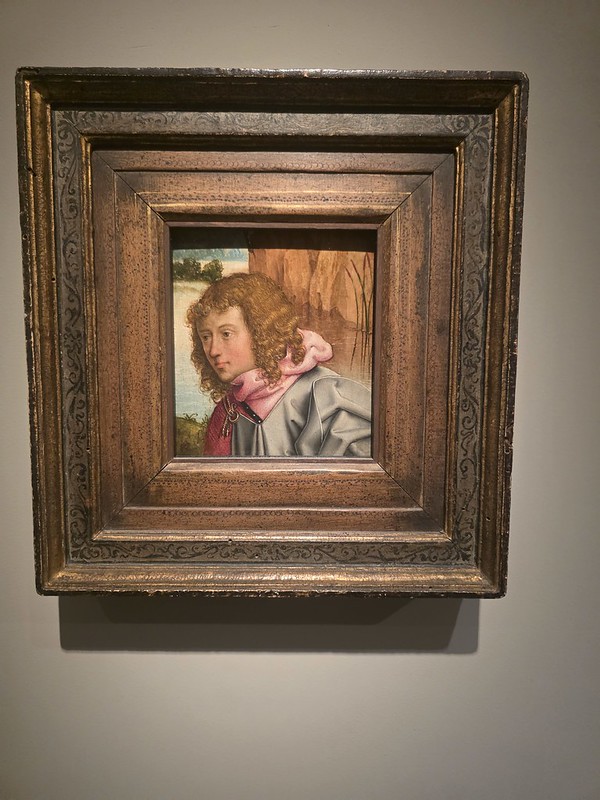
The gallery gives this artwork the title of “Head of a Man against a Landscape” which is all that they have since this has been cut so tightly that it has lost much of its original meaning. It was once likely part of an altarpiece, but now they don’t know who the image is of, nor who painted it.
The painting entered the gallery’s collections in 1952 as part of the Sir Robert Witt bequest. There’s something perhaps sub-optimal about such a small piece of the original artwork and in such a large frame, but at least some has remained.
Given this lack of clarity, and my slight obsession with AI, I asked ChatGPT and Google Gemini to have a go at this. Along with the gallery’s best guess, this is the result of the artist, date of painting and who is in the image.
GALLERY : No artist known, but likely Dutch influence. Painted between 1495 and 1500. No knowledge of who is in the image.
CHATGPT : Maybe school of Hans Memling, but likely Dutch influence. painted between 1480 and 1500. Possibly Saint John the Evangeliest.
GEMINI : No artist known, but likely Dutch influence. Painted between 1510 and 1540. No knowledge of who is in the image.
I also asked Microsoft Copilot but the answer was complete nonsense, it announced that this was a nineteenth century copy of an earlier piece and was painted by an Italian artist.
I’m interested if I retry this experiment in a couple of years whether the results will be better, although ChatGPT seems to be nearly there.
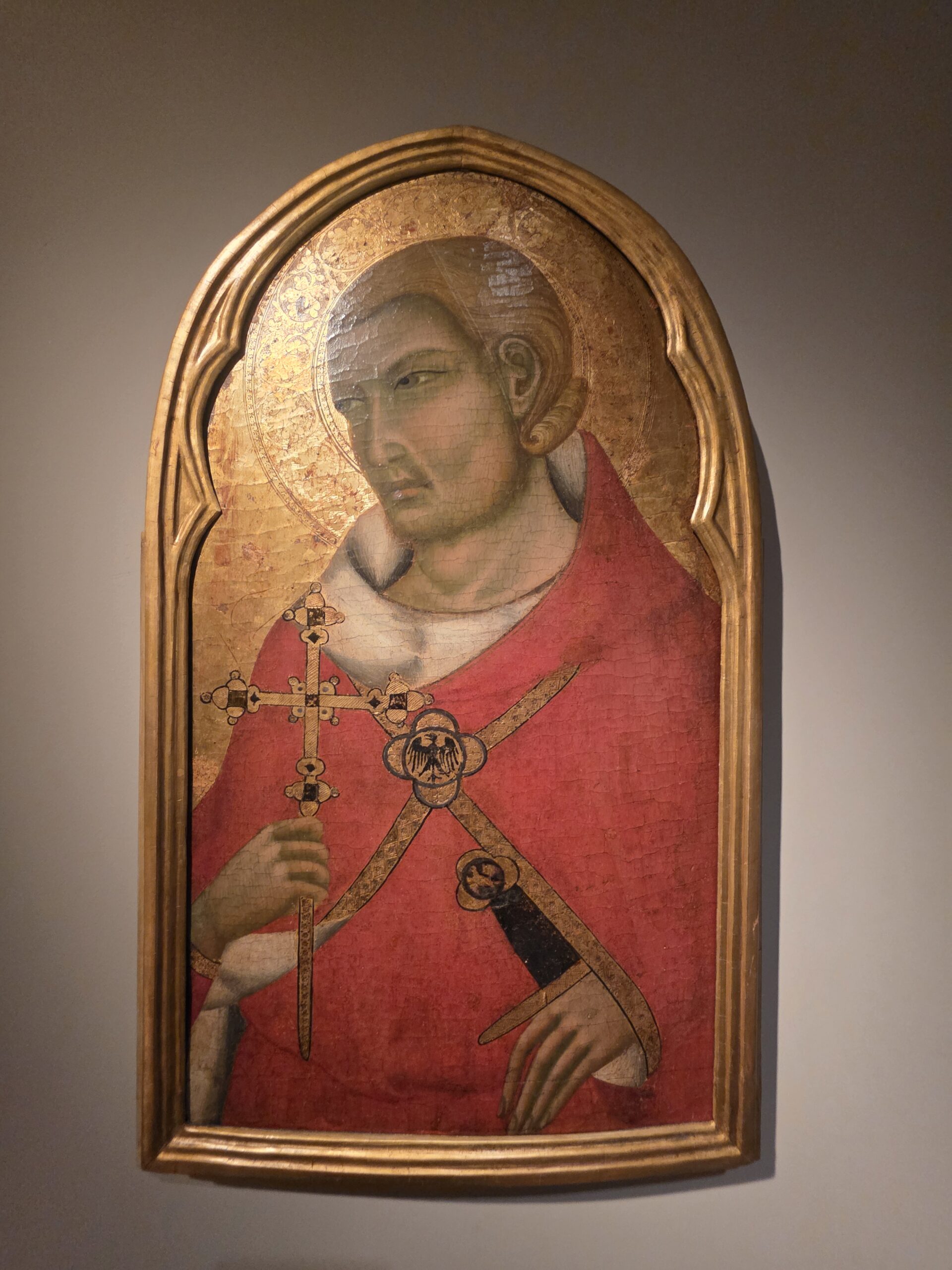
I’ve been meaning to go to the Courtauld Gallery in London for some time and with my Art Pass I was able to get free entry. And this artwork in the first room was very appropriate, as it’s Saint Julian. The gallery notes:
“The rich garments and fine sword refer to the traditional belief that Julian was a nobleman before devoting himself to the sick and needy.”
That sounds very much like me. Well, other than the rich garments, fine sword and nobleman bit. The artwork is part of an altarpiece from the Church of San Torpé in the Italian city of Pisa. Originally, Julian was looking towards the central panel of the altarpiece which contained the Virgin Mary and Jesus Christ. The church is still there, but the rest of the altarpiece is likely long gone.
The artwork, originally painted in around 1320 was donated to the gallery as part of the Gambier-Parry Bequest in 1966. The provenance isn’t known, but it’s thought that it was originally purchased by Thomas Gambier-Parry (1816-1888) after 1863. There’s an interesting book on this whole Gambier-Parry collection with the introduction of that written by Sir Anthony Blunt who later became better known for other things…
Anyway, this was a very positive first impression of the gallery for me.
Sorry, wrong image. Anyway, this is the posh bit of the American Airlines lounge and again I’ve only visited the standard bit before so many thanks for Richard guesting me in.
The staff member checking us in wanted to see my passport to check that Richard wasn’t guesting in some member of the lower classes, before joking that she needed to decide which lounge to send us. However, after seeing all of Richard’s bags, she thought she’d better send us to the premium bit and here’s the menu board outside.
Apologies about the complete lack of useful photos in this post, I was too excited about the trip ahead. The beer selection was woeful, American Airlines hadn’t managed to get any American beer in, which would have least shown some willing.
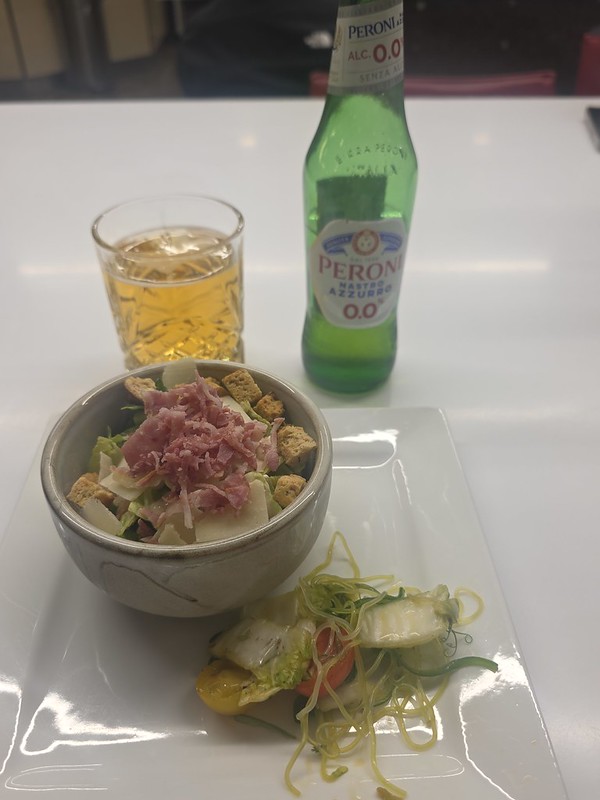
We didn’t go for the table service as we’d just had a three course meal, but I had a healthy salad with a generous amount of bacon bits from the self-service area. This tasted perfectly acceptable for a salad, with the Peroni 0% tasting thin and dull as ever.
I should have really explored the lounge a little more to write a fuller report, but time was starting to get short and I was getting distracted. There could have been more power points available, but we found some by a seating area, but a wider provision would have been useful.
There were some pre-packaged sandwiches in the fridge which I assume they didn’t mind if passengers took, but I decided against it. I did take some crisps for the evening though as I saw numerous others doing that.
I felt that this was the weakest of the four lounges with the whole arrangement being a little lacking in atmosphere, power points, food and drink. The ceiling was also leaking and it didn’t have the calmness of British Airways, the informality of Qantas or the luxury of Cathay Pacific. However, the staff were helpful and the surroundings were generally clean and organised.
Richard was very kind to guest me into the lounges, it’s been some time since I’ve been to Heathrow Terminal 3 (now I use Wizz Air to go just about everywhere) but it was all an interesting experience.