Tag: Dortmund

  • Wizz Air (Dortmund to Katowice)

    Wizz Air (Dortmund to Katowice)

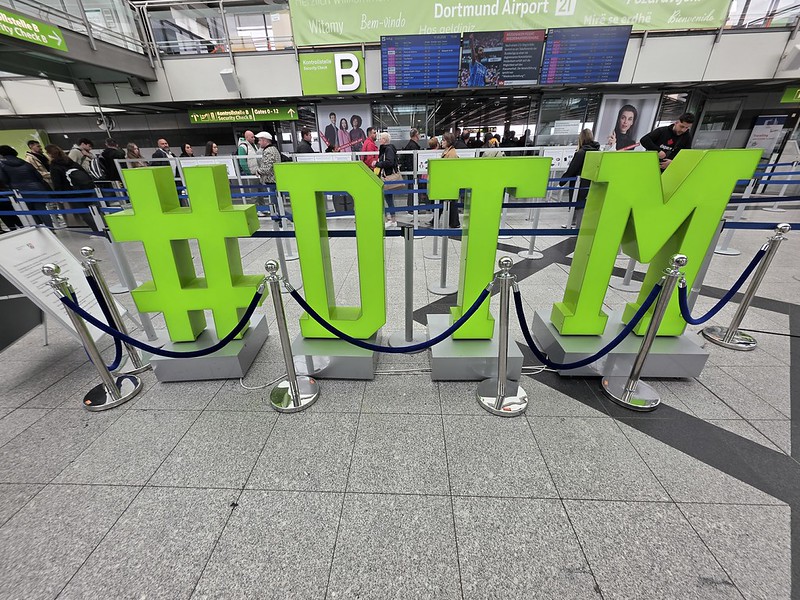
    Dortmund is one of the older airports which is simply too small to deal with the number of passengers it currently has to handle. There are over three million passengers using the airport every year now and they have been creative about using the space that they have.

    Mine was the 13:25 flight and I took this photo just after I went through security, showing how perilously close I was. Well, by my standards. The security process was slightly problematic as some drunk, mostly older, Polish football fans barged by a few of us in the security line. I decided to take the opposite security line to them and managed to get through quite a bit quicker, and certainly had a quieter time.

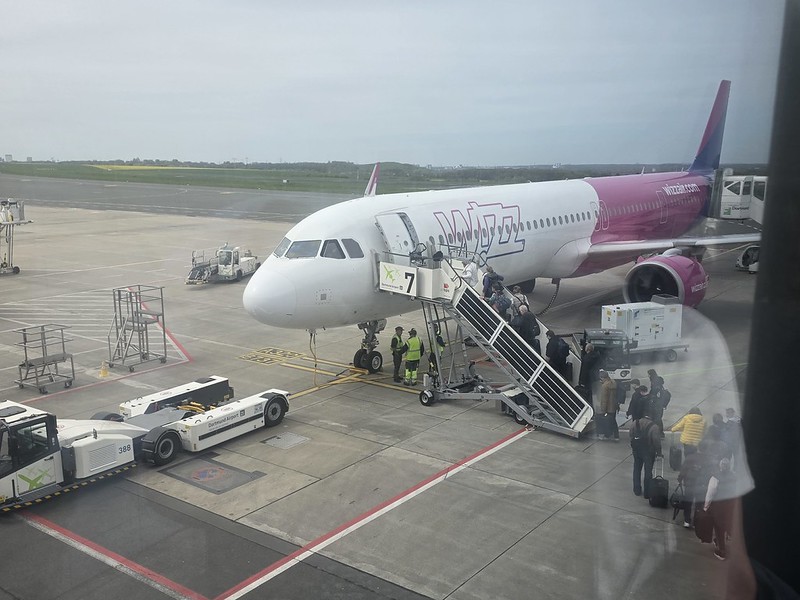
    And the aircraft arrives, albeit a little late. The seating arrangement at the airport wasn’t dreadful, but they do need more seats for passengers as quite a few just opted for the floor. There were no power points and the general facilities at the airport were quite limited, but everything seemed to work efficiently.

    I was slightly nervous of a delay as I had a flight from Katowice four hours after this one arrived, but fortunately, there was no impact of note.

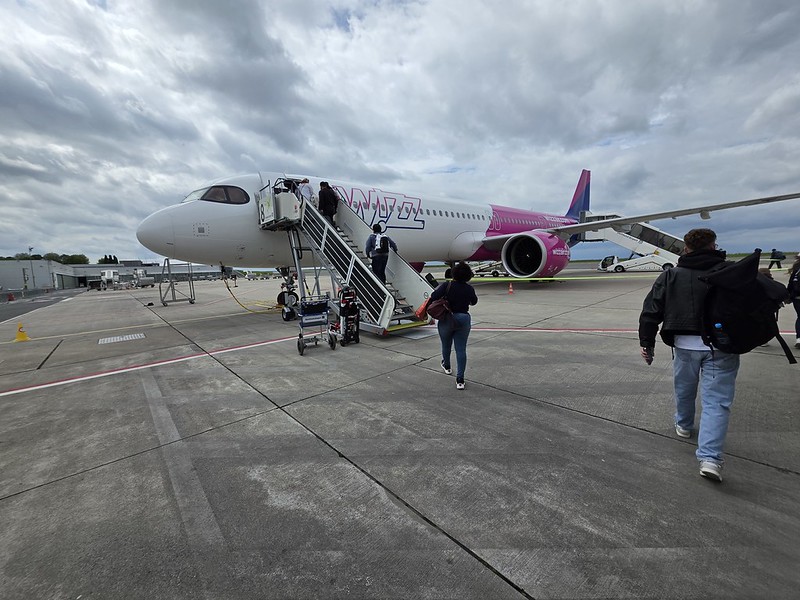
    This is aircraft HA-LVD, yet another one that I haven’t been on before, with this one in operation since 2019. The seating Gods had given me a window seat near the back, which suited my needs entirely for a flight of a little over one hour.

    Somewhere over Dortmund.

    What looks like a pretty town, this is Soest in Germany.

    And safely into Katowice and we we hardly late at all, giving me more than enough time at the airport to sit in the lounge for hours….

    The flight cost £9 with my Multipass and was another competently managed operation, with the aircraft being clean, the crew being friendly and the pilots sounding professional. It’s becoming a bit samey I know with Wizz Air, but routinely good isn’t a bad thing…

  • Dortmund City Centre to Dortmund Airport (with some slight faffing about)

    Dortmund City Centre to Dortmund Airport (with some slight faffing about)

    I left the Ibis hotel in Dortmund just four and a half hours before my flight to Katowice left, so that was positively cutting it fine as far as I’m concerned. I had a vague plan of how to get to the airport and since I’ve done this before, albeit in a different way, I didn’t think much about it. Although therein lies the first problem….

    Dortmund Stadthaus isn’t perhaps likely to win any design awards for the frontage, despite the efforts made with the mural above it. Anyway, my plan was to get a U-Bahn from here to near the airport and walk the 50 minutes to the airport itself.

    I get to the railway station ticket machine and notice that there’s a cheap ticket to the airport as one of the options. I knew that there was a more expensive train to the railway station, but I refused to spend that much and liked the idea of the cheaper ticket that I hadn’t thought about.

    So, I leave the station and walk twenty minutes back to the central station. It was a nice walk, but I’m not entirely sure why I did that. What actually happened here is that this cheap ticket is the combined U-Bahn and bus to get to the airport, I hadn’t realised that’s what they meant, I think I thought there was a cheaper train direct to the airport from Dortmund Hauptbahnhof.

    I got to Hauptbahnhof and downloaded the app to buy a ticket, having by this time worked out how the ticket worked. I missed the train that I needed as apparently they need an address in Germany to buy the ticket. I have no idea why they have this requirement, so I slightly grumpily walked back to the ticket machine to buy it there instead.

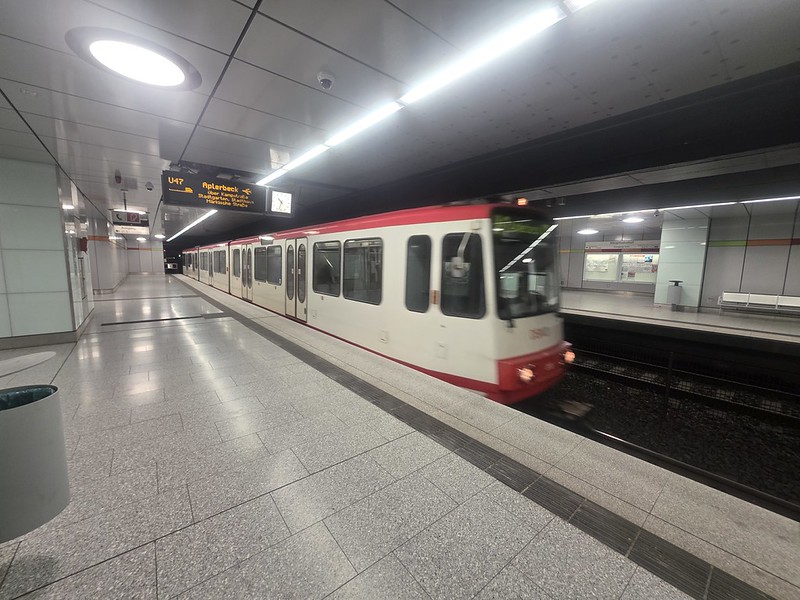
    And here’s the U47 to Aplerbeck. This doesn’t actually go the airport, but they’ve sensibly signed it to make clear that it’s the one to get to be able to connect to a bus that does go there directly.

    Safely on board the U47 and it was only at this point that I realised the train went through Dortmund Stadthaus, where I had been an hour before. This explained why they sold tickets to the airport from there, namely, because the train to the airport went from there. Logical really.

    The U-Bahn stops at Aplerbeck and passengers then get off and walk around 50 metres to the bus stop.

    Rather oddly, the buses were only once every hour, although fortunately, I only had a wait of fifteen minutes. I was there on a Sunday, so perhaps the service is less regular then, but it was a busy bus when I got on.

    On the bus and I was able to get the front seat, I still get a childlike sense of excitement about that.

    I liked that there was a button there which is by the window of the front seat, as often buses don’t have anything nearby (I don’t think many people spend time worrying about things like this). This is a minor design detail, but sometimes the simplest things are the best.

    And safely at the airport with just two hours to go before the flight. Perilously close I tell you… Anyway, everything went smoothly despite my faffing about. The moral of this entire, and slightly dull, story is that the direct train costs nearly €10 whereas the combined train/bus costs around €4, so I liked the latter one best.

  • Cologne to Dortmund with FlixTrain

    Cologne to Dortmund with FlixTrain

    I have a lot more to write about Cologne, as I’m partial to wittering on, but I’d better catch up with the rest of the trip I made last week before I forget the last bit of it. I had spent three nights in Cologne and I was then spending one night in Dortmund before leaving Germany. So, that meant a train journey and I like a train journey.

    Mine was the 12:14 train to Leipzig.

    This is Cologne’s main railway station and it first opened in 1859, replacing the rather awkward and sub-optimal arrangement of separate railway termini that had grown up as different companies did their own thing in the traditional nineteenth century manner. Putting the station beside the cathedral was, on one level, completely logical, because it placed rail travellers right in the middle of the city. On another level, it was a bold little decision to squeeze one of Germany’s key railway hubs next to one of Europe’s great Gothic buildings and simply hope the whole arrangement would somehow look dignified.

    And they’ve failed in my view with the new building, there’s the grand cathedral on the right and the rather dumpy frontage of the railway station. But, it’s rare for a central railway station to be this central, I’m impressed at their forward planning.

    It is an odd mix really, but anyway, back inside.

    The current railway station is largely the result of rebuilding in the late nineteenth century and then, of course, the rather undesirable outcome on the city from the Second World War. After 1945, the station was rebuilt and it remains one of Germany’s most important railway interchanges, at least being quite grand inside.

    I was meant to be getting the train from platform 5, but then the Brussels train was running late, so we were shunted to platform 4. This was not much of an inconvenience, since it’s a walk of around three metres.

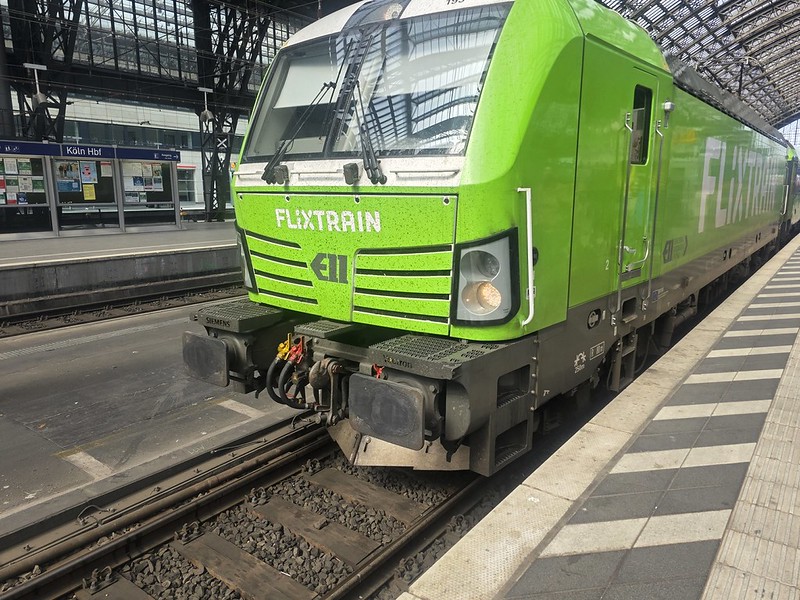
    And here comes the FlixTrain storming into the platform. I’ve taken many FlixBus journeys, but this is the first version by train. I’d note that the prices were low, this journey cost under £10. Trains in Germany are generally cheap as it’s possible to pay £60 a month and then get unlimited free local travel on trains, something I’d love to be introduced in the UK. This FlixTrain isn’t included in that offer as it’s a private operator, but they made lots of clear announcements about that.

    Everyone is given a seat, although passengers can change it on the app, and mine was in the front carriage. Unfortunately, that was quite a way from where I was standing, and there were quite a lot of passengers shuffling along to the appropriate place. I meandered slowly, there were some passengers that seemed entirely panic-stricken by the whole process.

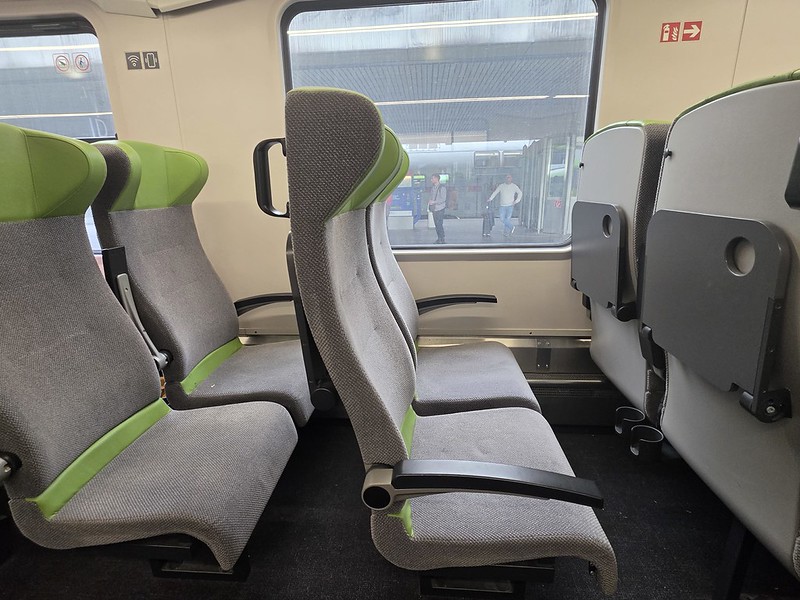
    The interior was spacious and everything was clearly signed.

    The train wasn’t that busy and there was no-one in the window seat for the journey, so it felt spacious. There were no power points, but the seats were comfortable enough.

    I was impressed that there was enough space to use my laptop, it’s often the situation on trains where the tray isn’t wide enough or the seat pitch doesn’t allow it.

    A photo of the carriage with its wavy ceiling.

    We arrived into Dortmund 35 minutes late, but I’m used to lengthy delays on the German rail network.

    And the outside of Dortmund railway station.

    I was impressed at the whole arrangement as the booking process was easy and used the same app as the bus service. It was clear where to get the train from, the seating options were easy to understand and the pricing was firmly towards the lower end of the scale. I’d certainly use this again and I hope that FlixTrain continues to expand their operations.

  • Dortmund – German Brewery Museum (Declining Number of Breweries in the City)

    Dortmund – German Brewery Museum (Declining Number of Breweries in the City)

    20250614_125812

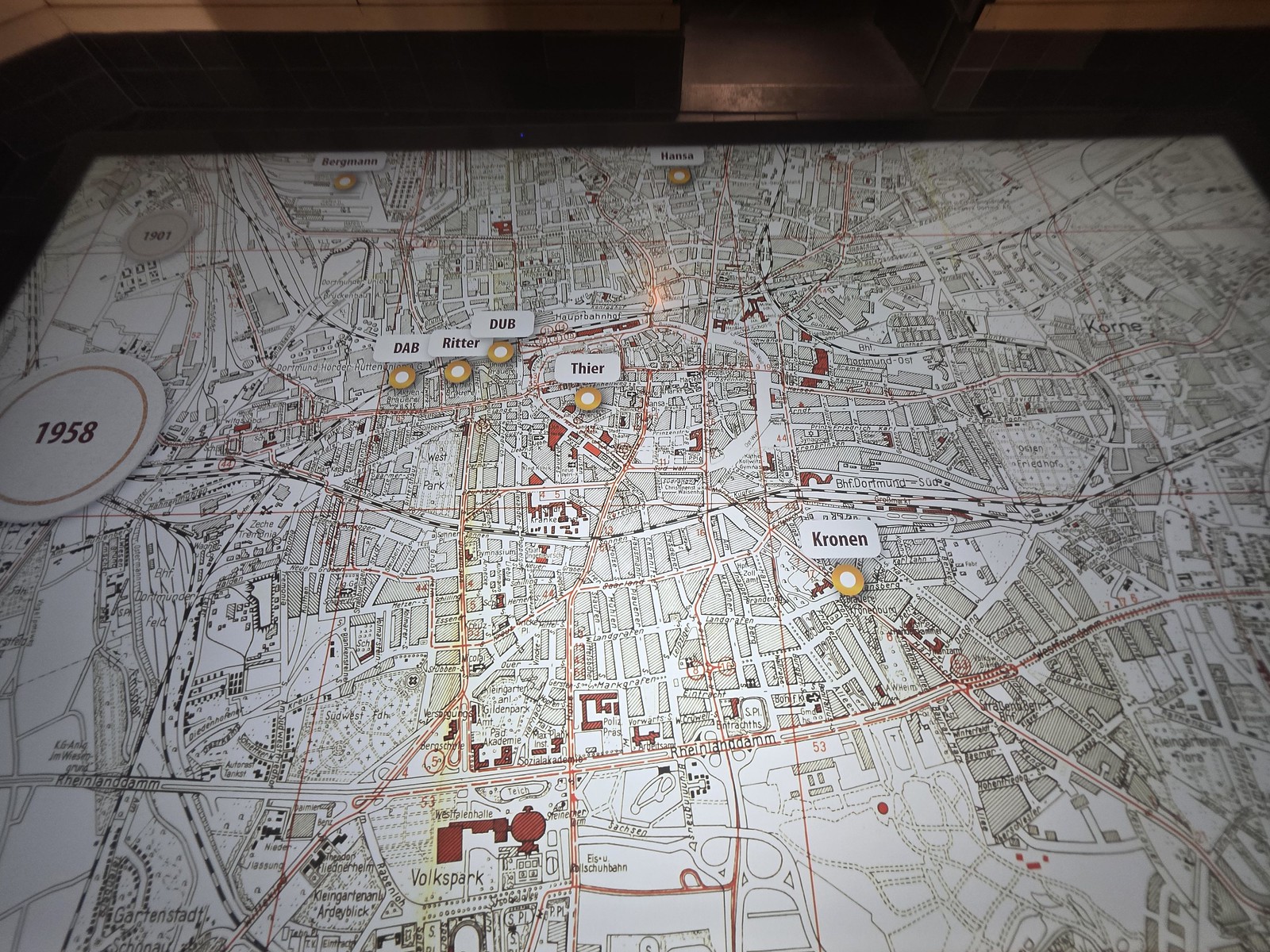
    More on the brewery museum in other posts, but there was an interesting display at this museum at just how brewing has changed in Dortmund. From tens of brewers at the beginning of the twentieth century, the number had fallen sharply by 1958 and it was down to just one by the beginning of this century.

    20250614_125859

    1901 and there was no shortage of breweries to surprise and delight the locals.

    20250614_125827

    1958 and consolidation and buyouts had begun.

    20250614_125837

    2006 and down to just one brewery in the city, which is Dortmunder Actien Brauerei (DAB) who are owned by Dr. Oetker of pizza fame.

  • Dortmund – German Football Museum (Sole Remaining Ticket from 1903 German Football Championship)

    Dortmund – German Football Museum (Sole Remaining Ticket from 1903 German Football Championship)

    20250614_120954

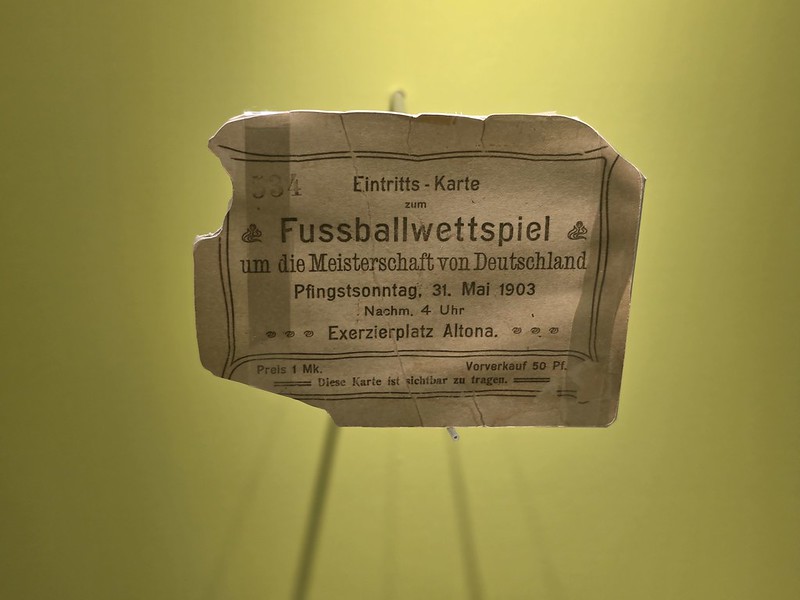
    This ticket is the only one surviving from the first major football championship to be held in Germany. This event marked the beginning of organised national football in Germany, albeit in a fashion that can only be described as enthusiastically chaotic. At the time, football in Germany was still in its infancy and regional leagues were the norm. The Deutscher Fußball-Bund (DFB), founded in 1900, had only recently decided it was time to crown a national champion. So, they came up with a straightforward plan which was to take the champions of various regional football associations and have them compete in a knockout tournament. Well, that’s what their decadent plan was and what could possibly go wrong?

    Only six teams actually entered: VfB Leipzig (Central Germany), DFC Prag (Bohemia – not in Germany, but they were part of the DFB), Karlsruher FV (Southwest), Britannia Berlin (Berlin-Brandenburg), Altonaer FC 93 (Northwest), and 1. FC Pforzheim (Southern Germany). Several other qualified teams either couldn’t afford to travel or simply forgot to show up, it feels slightly sub-optimal for the organisers. The final match was played on 31 May 1903 in Altona, now a part of Hamburg, between VfB Leipzig and DFC Prag. DFC Prag were based in what is now the Czech Republic, but since Bohemia was part of the Austro-Hungarian Empire and DFB membership was open to clubs across German-speaking Europe, they were allowed in. The final was played in front of around 2,000 spectators, which wasn’t exactly what they were getting at Wembley. VfB Leipzig won 7–2, becoming the first German football champions. Their player Heinrich Riso scored two goals and earned minor celebrity status, at least within the very niche world of 1900s Saxon football.

    Karlsruher FV lodged an official complaint that they hadn’t been told about their semifinal which is highly sub-optimal. They were meant to be playing in Leipzig, but Karlsruhe received a telegram apparently from the German Football Association telling them that their match had been cancelled. The telegram was about as genuine as a politicans’ promises and they got disqualified.

    The trophy was a silver championship shield, which Leipzig proudly took home, probably on a very slow train knowing Deutsche Bahn. This slightly farcical but pioneering tournament laid the groundwork for what would become one of Europe’s most prestigious football traditions. The German championship continued in a knockout format until the Bundesliga was created in 1963, bringing league football into a modern, more reliably scheduled age. Anyway, I digress, it’s quite impressive there’s only one ticket surviving and it’s found it forever home here.

  • Dortmund – Mercure Dortmund City

    Dortmund – Mercure Dortmund City

    20250614_144119

    I had a one night stay at the Mercure Dortmund City a few days ago and it’s fair to say that I rather liked the hotel.

    20250613_135212

    I had arrived, without sleep, into Dortmund so I thought that I’d go to the reception desk at 14:00 to see if the room might possibly be ready. It was and the staff member there was friendly, engaging and personable. The welcome gift here is offered in this large glass bowl, so I went for some chocolate to give me energy. Although I was so tired I forgot to eat it and found it in my bag the next day (the usual energy I bring to things evident there….).

    20250613_135640

    The room, which was an upgrade from the cheap and cheerful £40 one that I’d actually reserved. I got a Nespresso machine, a highlight of an upgrade, and all the trappings of someone who pretends they understand crema and intensity levels. There was also a large bath in the bathroom, something sadly being removed from hotels at some pace at the moment.

    20250613_135710

    And a large bottle of water which given the extreme heat of Dortmund was much appreciated.

    20250613_190642

    Some decorative items on the wall of the corridor. I didn’t understand them, but they were trying and I respect that.

    20250614_081150

    The bar area, everything spotlessly clean again.

    20250613_190949

    My welcome drink of the Dortmunder Kronen Pilsener which was light, hoppy and a bit generic, but improved considerably by the supply of snacks.

    20250614_074938

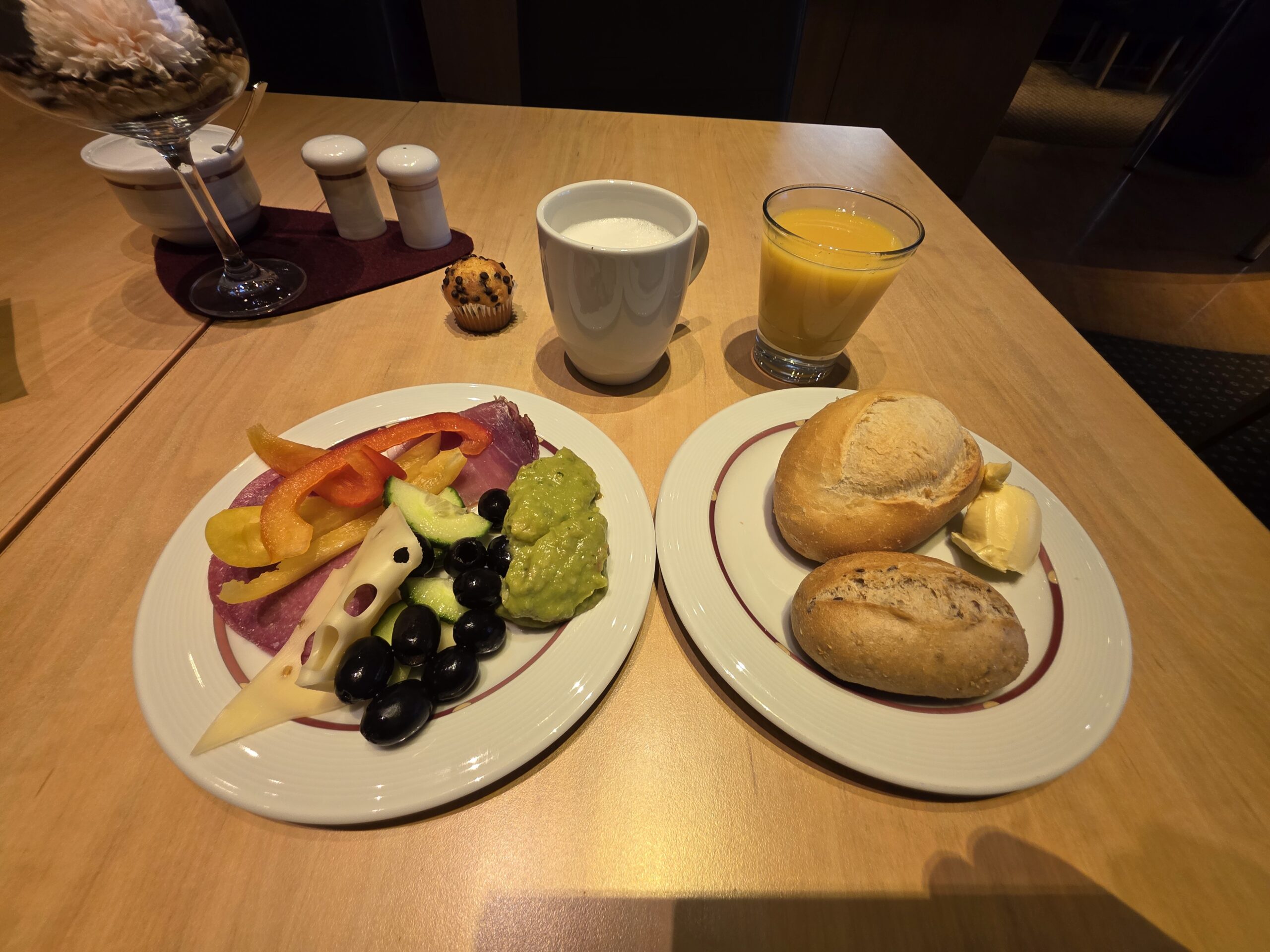
    The breakfast was excellent and it’s a reminder that this is something Germany can do better than most other countries. No distraction of unnecessary hot food, just delicious cold items such as meats and cheeses.

    20250614_075023

    Yoghurt, salad items and bread in the background.

    20250614_081357

    This went well on my yoghurt.

    20250614_075357

    And guacamole! Every hotel should offer this and I apologise that they lost quite a lot of it to me that morning (along with quite a few olives), but guacamole and bread is a delightful thing. There were also little cakes, rich coffee and numerous juices. A delight.

    I read through the on-line reviews and most are broadly positive, although a few uncultured heathens complained about the breakfast, but I hope that the hotel ignored them. The extreme heat of Dortmund that weekend, when it was reaching 33°C which is evidently excessive, meant that the room temperature was just marginally above where I’d like it, but the air conditioning was doing its best.

    I left my bag behind reception for the day and I’m pleased to say they returned it in the same immaculate state that I gave it to them. Everything about this hotel was clean, organised, functional and worked. Actually, it’s a shame that the hotel doesn’t operate the Dortmund public transportation system, but I may have already written enough about that.

  • Dortmund – German Football Museum (Manuel Neuer’s Football Shirt from 2024 Euros)

    Dortmund – German Football Museum (Manuel Neuer’s Football Shirt from 2024 Euros)

    20250614_103342

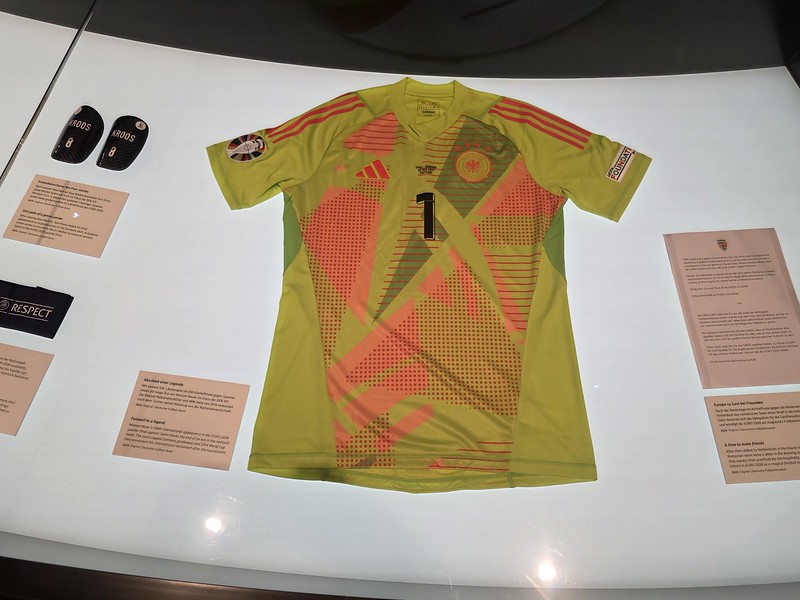
    This football shirt on display at the German Football Museum was worn by the German goalkeeper Manual Neuer for the Spain vs Germany match which took place in Stuttgart on 5 July 2024 as part of the Euros. This was the quarter-final match which Spain won, with Neuer announcing his retirement from international games shortly after the end of the tournament. But, there’s an element of interest to these exhibits as only a few months ago this shirt was being worn in a game watched by millions and the hopes of a nation rested on the players taking part. There would have been a sense of energy, excitement and nervousness when the goalkeeper put his shirt on, but it’s now all over and it’ll likely be in this museum permanently. I rather like the transience here of an active component of a sporting event now not exactly faded into obscurity as it’s on display, but its time as a functional thing has now passed. I should perhaps get out more….

  • Dortmund – German Football Museum (Murder of Lutz Eigendorf)

    Dortmund – German Football Museum (Murder of Lutz Eigendorf)

    20250614_114231

    The museum states that this is a copy of a Stasi note that planned to kill Lutz Eigendorf (1956-1983) who was an East German international football player who defected to West Germany. This defection was awkward as he played for BFC Dynamo, which was the plaything of Erich Mielke who also happened to be the head of the Stasi. I think it’s fair to say that he was displeased. The East Germans wanted to show off their sporting prowess and that’s made more difficult when the players run away.

    20250614_114242

    Eigendorf was killed in 1983 in a car accident which was never fully explained. It’s clear what the museum thinks happened, although there’s no evidence that Mielke was personally involved with the decision to assassinate him, although he probably was. Mielke was one of the most evil men in East Germany, he was corrupt and he ended up in prison after communism came to an end. There have been investigations relatively recently, but there’s not sufficient evidence to prove he was murdered and the case has now been closed by the German authorities. Eigendorf was very brave to do what he did, not just the defection, but also the criticisms he made of East Germany whilst in the West. He never saw his wife or daughter again, but the communists didn’t dare let him be free.

  • Wizz Air (Dortmund to Vilnius)

    Wizz Air (Dortmund to Vilnius)

    20250615_123434

    Dortmund’s beautiful airport…. I got the train to the nearby railway station and walked twenty minutes to get to the airport as the direct bus to the city centre was €10. That price is a rip-off, the city knows it’s a rip-off, but this is a city that likes cars and treats them with respect. As a comparison, the bus at the other end of this flight cost €0.70 in Vilnius to get from the airport to the city centre. There’s also no way of paying by card on the bus in Dortmund, but of course there is in Vilnius. The reviews of the airport bus service, which is run as a monopoly by the airport, in Dortmund are very poor, I was pleased not to go near it.

    20250615_123504

    The airport was appalling in nearly every way. There is no care here from management, the toilets had no working hand dryers or paper towels, not just one of them, but all of them. The floor was dirty, surfaces were grubby, it’s a dismal airport. The managing director is Ludger van Bebber, who has led this airport for five years, and the Board are so pleased with him that they’ve extended his tenure by another five years. I’ve seen people mock Luton Airport, but at least they keep the place clean. I had a little rummage around on the airport’s website for anything about customer satisfaction and that transpired to be a fool’s errand. The only document I could find was from 2011, congratulating themselves on being above average. That was also the last time they updated their awards page. Possibly because no one has given them one since.

    20250615_123600

    That middle screen does give a reflection on what this airport is like. However, the security staff were very friendly and engaging, although they had to work quickly as there’s so little space for customers given the small size of the airport.

    20250615_124950

    The airport apron and it’s mostly Wizz Air who are using the terminal at the moment.

    20250615_125257

    One oddly charming touch is that the airside area is so close to the pavement that people were waving goodbye to their loved ones through the glass. I don’t think that’s a feature though, more of a planning oversight that they’ve leaned into.

    20250615_125737

    Most airports have a photo of, well, the airport when they have “Welcome to” their city signs. This image is of Messe Dortmund, which is nowhere near the airport, but is an attractive building.

    20250615_150521

    The gate area had a certain mystery to it, since the screen that should have told passengers what flight they were queuing for was broken. As a result, everyone was sort of milling about asking each other what destination they hoped they were off to. It was a communal guessing game with mild existential dread.

    20250615_150437

    The aircraft was 9H-WAF, an Airbus A321 which has been in the Wizz Air fleet which had been loyally trundling passengers around since November 2022. It was the most competent thing I saw all day (well, until I got to Vilnius).

    20250615_151231

    Frankly, I was quite keen to leave Dortmund Airport, not least because I wasn’t entirely convinced it wasn’t held together by hope and old glue. In fairness, it’s a regional airport trying to stay afloat despite airlines abandoning it like a sinking ship. Wizz Air is doing most of the heavy lifting now but it does feel that the airport has gone by the number that they can easily cope with. There is a cafe that doesn’t have enough seats and that’s pretty much it, although I did find a seat to sit at near the gate and there was working wi-fi.

    20250615_151312

    Boarding was efficient and the member of staff at the gate was friendly and engaging.

    20250615_172456

    And off we go, the seat Gods gave me an aisle seat and there was also no-one next to me, so it was a very comfortable flight. I was going to, for the first time, buy a drink from the trolley as it came down the aisle, but I fell asleep so that moment passed. I’ve realised I don’t take many photos on the aircraft, so here’s a little treat. I’m not sure what it adds to this blog post, but there we go, it’s the thought of the content that counts. Once again, the crew were helpful, personably, well presented and worked hard, with the pilots making informative announcements. Nothing went wrong and that’s a very good thing.

    20250615_184047

    A guy with a bag (it’s actually the guy in the photo, but I can’t imagine he’ll ever read this blog) pushed past me and two others on the aircraft to get off, using some force. All three of us walked around him by the time we reached the terminal (which as is visible in the above photo really isn’t very far away), so he made no time up on that little expedition. Every time though, there’s this huge rush from a few passengers and they then meander about like a drunk snail at the bottom of the steps.

    20250615_184705

    My seat on the aircraft was about four rows from the back, so I deplaned (I know, it’s an American term, but I like it) quickly and I was through the airport quickly. To be precise, I got off at 18:40 and was on the bus at 18:45. I’d say that’s pretty good from Vilnius Airport and thanks to the lovely bus driver who saw me rushing to his bus and waved to signal he was waiting. The bus was clean, the contactless payment worked and it was everything that Dortmund wasn’t.

  • Dortmund – Not Entirely What I Expected

    Dortmund – Not Entirely What I Expected

    20250615_101943

    Blog progress is a little slow at the moment given my laptop keeps malfunctioning, but hopefully my two loyal blog readers will persist until I can permanently fix the problem later this week. I arrived into Dortmund a few days ago expecting the usual German city break fodder, perhaps half-timbered houses, cobbled streets, medieval charm or even a large pretzel offered by someone in an apron. What I found instead was slightly less decadent, more smashed glass, graffiti and a friendly man who handed me a free ticket to the football museum (I liked him). Dortmund, it turns out, is not what I expected although my lack of research meant that I didn’t have a very defined vision anyway. And, I’m not even sure what it expects of itself, it’s a quirky place and it’s had some interesting decades historically.

    The city was pretty much flattened in the Second World War, quite literally, with over 90% of its centre destroyed in Allied bombing raids, and what stands today is, in many ways, an architectural shrug. After the war, there was even debate over whether to rebuild at all or simply start again elsewhere. A similar discussion was had with Warsaw, I do wonder whether turning a huge German city into a museum would have been something that might have been a permanent reminder of the Second World War, but I imagine the residents wanted normality to resume. Given that, the authorities opted for rebuilding, albeit in a way that perhaps prioritised function over flourish. The result is a city centre that follows the original medieval street lines but feels decidedly post-apocalyptic Ikea.

    Heritage here is elusive. Some older buildings remain, especially as I edged further from the centre, but they don’t shout about it. In fact, most of them don’t say anything at all as there’s a distinct lack of signage about the city’s history, I’m unsure why they couldn’t have splashed out on a few more information boards. The only trail I encountered was football-related, although that was a common theme across the city in numerous ways and I can see why the German Football Museum was located here. In Dortmund, history is mostly told through football it seems, which is fitting, really, because the one thing this city has managed to preserve, polish and proudly display undamaged is its sporting spirit. The German Football Museum is an actual triumph as it’s glossy, modern and enthusiastic, so it’s not an entire surprise that so many other cities wanted to hold it. I wasn’t here when Borussia Dortmund were playing, but I imagine that there is an all consuming atmosphere and excited feel.

    I walked a lot, as might be expected as it seemed the best way to understand the place, and to avoid the metro, which was pricey and I thought a little poorly signed. Walking revealed a functional city with reasonably well-maintained pavements, an interesting if slightly stern street layout and a distinct lack of benches. Want to sit? Buy a coffee or lean against a wall. Public space is clearly for movement, not musing. Green spaces, on the other hand, are plentiful when going further out and, in the summer heat I experienced (and hardly complained about once), heaving. Families sprawled across lawns, teenagers argued over Bluetooth speakers and a general sense of life pulsed through the parks. The former walled city ring provides a helpful visual guide for the pedestrian, a sort of phantom moat that lets you know where the city used to end and now endlessly continues into the suburbs.

    I mentioned that the metro was pricey, and it cost me £3.50 to go three stops, but it was so hot that I found that a useful service and I wanted to experience the network. But that’s a ferocious price and it was no surprise to see just how many cars there were in the city. The signage on the metro was frankly not ideal and I sometimes wonder whether anyone from the network actually looks at the signage and follows it through, to see if it’s logical to visitors. Most networks don’t struggle with this. I note this as I ended up going back on myself and I don’t claim that I’m entirely competent in these matters, but a bit of assistance would have been useful from signs rather than having to seek comfort in Google Maps. I didn’t see a single staff member anywhere on the metro system which also felt sub-optimal in case anyone did need assistance.

    I don’t like Deutsche Bahn for numerous reasons, but I don’t want to dwell on that for too long as balance is the key as my friend Richard always says. But there was again a lack of staff availability at the city’s main station, it was expensive and there was again poor signage (a bit of a theme in this city) although it was relatively clean and a staff member was enthusiastically clearing debris from the steps. I don’t like the ticket barriers on the UK rail network, but at least it means that staff are available and easy to find if anyone needs help. If I had a disability, I would have struggled here to get any assistance at the city’s main railway station. Having just come from Poland, the city was a country mile behind their neighbour in terms of public transport, whether that was price, ticket acquisition, cleanliness or signage. But, to give Dortmund some credit, their public transport network is integrated and extensive so it is very useable.

    But Dortmund is not without its complications. The city’s scars are not just historical. There’s a visible and extensive homelessness problem, begging is common, anti-social behaviour is evident, there’s litter, graffiti and a smattering of smashed windows. One doorway with smashed windows was scrawled with the phrase “drug dealer”—not exactly the kind of street art you hope to discover on a cultural wander. And yet, despite these signs of wear and worry, I never felt unsafe, but the situation often felt sub-optimal, it was all just a bit gritty. The centre of the city has numerous shopping options with a number of international chains, although I didn’t notice any shopping malls, with independent shops located more in the suburbs. I’m not sure how many tourists the city gets, there isn’t much in the way of guided tours, city sightseeing buses or the like.

    The people, however, were a different matter entirely. Everywhere I went, I encountered friendliness. A man with a spare football museum ticket gave it to me with a smile, although this arrangement rather confused the reception desk as two people arrived with joint tickets and one spoke fluent German and the other, well, didn’t. But back to the generality, the city’s bar staff were engaging and the staff in the hotels were particularly helpful. It was the kind of warmth that might catch one off guard when they’re surrounded by concrete and broken glass. Dortmund’s people are, if anything, its redemption arc. It’s a multi-cultural city with a fair amount of immigration, which brings a breadth of food and cultural depth along with it. The city has depopulated over the last few decades and I wonder whether the migrant population has been used to prop up the local economy, but either way, there’s a substantial Turkish community here and from what I could see they have integrated well.

    On Friday evening, the city centre came to life following a day where a fair amount of stuff seemed shut. A food and drink event had taken over the heart of town, and for a few hours, it all made sense in terms of its vibrancy. This is what Dortmund is striving for: community, togetherness, a reason to gather. It was joyous, and it felt like the city had shrugged off its trauma just long enough to have a dance and a sausage. I’m sure locals would tell me that the sense of community in the city is just fine, but in the couple of days I was there, it wasn’t blatantly obvious to me. Beer, maybe oddly but maybe not as it’s Germany, is where Dortmund seems oddly restrained. The local Pils dominate the arrangements, with little craft variety, but this is a constant theme that I go on about. The bars are more old-school than cutting-edge, but again, the service was warm and the beer was refreshing. You won’t find pretentious (also read delicious) flights of IPA here, just solid lager and people who’ll chat to you about football, the weather and how much better things used to be. One day the craft beer will come though, I’m confident about that, the Reinheitsgebot will just have to evolve. I did go to the brewery museum, a recommended affair that is free of charge and relatively extensive.

    Perhaps the biggest surprise was the persistence of cash. Many places didn’t accept cards, and finding a cash machine was more of a treasure hunt than a convenience. For a city with such modern trappings, Dortmund clings to coins and notes with curious enthusiasm. The whole arrangement is a nuisance, it’s evident from the signs, often in English, that tourists expect cards to be an option and the direction of travel here seems to be one way in terms of giving visitors choice. Numerous takeaway stands made clear they accepted cards, fearful likely of losing considerable amounts of trade if they didn’t.

    If I had to sum Dortmund up in one word, it would be: troubled. But that feels too harsh, although there’s no immediate beauty to be found here as there might be in other German cities. Perhaps “full of potential” is better. This is a former industrial city which has had to change into a service led economy, research and tech is pretty big here, but that’s a challenging transformation. It’s a city with bruises but also heart. It’s not polished or pristine, but it’s trying its best. And perhaps it’s worth visiting not because it’s perfect, but because it isn’t. I think my return visit to Dortmund, as I’m sure that there will be one, will be made with an open mind, a pair of sturdy shoes and some spare change. I might not fall in love (it’s not Poland or the Baltic states after all), but I might, just for a moment, understand it a bit better and it’s certainly a resilient place. Oh, and it loves football.