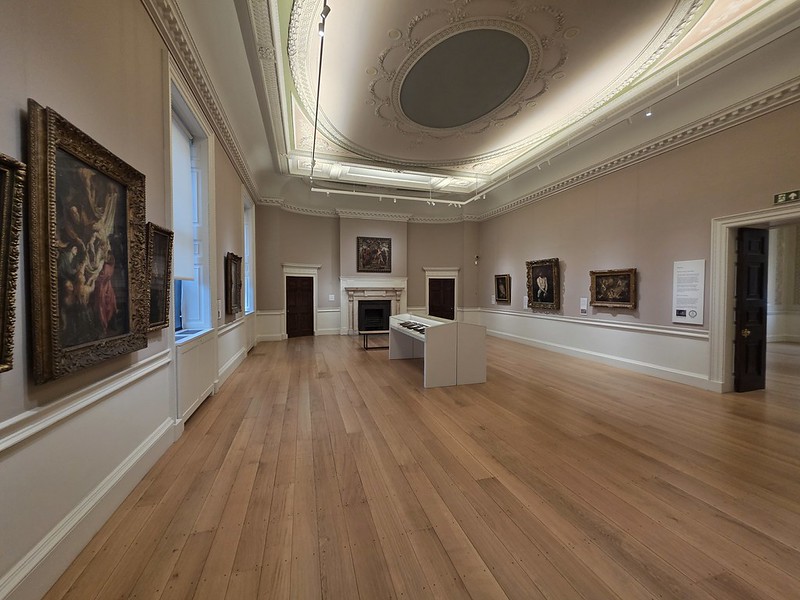
One thing that I really rather liked about the Courtauld is that they’ve got information in each room about how the space was once used. Today, this is Room 6 which is used to display the gallery’s collection of works by Peter Paul Rubens. The plasterwork on the ceiling is by Thomas Collins, who also completed work in other rooms at Somerset House.
However, it was once the Council Room of the Society of Antiquaries, which was created in 1707 to study ancient monuments. Their first meeting was at the Bear Tavern nearby on the Strand and they moved into Somerset House in 1780 and remained there until 1874. They moved at that point to Burlington House on Piccadilly and they’re still there today.
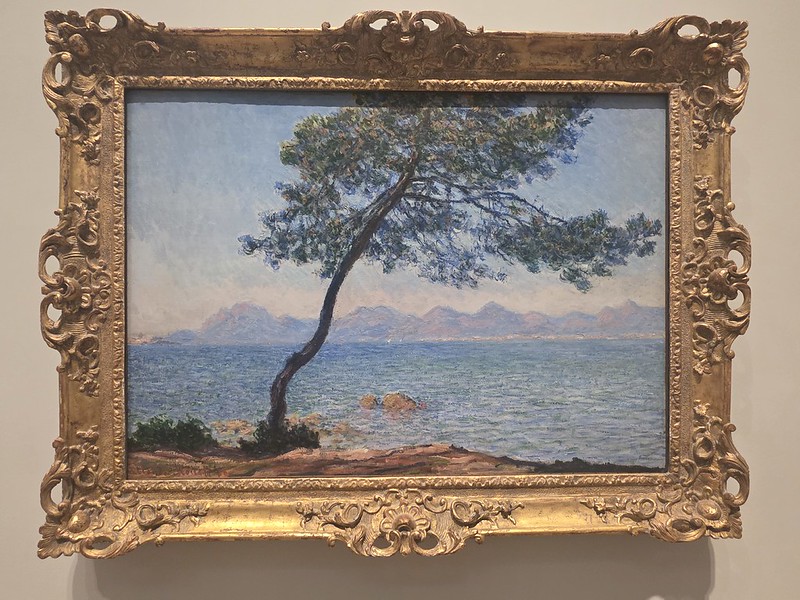
When Claude Monet (1840-1926) arrived in Antibes, on the Mediterranean coast of France, in January 1888, he was not just looking for fresh subject matter he was in pursuit of something far more elusive, namely, light. I don’t know very much about artwork, but every guide to this painting talks about the importance of light. Lovely as it is, it was the history of the painting’s ownership that particularly interested me, but more of that in a moment.
Monet himself said “one must repaint a single subject three times, four times, even twenty times”, which I would say is the amount of effort that I put into this blog, although that might not be entirely true. Anyway, there’s one maritime pine in the painting and we’re supposed to look at that and then dwell on the beauty of the light from the water, the sky and from the mountains.
One thing I like from gallery websites, which I think is all too rare, is seeing the provenance of an artwork. This one is listed by the Courtauld, namely:
“Bought from the artist by Boussod & Valadon, June 1888; (?) with Georges Petit, 1888; Mme Vve Barbedienne, Paris, 1894; sold Hôtel Druout, Paris, 24 February 1894 (lot 39); bought Paul Durand-Ruel; Decap, Paris, 1894; Bernheim-Jeune, Paris, 1907; Baron Caccamisi, Paris, 1907; Mrs Blanche Marchesci, London, c.1910; Paul Rosenberg, Paris; M. Knoedler & Co., London; purchased by Samuel Courtauld, August 1923; Courtauld Bequest, 1948”.
I wondered why a hotel, namely the Hôtel Drouot, had purchased a painting like this, but then I checked and have realised that it’s actually a large auction house in Paris which is still trading. This auction house was implicated in the sale of looted Jewish artworks and Paul Rosenberg, who was a Jewish art collector who owned this artwork for a while, later had some of his collection stolen. It was then purchased by Samuel Courtauld, who ultimately gave it to the gallery which bears his name. Although, if Rosenberg hadn’t of sold it, then it might well have later been part of the collections that were stolen by the Nazis. And on that theme, the son of Blanche Marchesi, namely Leopold Popper-Podhragy, was sentenced to death by the Nazis although he managed to avoid that and lived until 1986, but his artwork collection was also taken.
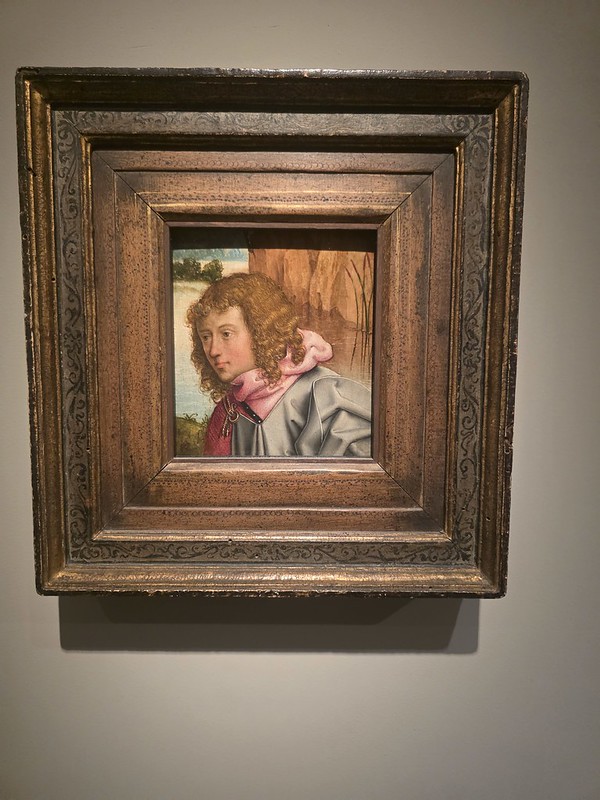
The gallery gives this artwork the title of “Head of a Man against a Landscape” which is all that they have since this has been cut so tightly that it has lost much of its original meaning. It was once likely part of an altarpiece, but now they don’t know who the image is of, nor who painted it.
The painting entered the gallery’s collections in 1952 as part of the Sir Robert Witt bequest. There’s something perhaps sub-optimal about such a small piece of the original artwork and in such a large frame, but at least some has remained.
Given this lack of clarity, and my slight obsession with AI, I asked ChatGPT and Google Gemini to have a go at this. Along with the gallery’s best guess, this is the result of the artist, date of painting and who is in the image.
GALLERY : No artist known, but likely Dutch influence. Painted between 1495 and 1500. No knowledge of who is in the image.
CHATGPT : Maybe school of Hans Memling, but likely Dutch influence. painted between 1480 and 1500. Possibly Saint John the Evangeliest.
GEMINI : No artist known, but likely Dutch influence. Painted between 1510 and 1540. No knowledge of who is in the image.
I also asked Microsoft Copilot but the answer was complete nonsense, it announced that this was a nineteenth century copy of an earlier piece and was painted by an Italian artist.
I’m interested if I retry this experiment in a couple of years whether the results will be better, although ChatGPT seems to be nearly there.
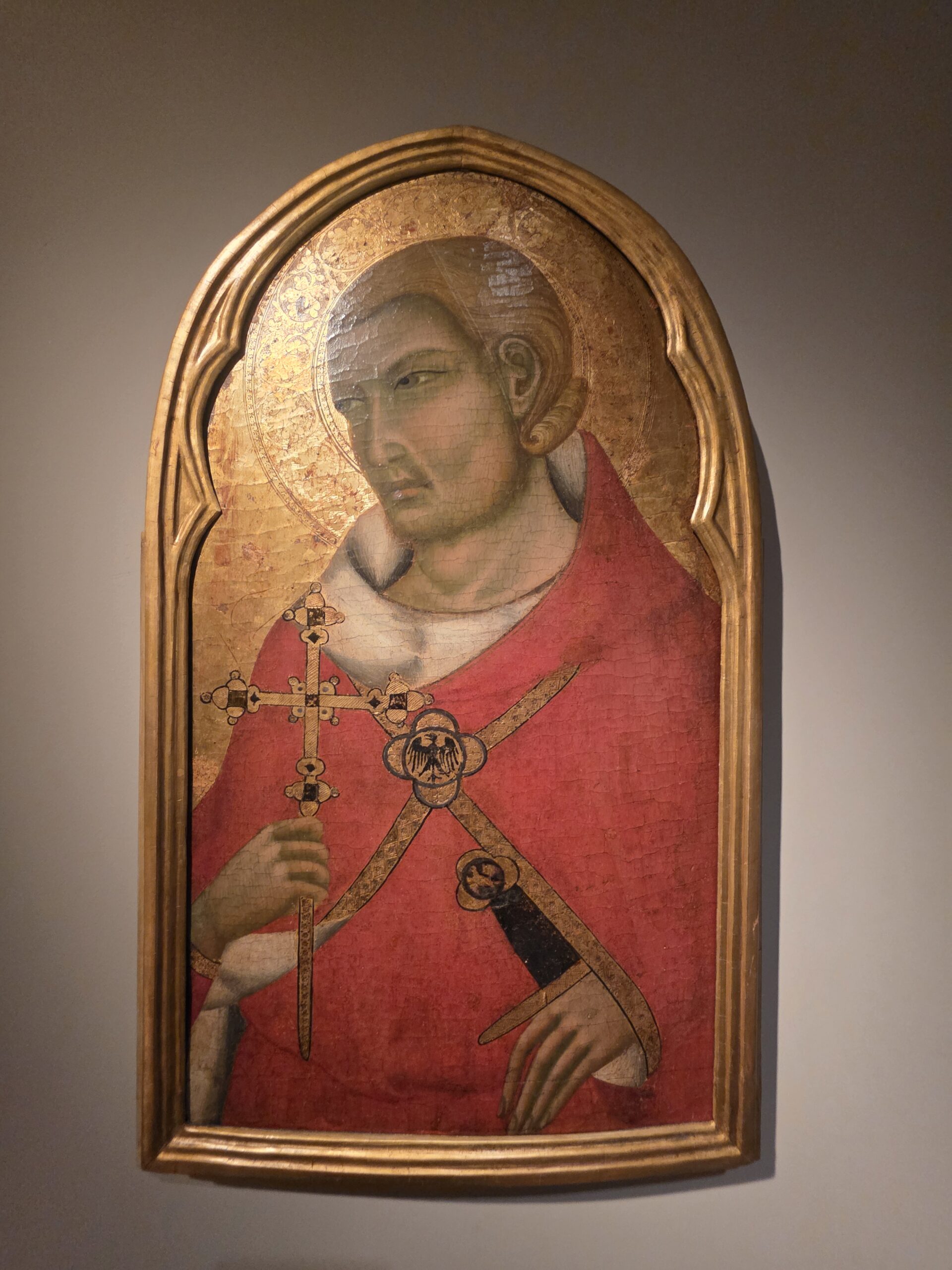
I’ve been meaning to go to the Courtauld Gallery in London for some time and with my Art Pass I was able to get free entry. And this artwork in the first room was very appropriate, as it’s Saint Julian. The gallery notes:
“The rich garments and fine sword refer to the traditional belief that Julian was a nobleman before devoting himself to the sick and needy.”
That sounds very much like me. Well, other than the rich garments, fine sword and nobleman bit. The artwork is part of an altarpiece from the Church of San Torpé in the Italian city of Pisa. Originally, Julian was looking towards the central panel of the altarpiece which contained the Virgin Mary and Jesus Christ. The church is still there, but the rest of the altarpiece is likely long gone.
The artwork, originally painted in around 1320 was donated to the gallery as part of the Gambier-Parry Bequest in 1966. The provenance isn’t known, but it’s thought that it was originally purchased by Thomas Gambier-Parry (1816-1888) after 1863. There’s an interesting book on this whole Gambier-Parry collection with the introduction of that written by Sir Anthony Blunt who later became better known for other things…
Anyway, this was a very positive first impression of the gallery for me.