Category: Somerset

  • Bath – The Old Post Office (JD Wetherspoon)

    Bath – The Old Post Office (JD Wetherspoon)

    This is the new JD Wetherspoon in Bath that opened a few weeks ago in March 2026, the second one of the chain’s pubs in the city and this refurbishment cost them £2.2 million. This building was once Bath’s Post Office, but was for the last fifteen years or so used by Revolution until they closed.

    One thing that JD Wetherspoon does well, amongst many other things, is having an interest in the history of their buildings. This reads:

    “York Buildings is a grade II listed Georgian terrace, with a grand frontage along George Street. Completed in c1760, most of York Buildings, excluding No. 2, was the York House Hotel, latterly the Royal York Hotel. No 2 is at the end of the terrace. Previous uses include the Midland Bank, an auctioneer/estate agent’s premises and Bath’s main post office.

    York Buildings was designed in the Palladian style by John Wood the Younger, who also designed Bath’s world-famous Royal Crescent, one of the finest examples of Georgian architecture in Britain. The porches were added in the 19th century, with ground-floor alterations made to No.2 in the 1870s. Bath’s architectural transformation into a Georgian city was begun by his father, John Wood the Elder. An outstanding architect and town planner, he began laying out George Street in 1734.

    On the front of 2 York Buildings is carved ‘The Old Post Office’. During 1854–1927, these premises housed Bath’s main post office, with Oldham T Taylor its postmaster for nearly 30 years (1863–90). Thomas Moore Musgrave was also a long-serving postmaster here. On 2 May 1840, Thomas famously posted an item of mail from the Bath post office, then at 8 Broad Street, with the newly invented Penny Black postage stamp — this was the world’s first adhesive postage stamp’s earliest use.

    Ralph Allen was another famous postmaster. He arrived in Bath in 1710 and worked as a postal clerk. Two years later, aged only 19, he became the postmaster of Bath. In 1722, Ralph was elected mayor of Bath. During the intervening years, he made a fortune from reorganising the main postal routes across England.”

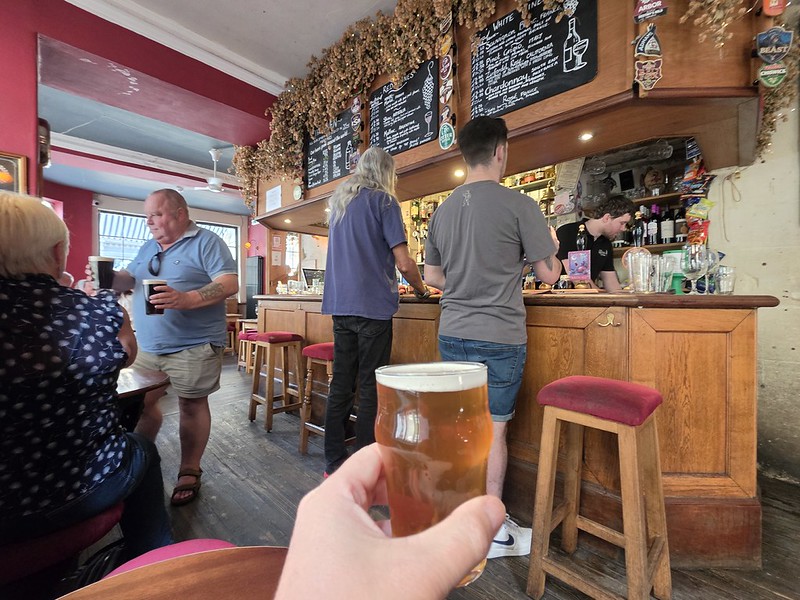
    The downstairs bar and it all looks colourful, bright and clean.

    The window seat was handy for people watching. There’s an upstairs bar as well and the whole arrangement is quite sizeable.

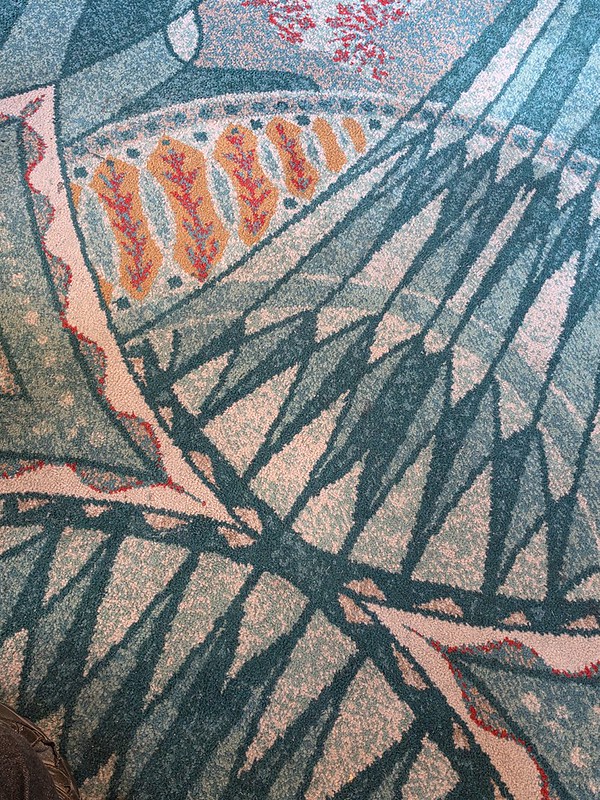
    My now obligatory carpet photo.

    There were six real ales on (with beers from Thornbridge, Oakham, Brains and Greene King), but as it was still morning I went for the £1.89 refillable coffees.

    As usual for this chain, I felt drawn to look at the online reviews and it’s one of the higher rated JD Wetherspoon locations on Google although it has only been open for a few weeks.

    “I was disappointed to see the lack of diversity in the interior design of this new bar in Bath. The images displayed throughout the venue only portray white men, which feels out of touch in 2026 and does not reflect the diverse history and communities that exist. Public spaces should be inclusive and representative of everyone. I hope this is something the management considers improving ASAP as it would make the environment feel more welcoming and inclusive.”

    Although the photos the reviewer took showed half the images in the venue were women and there is perhaps a limit of how many eighteenth and nineteenth century diverse images of famous Bath residents they can find without it looking a bit forced. I can’t imagine that this will be a priority for JD Wetherspoon.

    “Arrived to the new weatherspoons and looked good. Asked if we could have a table with our dog and was told yes out side. Sat down ordered food , told I have to order to a table inside and take it out side my self .
    After getting oue drinks and paying I am told that I must leave as my dog was not welcomed due to policy.
    I understand policy, how ever being told I can have a table outt side then order my food .to then be told I have to leave is not on. I did get a full refund , as my food arrived. Will never return”

    There’s already a review that JD Wetherspoon don’t accept dogs anywhere in their venues, that didn’t take long.

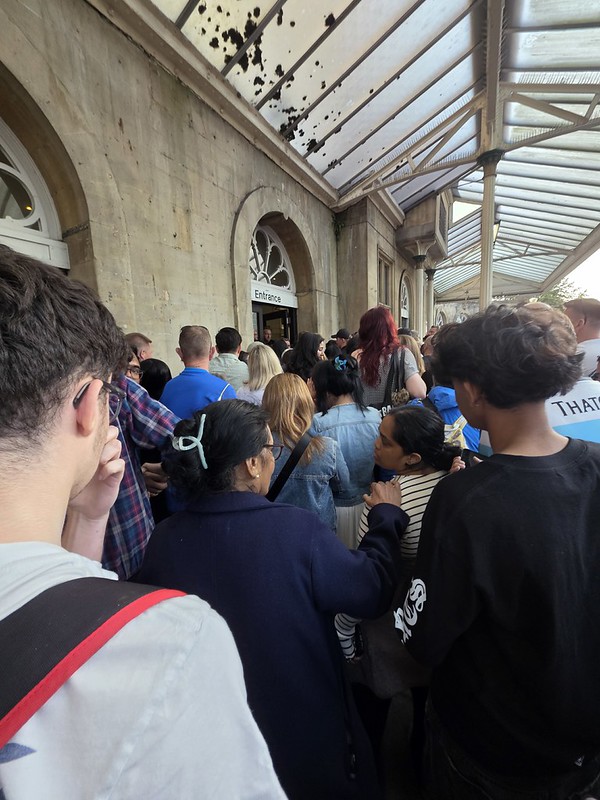
    And that’s about it, just some disappointment about cold breakfasts and tables that weren’t cleared down very quickly, otherwise customers seem to like it. It was certainly busy when I went on a Saturday morning in June, with the service all being fast and efficient. All very lovely and that’s another one of the chain’s venues that I’ve visited, so I then thought I’d better visit some Good Beer Guide pubs as well.

  • Bath – Beckford’s Tower (Tomb of William Beckford)

    Bath – Beckford’s Tower (Tomb of William Beckford)

    The tomb of William Thomas Beckford (1760-1844), with Beckford’s Tower in the background, more on which in another post. Beckford managed to have quite a few interests, aided with a substantial legacy from his father of the same name, which included literature, art collecting, travelling and building design.

    Beckford was buried at Bath Abbey cemetery on 11 May 1844 and the tower where he wanted to be buried, then called Lansdown Tower but now better known as Beckford’s Tower, was flogged off to the publican of the Freemasons Arms on Abbey Green who planned to use the land as a beer garden. I doubt Beckford would have been entirely satisfied at this, but fortunately for him, his daughter was able to buy back the land and in 1848, Beckford was buried outside the tower in this grand pink granite tomb. This had proved impossible earlier on as it was consecrated ground, but permission was granted and there are now around 5,000 other burials at the site.

  • Bath – December 25th Shop

    Bath – December 25th Shop

    When I took this photo in 2017, I assumed that this was just a shop set-up for Christmas, although I thought that they were being a little enthusiastic opening in August. The shop on Cheap Street was though much more permanent, run for over 30 years by Graham Tomkiss, but it sadly closed in 2018. A pop-up shop opened on New Bond Street for Christmas 2019, but there’s no confirmation yet whether there will be anything for 2020.

    For children though, this must have kept the excitement of Christmas alive for the whole year.

  • Bath – Views from Bath Abbey

    Bath – Views from Bath Abbey

    Just photos from a few years ago, from the roof of Bath Abbey which can be accessed as part of a behind the scenes tour of the building.


  • Bath Abbey – William Oliver Tablet

    Bath Abbey – William Oliver Tablet

    This lengthy memorial tablet is to the memory of William Oliver (1659-1716), a medical pioneer who was the uncle of William Oliver, also a medical pioneer from the city, who invented the Bath Bun and Bath Oliver. He was buried in Bath Abbey, which is where this tablet remains in place today.
    This William Oliver spent some of his time as the surgeon responsible for Lord Monmouth’s army, something which would have rather an innovation at the time.

    His tablet reads:

    “In memory of William Oliver MD FRS. He was descended from the family of Trevarnoe, in the County of Cornwall. While he was prosecuting the study of physick in foreign universities. The miseries of his country called aloud for a deliverer. He was ambitious of contributing his might to so great a work. He came into England an officer in King William’s Army in 1688. He was appointed physician to the fleet in 1693 and continued in that station till the year 1702. He was appointed physician to the hospital for sick and wounded seaman at Chatham in 1709 and in the year 1714 he had pleasure to have his old fellow sailors committed to his care. He being then appointed physician to the Royal Hospital at Greenwich in which honourable employment he died a bachelor on 4 April 1716. His love to this city, where he practised physick many years appears in his writings”.

  • Bath – Bath Abbey (Clock)

    Bath – Bath Abbey (Clock)

    As part of a tour of Bath Abbey, there’s the chance to see the inside of the clock. There are two small benches so people can sit by the clock for a few minutes, although the guide gave several warnings to not touch anything connected to the clock, which seemed sensible advice.

    Located on the north side of the building, the abbey’s clock, which belongs to the people of Bath, was moved here in 1834 after being lowered from a previous position when the structure of the tower looked a bit unstable. It was originally once backlit by gas to ensure that it was visible at night, but electricity has made that much easier.

    The advent of the railways brought problems to time-keeping in UK cities, as they often had slightly different times and this was problematic when trying to run a railway. Before the railways, no-one much minded if Bristol and Bath were running at different times by five-minutes, but what became known as ‘railway time’ required some standardisation. Bath did this by in 1845 installing a band of metal on the clock which would show railway time. Scaffolding was put up to ensure this addition could be made, although I wonder why Bath didn’t just keep railway time to keep things simple.

    The clock looks relatively small in the above photo, but that’s deceptive, and in 1926, the Bath Chronicle wrote about a refurbishment of the clock. They noted:

    “The diamond-shaped aperture in the face of the clock is due to having been removed in order that the hands might be disconnected. From the ground it does not look more than big enough for more than a fist to emerge, but that is deceptive as George Willis [the man in charge of the project] was able to project his head and shoulders through the opening. The minute hand is 3 feet long, and the hour hand 1 foot 10 inches in length. They revolve on a face having a diameter of 6 feet”.

    https://commons.wikimedia.org/wiki/File:Bath_Abbey.002_-_Bath.jpg

    And here’s a photo of the clock from the outside.

  • Bath – Smallcombe and Views Over City

    Bath – Smallcombe and Views Over City

    Just photos, of my walk down the hill from Bath University into the city centre a few years ago. There’s a peacefulness that is surprising from being so close to the centre of a city and fortunately, Bath has retained a large amount of greenery around it, without urban sprawl destroying its tranquility.

    The National Trust sign at the entrance to the walk at Smallcombe, which is all part of the Bath Skyline Walk.

    I liked the whole concept of the community nuttery.