In my little series of posts from 200 years ago, there’s a one line article on the court reports for 1825 that reads:
“By the decision of magistrates, Charles Smith, for non-performance of an order of bastardy – three months tread wheel”.
The tread wheel was a relatively new invention at this time, having been designed by Sir William Cubitt and introduced in the prisons of Bury St Edmunds and Brixton. The punishment varied, but Charles was likely on the tread wheel for around six hours a day, which must have been healthy but also tiring and probably rather annoying to say the least.
The concept of bastardy orders has roots in English common law, where children born to unmarried parents were deemed filius nullius, meaning “child of no one”, which does feel a slightly harsh way for a youngster to start their life. These children lacked legal standing in society and were prohibited from inheriting property from their father unless legitimised, which could be done rather more easily for the landed gentry. These children could not claim support from their parents, and the responsibility for their care initially fell upon monasteries and local councils. The Poor Law of 1733 in England stipulated that the putative father was responsible for maintaining his illegitimate child. Local authorities would issue public funds to maintain the mother and child until the father could assume responsibility.
The 1834 New Poor Law in England introduced a Bastardy Clause, representing something of a significant shift in social and legal approaches to illegitimacy. This clause shifted the responsibility for illegitimate children from the parish to the mother and this change aimed to deter illegitimacy and reduce the cost of poor relief by placing the burden on unmarried mothers . The Bastardy Clause was rooted in the principle of “less eligibility”, which sought to make workhouse conditions less desirable than even the lowest paying jobs, thereby discouraging reliance on poor relief. A Royal Commission into the changes that became the 1834 Poor Law stated that the existing system gave generous payments for illegitimate children and indemnified the mother against failure to marry, noting:
“The effect has been to promote bastardy; to make want of chastity on the woman’s part the shortest road to obtaining either a husband or a competent maintenance; and to encourage extortion and perjury.”
Charles Smith is too common a name for me to be able to work out much about him, but the parish officials would have made an Order which required him to pay for his child and it’s evident that he didn’t make those payments.
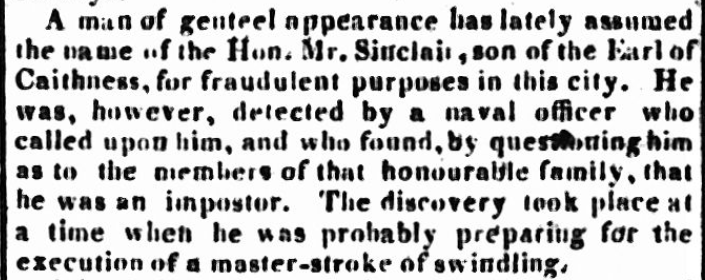
Back to my little series of posts about the Norwich Mercury from 200 years ago. It’s hardly a surprise that there were conmen operating in Norwich 200 years ago, but it must have been a lot harder back then to actually spot such deceit when it happened. The Earl of Caithness at the time was Alexander Campbell Sinclair, 13th Earl of Caithness, with the fraudulent man pretending to be his son. He was perhaps unfortunate to have discovered a naval officer who was able to ask penetrating questions about the Earl of Caithness, otherwise he might have gotten away with his little scam. It’s a nice little phrase from the newspaper though, “preparing for the execution of a master-stroke of swindling”, as there are some politicians that could be said about today.
As I’m up at 02:00 waiting for security to open at Rome Fiumicino airport, I thought I’d look at some newspapers from 1727 as that’s great entertainment for an early morning. It’s one of the earlier editions of the Norwich Mercury, which was printed from the early 1720s until May 1949.
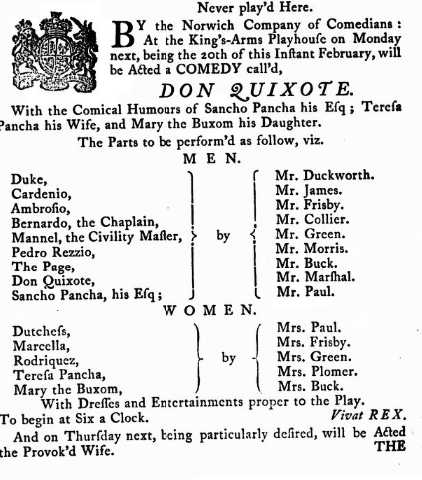
“Never play’d Here.
By the Norwich Company of Comedians:
At the King’s-Arms Playhouse on Monday next, being the 20th of this Instant February, will be Acted a COMEDY call’d,
DON QUIXOTE.
With the Comical Humours of Sancho Pancha his Esq; Teresa Pancha his Wife, and Mary the Buxom his Daughter.
The Parts to be perform’d as follow, viz.
MEN.
Duke, Mr. Duckworth. Cardenio, Mr. James. Ambrofio, Mr. Frisby. Bernardo, the Chaplain, by Mr. Collier. Mannel, the Civility Maſter, Mr. Green. Pedro Rezzio, Mr. Morris. The Page, Mr. Buck. Don Quixote, Mr. Marshal. Sancho Pancha, his Esq; Mr. Paul.
WOMEN.
Dutchefs, Mrs. Paul. Marcella, Mrs. Frisby. Rodriquez, by Mrs. Green. Teresa Pancha, Mrs. Plomer. Mary the Buxom, Mrs. Buck. With Dresses and Entertainments proper to the Play.
To begin at Six a Clock. Vivat REX.
And on Thursday next, being particularly desired, will be Acted the Provok’d Wife.”
Firstly, the King’s Arms Playhouse is something of a mystery and doesn’t come up on any searches. There have been ten pubs in Norwich with this name, but there’s only one which seems to have been open at this time and it’s a pub still in existence, now called Berstrete Gates. Don Quixote had been written just over 100 years before, so was an old favourite even back nearly three hundred years ago.
It’s rather sub-optimal that no first names were given, it’s too hard to work out who any of these early actors and actresses were. They were a touring company, as their names appear in locations across the region. Fortunately, a little more is known about the Norwich Company of Comedians, who between 1731 and 1757 made the White Swan Inn, near Peter Mancroft, their home. This pub started trading in the early 1600s, but the building was pulled down in the 1960s to make way for car parking. A sub-optimal decision…. Anyway, despite more being known about the company, there’s still no link between the names of the performers in this production and the history of the comedians, so that didn’t help much.
Despite my failures of research, it’s still a rather lovely little piece of Norwich history, a theatre company performing 300 years ago to surprise and delight the locals….
And just one more post from the Norwich Mercury of 200 years ago this week…..
“NORFOLK, SUFFOLK, AND ESSEX Rail Road Company.
At the request of several Gentlemen of influence and respectability of Norwich, the Committee of Management have consented to receive SUBSCRIPTIONS for SHARES until the 1st February, before which time all Tenders must be made, to Messrs. Gurney, Messrs. Tompson, Barclay, & Ives, Messrs. Onley, Hudson, and Harvey, and Messrs. Day, Bankers; Messrs. Unthank and Foster, Solicitors, at Norwich; Messrs. Brown and Co. Messrs. Oakes & Co. and E. Squire, Esq. Bankers, at Bury St. Edmund’s; Messrs. Borton, Solicitors, Bury St. Edmund’s; or to Messrs. Sir W. Kay, Price, Marryatt, and Coleman, Bankers, Mansion House-street, London; Messrs. Morland & Co. Pall Mall; Messrs. Wolfe and Edmunds, Brokers, ‘Change Alley, Cornhill; and Messrs. Wilks and Verbeke, Solicitors, 36, New Broad-street.
But all parties so making Tenders must remit the amount of deposit of £1 per Share, on the Shares for which they may tender, to one of the above-named Bankers, otherwise the Tender cannot be received.
London, 13th Jan. 1825. WM. SIM, Sec. Pro-Tem.”
I’ll ignore that Oxford Comma in the first line…. I can’t find any substantial reference to this company, although I like the early use of the words rail road, so I’m not entirely sure what happened to it. However, this must have been one of the earliest attempts to create a rail company in East Anglia, but it took over a decade for any line to appear in the region. However, I suspect I’ll start to see a lot more journalism and adverts about the rail network from 200 years ago, as in 1826 there was an Act of Parliament that authorised the Liverpool and Manchester Railway.
And (yet) another post in my series of things that I thought intriguing from the Norwich Mercury of 200 years ago this week. The article reads:
“On Thursday night, or early on Friday morning, some persons broke into the bar of Mr. Blackley, at the Castle Inn, by breaking the window over the porter-room door, and slipping the bar lock, and stole from thence a musical snuff-box, a silver snuff-box, four pictures, double-bitted bridle, pair of shoes, boots, silver wine strainer, and several other articles. The pictures are portraits of Mr. Blackley and some of his family. A person sleeping near the room imagined that he heard their attempt, but did not rise to ascertain the fact.”
It’s the last line that I thought of note and I can almost imagine the annoyance of William Henry Redhead Blackley, who was the landlord of the pub between 1823 and 1833, that the person mentioned didn’t attempt to stop what was going on. This was also a large venue (known over the time as the Castle Inn, the Castle Hotel, the Castle & Lion and just the Castle), it had been trading since the mid seventeenth century and it remained open until 1989, which seems like quite a decent run to me. Unfortunately, the building was lost in the 1990s as part of the Castle Mall development, but it had been a sizeable building.
As some other asides, it was quite a little haul that the thieves got away with, taking horse related kit, shoes and photos of the landlord. I had to look up what a porter room was and it’s apparently a Norfolk thing, it’s a reference to the posh bar or I suppose the lounge bar of its day.
As for the landlord, William died on 1 March 1833 and is buried at the Rosary Cemetery, although I’m not sure if his gravestone is still there.
And another in my series of posts that caught my eye from the Norwich Mercury of 200 years ago.
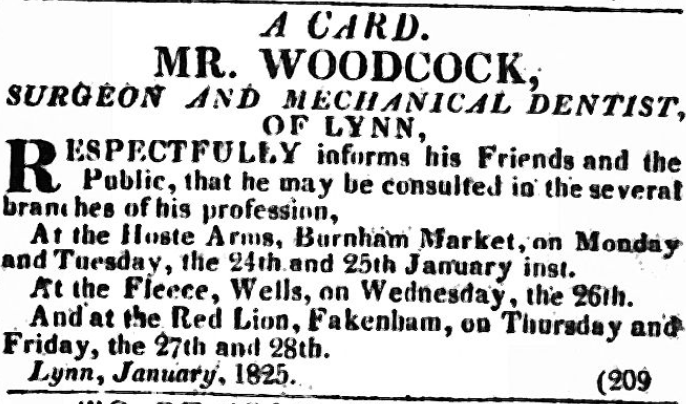
“MR. WOODCOCK, SURGEON AND MECHANICAL DENTIST, OF LYNN,
RESPECTFULLY informs his Friends and the Public, that he may be consulted in the several branches of his profession,
At the Hoste Arms, Burnham Market, on Monday and Tuesday, the 24th and 25th January inst.
At the Fleece, Wells, on Wednesday, the 26th.
And at the Red Lion, Fakenham, on Thursday and Friday, the 27th and 28th.
Lynn, January, 1825.”
A mechanical dentist is a phrase that was used for over 100 years and this is someone who made dentures and other dental appliances. But, what I rather like is that he wasn’t operating from a dental office, but was instead travelling to different towns and meeting patients in various pubs. I rather like this glimpse into what healthcare looked like in rural England in the early nineteenth century, for those with at least a little money at least. And meeting patients in a pub seems a quite marvellous idea to me.
What is also rather positive is that the three pubs mentioned are all still operating 200 years on. The Fleece is better known now as the Golden Fleece and the Red Lion closed in 1974 and was turned into council offices, but then reopened as a bar around twenty-five years ago. There’s something reassuring knowing that 200 years on, these pubs are all still there (although the Red Lion seems to be a little tentative at the moment) although I don’t think that they have anyone going around offering tooth repair.
200 years ago this week in the Norwich Mercury is this advert placed by John Sell Cotman. This wasn’t a new thing for him, he had been doing it for many years and so it must have been successful in getting work in.
John Sell Cotman (1782-1842) was a prominent English landscape painter and etcher, particularly recognised as a leading figure of the Norwich School of painters. Born in Norwich, he displayed an early inclination towards art, diverging from the path of his father’s business. Cotman’s artistic journey began in London, where he immersed himself in the art scene, encountering notable figures like J.M.W. Turner and Thomas Girtin. He became part of their sketching club, embarking on expeditions to Wales and Surrey, which significantly influenced his artistic development. By 1800, he was exhibiting at the Royal Academy, showcasing his captivating landscapes.
“MR. J. S. COTMAN RE-COMMENCES his Course of Teaching in the departments of DRAWING, PAINTING in OIL and WATER COLOURS, on the 24th in NORWICH, and at YARMOUTH on the 21st instant. St. Martin’s at Palace.”
Hindsight is a marvellous thing, and also a bit pointless as this was 200 years ago, but what an opportunity this would have been. Cotman on the other hand often had financial difficulties, as being an artist wasn’t always hugely profitable, so this sort of thing would have bought in extra revenue.
And another in my series of posts from 200 years ago this week (well, actually next week, but the crime was this week).
“£30 REWARD.
WHEREAS on Friday night last some Persons entered a Turnip Field, in Swardeston, Norfolk, and there STOLE TWO FAT SHEEP, the property of Mr. William Smith, of Swardeston Hall, the Skins, Heads, and Entrails of which have since been found hidden among the Furze Bushes on the Hall Green, at Swardeston.
NOTICE IS HEREBY GIVEN, That whoever will give information which may lead to the apprehension of the persons concerned in the above felony, so as they be thereof convicted, shall be paid the Sum of TWENTY POUNDS out of the Fund of the Association for the Prosecution of Felons within the Hundred of Taverham and adjoining Hundreds and Towns, in the county of Norfolk, and the further Sum of TEN POUNDS by the said Wm. Smith.
J. S. PARKINSON, Treasurer to the said Association.
Norwich, Jan. 10th, 1825.”
This caught my eye because this is a huge reward for the theft of two sheep, the equivalent of nearly £2,000 in today’s money. The level of this must have been intended to be a deterrent and the farmer must have had some considerable wealth and influence. The farm is there today, known as Swardeston Hall Farm, with the hall itself still standing. I couldn’t find any later reference to this case, so the perpetrators might well have got away with it. As a slight aside, Swardeston is where Edith Cavell was born in 1865.
I also think it’s interesting that this is the period when attitudes were changing towards crime. The Bloody Code which had increased the number of capital crimes had been pretty much phased out in 1823 and I wonder whether some landowners were nervous that crime might rise as a result of that.
I spend too long reading old newspapers and one thing is timeless, which is the worry that the local healthcare provision isn’t sufficient. This letter to the Norwich Mercury in January 1825 spells out the problems which the correspondent thought needed to be dealt with.
“It now becomes a matter of serious and important consideration, in what way the funds are to be employed, which have been liberally afforded to the Hospital during the present year; and as much advantage will be derived from having the public attention directed to this point, I beg leave to offer, through your means, to the attention of the Governors, a few remarks on the subject.
The clear profits of the last Festival having been from £2400 to £2500, we must consider £300 of this sum, to defray the preparatory expences of the next Festival. The balance is therefore £2100; and to this may be added the late very munificent donation of £533, which increases the funds of the present year to the extent of £2633, beyond the average income.
With regard to the appropriation of this balance, I presume that the first consideration will necessarily be, whether the establishment, on its present scale, admit of any improvements. This is a circumstance of which the gentlemen who are most conversant in the details of hospital management are the most competent judges, and I would only observe upon it, that as there are no wards but such as are in constant use, the operations of cleansing, whitewashing, and painting, must occasionally diminish, for many weeks, and even some months, the accommodation of the patients: and that an additional ward would therefore be very important, in order to give full effect to those which the Hospital possesses.
Such an extra accommodation would likewise permit a ward to be employed for males or females, as an occasional overflow of the one description of patients or the other, might render necessary.
This goes upon the presumption, that the Hospital does not require any permanent magnification; but when the increased and increasing population of the city of Norwich and the county of Norfolk are taken into account, it will hardly be considered, that an establishment, which was intended for 80 or 90 patients half a century ago, when the population was near 10,000 less than it now is, could not, at the present time, be advantageously enlarged.
By the printed report it appears, that during the last twelve years, the average annual admissions have increased about a fourth; viz. from about 500 to 600; but it has very frequently happened, as is well known, that for many weeks together several of the applicants have not been admitted, though some of them have come from a considerable distance, and at great fatigue, expence, and inconvenience. This is an evil which can only be supplied by a permanent addition of beds to the Hospital.
The necessity for more room was felt even during the life-time of Dr. Alderson, who died in 1821; and plans and estimates were in his time obtained, as to the mode of enlarging the Hospital, by the erection of two new wards at the North-west corner of it. The state of the finances might at that time prevent the measure from being carried into effect, but the friends of the Hospital may now congratulate themselves, that there are the means of accomplishing this, or any other plan for increasing the utility of the establishment, which may be deemed necessary.
The erection of two new wards, similar in size to the present, and the addition of one of them to the regular establishment of the Hospital, may be easily provided for. By the printed accounts it appears that the housekeeping expences amount to about £16 or £17 per patient: that is, supposing 90 persons, including the officers, to be always on the diet tables of the Hospital. An addition of 15 patients, including nurses, &c. would not exceed, at £20 per annum per patient, £300. If the erection of two new wards amounts to £1000, there will still remain to be disposed of £1500, of the balance above mentioned. Suppose one of the new wards to be considered as independent on the Festival for its support, £900 or £1000, of this money will be required to keep it open till the next festival, when a similar sum may be appropriated to the same object.
Thus will the benefits of a Festival be immediately felt, in the increased relief afforded to the poorer orders of society, and at the same time a fair prospect afforded of keeping up the advantages of the augmented accommodation in future. The experiment would not hazard at all the safety of the establishment: for a ward which is meant to depend on a Festival for its support, might cease to be employed, if the funds intended to keep it open should fail. But when it is considered that the expences of future Festivals will be less than those of the last, and that none of their receipts will be necessary in new erections, there will be every prospect afforded, of not only keeping up, permanently, an augmented number of patients, but of likewise preventing the necessity of appropriating, in the regular support of the charity, those donations and legacies which, without aiming at making it independent of the continued protection of the public, should provide for its permanent and increasing utility.
I remain, Sir,
Your obedient servant,
A SUBSCRIBER.”
The hospital had been built in 1771 as a charitable institute and it was for a long time unable to cope with the demand placed upon it. A new hospital was built on the same site in 1883 and free healthcare was out of reach for many, but letters such as this seem to have a reassuring presence that the health service will probably never really be able to cope with the demands placed upon it.
As another aside (I have a lot of those), I personally prefer the archaic spelling of ‘expences’, although the origins are from the French word ‘espense’, so the current spelling does have historic integrity….
I really love this article from the Norwich Mercury in January 1825, primarily for the randomness of what happened.
“On Tuesday se’nnight a man and a boy in a blue cart and with a bay horse were observed, about 5 o’clock in the afternoon, to go to the foot of St. James’s-hill, near the barracks, and to throw down the contents of the cart, which they covered with mould, and then went away. Some boys playing near the spot, on the following morning, discovered the articles, which proved to be very old and excellent Cheshire, Derbyshire, Gloucester, Wiltshire, and Dutch cheeses. In the course of the next day another load was discovered in a gravel-pit on Mousehold. The news of these discoveries soon attracted large parties of persons to the two spots, and the entire quantity of cheese, amounting, it is believed, to between a ton and a ton and a half, very quickly disappeared among the inhabitants of the city adjacent to the places where the cheese was discovered. One person has now cheese in his possession of the value of eight pounds. F. Stevenson and other persons have been making enquiries among the grocers and cheese factors of this city, but no robbery has been committed here which can account for the secretion of so enormous a quantity of this article.”
I love the word ‘sennight’, meaning week or the last seven days. I really struggle to comprehend how nearly a ton and a half of cheese appeared, although I can’t imagine that the owners were too pleased with those boys playing near the spot who found it. I can though imagine the surprise and delight of Norwich residents who went on a cheese hunt to see what they could find themselves. As Wallace said, “we’ll go somewhere where there’s cheese!”