Author: admin

  • Cologne – Kölnisches Stadtmuseum (1300s Jewish Gravestone)

    Cologne – Kölnisches Stadtmuseum (1300s Jewish Gravestone)

    This is a Jewish gravestone dating to 1323 and it commemorates the life of a lady called Rachel. I’ve already made reference to the synagogue built in 1280 and the pogrom of 1349. The gravestone was uncovered during excavations near the city hall in 1953 and it’s thought that it was hidden during that pogrom. The Jewish community were expelled from Cologne in 1424 and they didn’t return for centuries, so all memory of this gravestone would have been lost. In what has been a traumatic history for Jews in the city, at least the memory that this was meant to preserve has not been entirely lost.
  • Cologne – Kölnisches Stadtmuseum (Konrad Adenauer by Eduard Horst)

    Cologne – Kölnisches Stadtmuseum (Konrad Adenauer by Eduard Horst)

    Before the Second World War, Konrad Adenauer was best known as a Catholic politician of the Centre Party and as the long serving mayor of Cologne, where he developed a reputation for administrative competence, modernisation and a rather practical approach to urban Government.

    Born in 1876, he rose through local politics during the German Empire and the Weimar Republic, helping shape Cologne’s infrastructure and civic life while also serving in wider Prussian politics. He was conservative, anti extremist and not remotely enchanted by the rise of National Socialism, which led to his removal from office after Hitler came to power in 1933. It seems that Hitler respected his ability to get things done, but his politics were too far removed for him to be allowed to remain in office. During the Nazi period he lived under suspicion, was at times arrested and remained politically sidelined.

    After the war, Adenauer became one of the central architects of the new West Germany and a far larger figure than the pre war municipal politician might have suggested. As the first Chancellor of the Federal Republic of Germany from 1949 to 1963, he tied West Germany firmly to the West through NATO, European integration and close relations with France, Britain and the United States. He died in 1967, at the age of 91 and remained as a member of the Bundestag until his death.

    In post war history he is often seen as one of the founding fathers of modern democratic Germany and is also regarded as one of the founding fathers of the European Union. That’s quite a handy list of achievements and in a poll of Germans he was voted as the greatest of them all.

    The painting is by Eduard Horst (1893-1966) and was painted in 1928, when Adenauer was Mayor of Cologne. The museum seems to be a little more guarded about his reputation, the information panel by the painting notes:

    “He was assertive and sometimes authoritarian. On occasion, his political actions pushed the boundaries of legality.”

    That’s not entirely a glowing summary of your life’s work.

  • Cologne – Tipsy Monk

    Cologne – Tipsy Monk

    I think that this is the best pub in Cologne and I’m unanimous in that as Mrs. Slocombe would say…..

    Styled to look like a traditional bar, this is firmly on-trend as far as I’m concerned. The menu is on Untappd, there’s a wide range of craft beer and the vibe was welcoming and laid-back.

    This is the first time that I’ve seen this at a German bar and it’s in a city where a few of the brewery bars don’t even willingly accept cards.

    The bar arrangement and I’d note that I got there soon after it opened, although it got busier quickly.

    The beer selection.

    I like quirky decoration.

    Raw fire in a bar, what could possibly go wrong….

    The food menu.

    But, back to the main event which was the beer. This is the Howling Wolf from Two Chefs Brewing who are based in Amsterdam, with the porter being rich with flavours of coffee and dark chocolate.

    Next was the Alexander from Brouwerij Rodenbach of Belgium. This was very punchy from the cherries, lightly tart, rounded and suitably slightly sweet. I’m not very knowledgeable about Belgian beers, but I’m ready to learn….. It’s good to be flexible like that.

    I then realised I hadn’t had anything German, which was a bit of an omission, so I went for the Death Luxury from the Sudden Death Brewing Company. This was heavy on the citrus, but refreshing, smooth and moreish.

    I very much liked this bar, it was welcoming, informal, on-trend, interesting and had one of the best selections that I could see in the wider region, let alone just in Cologne. All very lovely.

  • Cologne – Schnütgen Museum (Jesus on a Donkey)

    Cologne – Schnütgen Museum (Jesus on a Donkey)

    It was hard not to note this quite punchy little sculpture number which depicts when Jesus rode into Jerusalem on his donkey. The inhabitants of the city lay palm fronds in his path (or psalm fronds if you’re Robert Jenrick) as a sign of veneration and love.

    This little arrangement was made from limewood and dates to around 1520, being made locally in Cologne. The donkey comes from the Church of St. Kolumba and it was documented as being taken through the streets of Cologne as late as 1778. The church was unfortunately lost during the air raid bombings during the Second World War.

    I do wonder how these things survived through the centuries as it’s not the easiest thing to store. I accept that it’s quite easy to move, but I wonder where churches have stored it over time.

    And here are some images that AI has created to try and picture the scene back in the late medieval period.

  • Cologne – Schnütgen Museum (1270 Virgin Mary Wooden Sculpture)

    Cologne – Schnütgen Museum (1270 Virgin Mary Wooden Sculpture)

    It’s definitely fair to say that I was excited to discover a medieval religious art museum in a former church, so that’s another set of posts that will be occupying me all week. This is a sculpture made of oak that depicts the Virgin Mary and Jesus, with a suspicious amount of paint remaining which makes me wonder if it has been touched up somewhat.

    Anyway, this was the new French influence where the Virgin Mary was looking in a caring manner towards the baby Jesus, rather than the previous more formal look that had been the norm. She’s holding an apple, but that’s rather for religious symbolism than what the child might have wanted to eat. The information panel at the museum notes that Mary is standing on a dragon, although I’m not sure that I would have realised that.

    I’ve had AI have a play with it and I think this is probably a reasonable stab at how it looked. I’m impressed that it has pulled out the dragon thing to at least some degree, although the imagery is obviously wrong there.

    The sculpture was likely once in a church and it has been dated to around 1270. It was likely made in Cologne, but the wider throne the sculpture sits on was likely changed in the later medieval period.

  • Cologne – Kölnisches Stadtmuseum (Deutz Suspension Bridge)

    Cologne – Kölnisches Stadtmuseum (Deutz Suspension Bridge)

    The Deutz Suspension Bridge, which was later renamed the Hindenburg Bridge in 1935, was once a pioneering feat of engineering that defined the Cologne riverfront. Completed in 1915, it was a self-anchored suspension bridge utilising massive eyebar chains rather than the wire cables common today. Its design was so influential that it served as the direct architectural inspiration for the ‘Three Sisters’ bridges in Pittsburgh and the Kiyosu Bridge in Tokyo. For decades, it provided a vital link between the Cologne city centre and the district of Deutz, carrying motor vehicles, trams and pedestrians across the Rhine.

    The demise of the bridge was a dramatic and sub-optimal affair that occurred in the closing months of the Second World War. On 28 February 1945, while Cologne was under heavy Allied pressure and suffering from frequent air raids, the bridge unexpectedly collapsed into the Rhine. Unlike many other Rhine bridges that were intentionally demolished by retreating German forces to slow the Allied advance, the Hindenburg Bridge failed during urgent repair works intended to fix damage that had been sustained in previous bombings. The collapse was a catastrophic event that reportedly resulted in many civilian casualties, as hundreds of people were allegedly on or around the structure, with many fleeing the city, when the weakened chains finally gave way.

    In the museum there is one of the rivets from the collapsed bridge, one of the many thousands that once held the structure up. If it hadn’t collapsed it would have been blown up by the retreating German army just a few days later, but without the huge loss of life. It’s a rather small survival from such a substantial structure, but it still tells the story of the disaster.

  • Cologne – “Eistüte” or the Dropped Cone

    Cologne – “Eistüte” or the Dropped Cone

    The ‘Eistüte’ or the Dropped Cone, is one of the city’s more whimsical pieces of public art, perched precariously on the corner of the Neumarkt Galerie shopping mall. Created by the legendary Pop Art couple Claes Oldenburg and Coosje van Bruggen, the sculpture was installed in March 2001. The inverted vanilla scoop is made of reinforced plastic and stainless steel and was designed to be a response to commercialism and the rather ubiquitous nature of the ice cream stand in the city. There’s something rather charming that Primark have moved in underneath it.

  • Cologne – Kölnisches Stadtmuseum (Rebellious Butchers)

    Cologne – Kölnisches Stadtmuseum (Rebellious Butchers)

    The museum noted that the butchers in Cologne were quite rebellious during the Middle Ages. They refused to sell meat by the weight and ignored many of the demands placed upon them by the authorities. The butchers held some significant power in the city, being one of the early guilds.

    The set of sculptures in the above photo are from the city’s former meat hall. They were made after 1372 and there is a butcher on the left, then an ox led by a farmhand, a farmer and then the farmer’s wife dealing with the money. The Fleischhalle in which they were located was demolished in the early twentieth century, so that’s at least one building that the British didn’t bomb.

  • Cologne – Kölner Philharmonie and the Noise Problem

    Cologne – Kölner Philharmonie and the Noise Problem

    This is the public square above the Kölner Philharmonie, a concert hall that was opened in 1986. The design was apparently revolutionary, the hall has no columns, the sound is meant to be perfect and it has a near perfect room acoustic.

    It all looks quite a nice place to stand, but there are security guards standing around it to keep people off it.

    Those security guards are there to keep people off the square as anyone walking on it can cause noise disturbances for those in the concert hall. So, when performances are taking place, which seemed to be every time that I walked by, they have to pay staff to keep people away. Was this really the best way to design this?

  • Cologne – Brauhaus FRÜH am Dom

    Cologne – Brauhaus FRÜH am Dom

    The story of Brauhaus FRÜH am Dom begins in 1904, when Peter Josef Früh established a brewery and tavern in the shadows of the city’s cathedral. It has since become something of a tourist destination and it’s one of the largest brewery taps in the country. The buildings were badly damaged during the Second World War, but the cellars remained and they were able to rebuild relatively quickly.

    I’d add now that this isn’t really entirely my thing, it’s a beer style that I don’t much rate in what feels like a pile it high sell it cheap type approach. That’s great and I wanted to experience it, but I was never sold on it. There were countless rooms leading off from each other, some looked like larger dining rooms but I was seated in this section which had a bit of character to it. Well, it was a bit dark anyway and I like that.

    The place is huge and I was directed to a table by a slightly gruff, but not unfriendly, server. He took my order and only looked slightly annoyed that I checked in advance if I could pay by card. More on how the cash only model is falling away in Cologne in another post though, I won’t get distracted with that here.

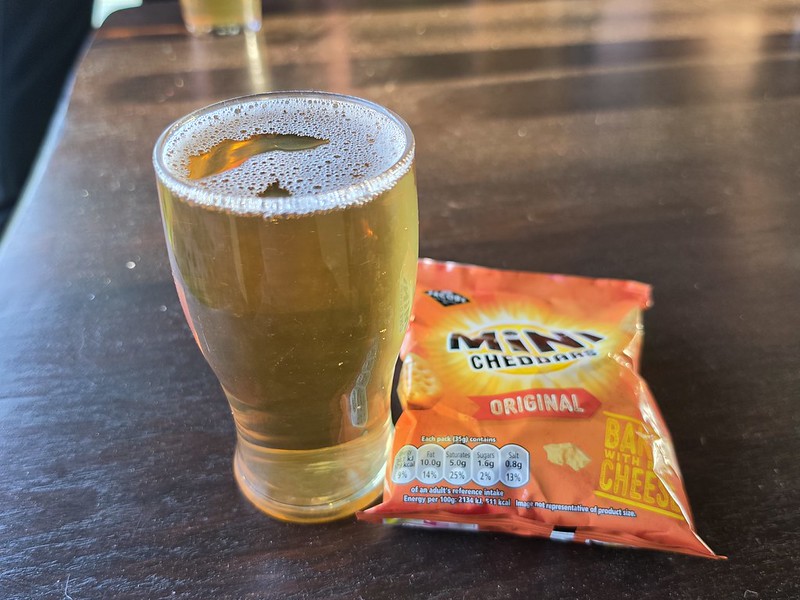
    The local beer style is Kölsch, a top-fermented ale that is finished with cold maturation like a lager. I was amused that the city’s museum states that the glasses are like this as the beer gets stale very quickly otherwise, which doesn’t really excite me in a drink. As a beer, it hasn’t burdened itself with flavour, taste or depth. But it’s cold and crisp.

    The beer is served as 0.3 litres per glass as standard, they then mark off on the beermat how many drinks have been consumed. I went for two, even though that breaks my Untappd rule of rarely having the same beer twice in one place, just to add some excitement to the proceedings. I did the thing of putting the beermat on the top of the glass when I was finished.

    The service was efficient and routine, I was quite content with the value of the whole arrangement. But, the service for others seemed a little more brusque, the server managed to have a slight argument with two of the four tables that he was serving. One of the tables was a group of American tourists who said they wanted to sit by the window and the server didn’t want them sitting by the window, but I quite enjoyed watching the awkward manner when he took the order with everyone being a bit annoyed.

    The general reviews for the place are decent, although the service element gets just a 2/5 on Google which is really quite low. But it’s just such a high turnover place that I can see that the servers just want customers served quickly rather than have endless conversations with what mostly seemed like tourists.

    The food was quite expensive so I limited myself to the beers and they have kept the price of those moderate. The cost of the two beers was €5 and the server didn’t try and charge a tip, which seemed a little unusual but perhaps he thought I looked grumpy. Numerous reviews mention that the servers have to give some of their tips to the kitchen, but perhaps they focus on those eating food rather than having two beers. I didn’t try and visit the toilet facilities, but it seems that the attendant expects payment for using them. Imagine JD Wetherspoon trying that….

    It was an interesting place to visit, but it felt like a bit of a tourist trap to me rather than being anything authentic. For anyone serious about beer, there’s the relatively nearby Tipsy Monk bar which was operating to a very high standard of customer service and they also had the same Früh Kölsch beer on draft for those who want to try it.