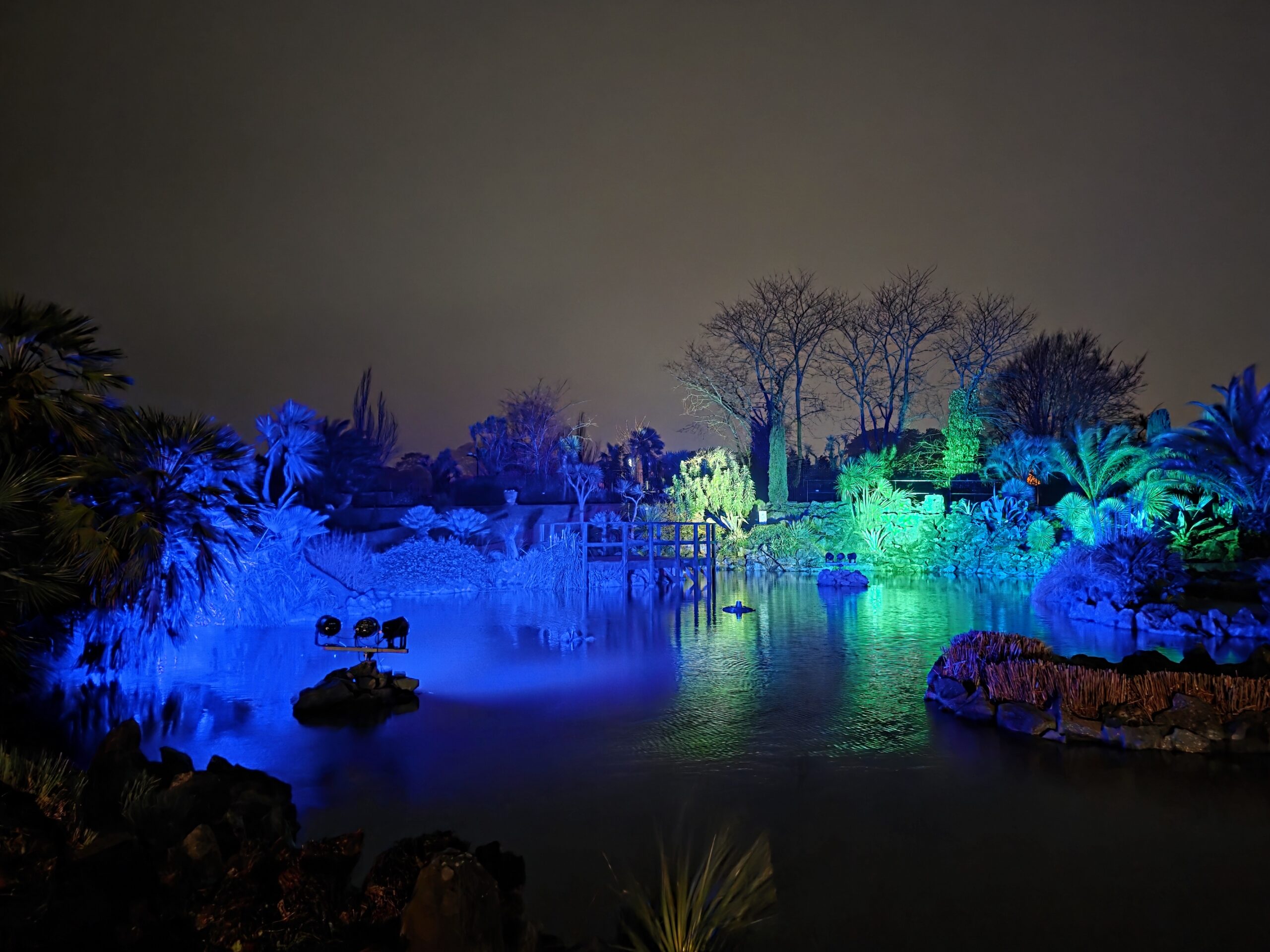
I thought that this looked rather lovely, it’s one of the ornamental ponds in Abbey Park, next to where the Grosvenor Hotel (as was) is located. The council showed some foresight when they bought this land, formerly part of the Torre Abbey estate, in 1924 and they paid the equivalent of over £1 million for it. Without their buying this, it’s likely that it would have been built on rather than being a little oasis of calm.
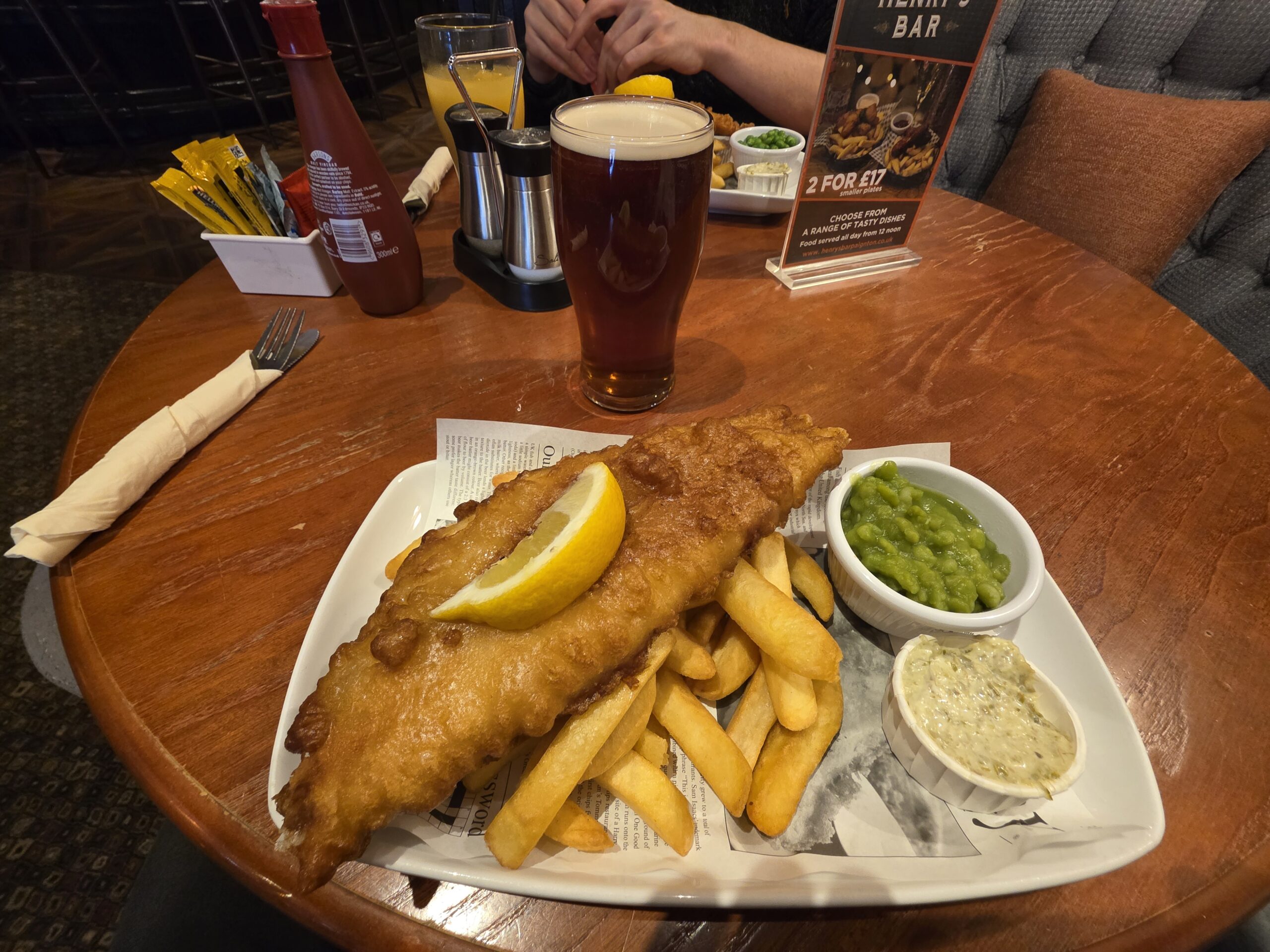
Ross wanted to relive his youth or something similar, so we bravely walked to Paignton (and back again) from Torquay and I hadn’t given much thought to the lunch options. I had a look at Google Reviews and Henry’s Bar was very well reviewed and I was craving fish and chips, so I opted for that. I was surprised and delighted to discover that it’s the only pub in Paignton which is listed in the Good Beer Guide, so that’s another one ticked off.
It’s not a new venue, the Torbay Express wrote an article about the new venue in November 1984:
“The cheerful bright red of Henry’s Bar heralds a new type of place to eat and drink in Torbay.
This upmarket combination of wine bar plus traditional beer-selling free house is the idea of Mr Ray Shermon.
“It is a really nice place for people to meet friends,” says Mr Shermon of his bar in Paignton’s Torbay Road.
Henry’s Bar, with its wide variety of food and drink, is certainly family-fun. Mr Shermon’s wife, Gerry, daughter Maxine, 18, and James, 14, are all involved in the business.
Even the name – Henry’s Bar, has family connotations. Henry was the name of Mrs Shermon’s late father.
Mr Shermon is not new to the food and drink trade. He bought Henry’s Bar, then La Taverna, having sold The Patio Restaurant across the road.
He and his wife have run La Taverna since July, but, after a total refurbishment taking three weeks, the old restaurant is unrecognisable.
The colour, inside and out, is a welcoming red, with red cushioned seating round the walls and padded stools of various heights.
There is a curving bar, a traditional style of carpet and attractive touches such as old-style lighting, a fan and mirrors, not to mention modern central heating.
This, combined with unusual arches, makes for a smart but comfortable atmosphere in a bar which would be ideal as a starting place for a late night outing.
Mr Shermon, who opens in normal pub hours, is aiming for an all-year and not just seasonal trade, and Henry’s Bar should attract people not only in the evening, but also at lunchtimes.
“It is a place not only for youngsters, but for everybody,” says Mr Shermon.
Henry’s Bar serves a good range of drinks, beers, a variety of wines and spirits. Mr Shermon also has a number of coolers to offer, including peach, cherry and apricot flavours.
Food is served until half-an-hour from closing time, and there is certainly something for everyone on the menu.
There are basket meals including chicken, pot meals ranging from curry to beef stew, and Sunday lunchtimes would be a good time to visit Henry’s Bar.”
There was another article in 1987 which mentioned that Tetley’s Bitter was 60p a pint and Castlemaine 4X was 70p a pint, although they were special prices as there had been a refurbishment. Steak & kidney pie was available for £1.95, pizzas were from £1.75 and a jacket potato was 75p.
Later that year there the venue was put up for sale at an asking price of £395,000 which seems high to me, I’m not sure that they’d get much more than that now, nearly 40 years later.
The interior which I felt had plenty of character and atmosphere. It was relatively quiet when we visited, but I can imagine that this gets very busy during the warmer summer months. There seemed to be some party of dog owners when we visited, but the pub does welcome dogs but has some sensible rules about they shouldn’t bark, they shouldn’t be on seats and they shouldn’t disturb other customers, which is all very reasonable. Not that this stops some customers complaining when they’re told not to let their dog on the seating, which is a selfish thing to do in any regard in my view, but the venue responded professionally:
“I can only apologise for the way that this situation was handled. We do love the dogs visiting us, but you must appreciate, that not everyone does. That, coupled with the fact that we have just been re-upholstered, has made us request that all dogs “paws stay on the floors”. This signage is scattered throughout the pub, but obviously not on the front doors, as you have highlighted . I have arranged for a new sign to be placed here too.”
This is part of the reason why companies such as JD Wetherspoon just ban dogs entirely….
The beer selection, I’m not much of a fan of Doom Bar from Sharp’s Brewery, but it is a sort of local beer given that it’s from Cornwall. I went for the Sea Dog from Teignmouth Brewery, it was malty and smooth, rather agreeable. There’s normally a wider range than just two real ales, but it felt sufficient for a quiet weekday afternoon in February. The service was efficient, polite and prompt, so I felt that we were made welcome.
The fish and chips which was served with mushy peas, all nicely presented and at the appropriate temperature. The chips were firm on the exterior and fluffy on the interior, with the tartare sauce portion being generous (this is important to me, I have a slight obsession with tartare sauce and I can’t be doing with silly little pots). The batter was crispy and had a depth of flavour and the fish itself was of a reasonable quality, so all good.
I was very pleased with the whole arrangement given that the beer choice was reasonable, the food was rather lovely, the service was friendly and the environment was comfortable. And that was 100% of all Good Beer Guide pubs in Paignton visited in one go.
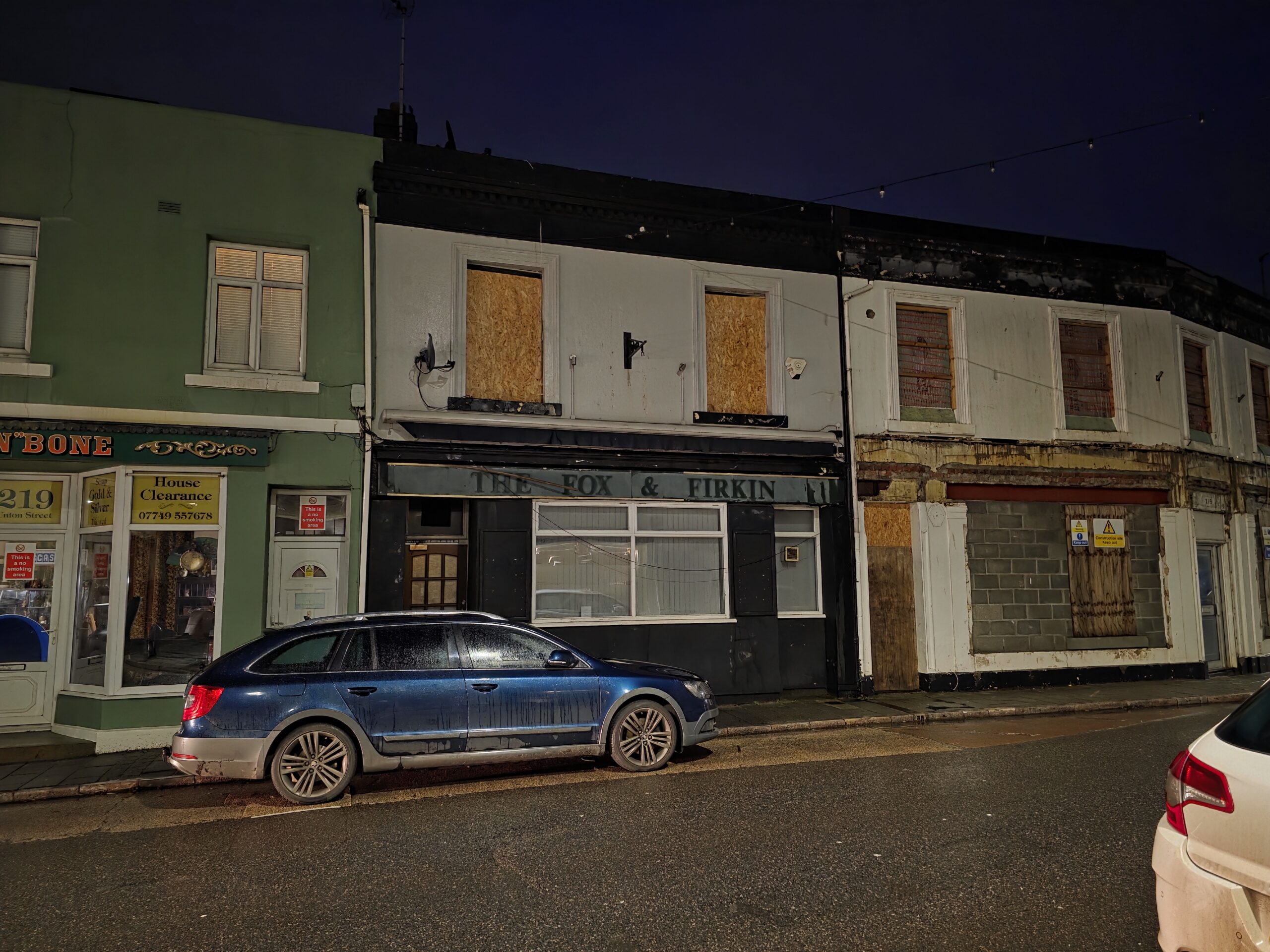
Well, this is the total of the pubs that we visited in Torquay itself, the eleven isn’t the total number of pubs but it does include the Good Beer Guide ones and the more notable ones. There are a couple of pubs quite close to each other, the Printers Elbow II and the Fox and Firkin, which have both unfortunately closed. On that topic, there are concerns that the Good Beer Guide listed and likely the oldest pub in the town, the Hole in the Wall, might well close soon as well.
The Clocktower offered some really affordable drinks in a comfortable atmosphere, whilst the JD Wetherspoon had the most real ales and the lowest prices in the town. The Rabbit Hole is an attempt to do something different in a troubled part of the town, the owners have recently taken over a venue that had been shut down due to licensing concerns. But, my favourite of them all, TQ Beerworks Taphouse, which had the best craft beer selection and offered a friendly and engaging welcome. All very lovely.
This pub at the top end of Union Street closed in 2023 and has now been sold, quite cheaply by the looks of it, with the chance of it remaining a pub being slim. CAMRA note that it was known for its cheap beer and community feel, including its darts team. There’s an article about the pub closing and also an internal photo of the bar area at https://www.devonlive.com/whats-on/whats-on-news/seaside-pub-flat-up-grabs-7179424. The price that it looks like they got wasn’t a vast amount higher than the £110,000 that the pub sold for towards the end of 1998.
As an aside, in 1998, The Torbay Express reported:
“The Torbay Combination League has thrown out and fined First Division side Fox & Firkin £300. And they have sent Devon FA a list of 28 players registered with the Torquay pub team, which could lead to bans from playing all forms of football until the money is paid. “Hopefully it won’t come to that, but we’ve had enough of the Fox & Firkin,” said league secretary Bill Matthews. The overall fine includes £200 for being kicked out, and £100 for not paying previous fines imposed for failing to raise sides, send in match cards and telephoning results of home games.”
My favourite bit they added was that they turned up to one match with eight player but four of those had gone home before the end of the game. It’s always a shame to lose a pub, especially as it’s very close to the Printer’s Elbow II which is also currently closed.
It might not be the height of culinary decadence, but I do like an ‘all you can eat’ Chinese. And it’s an easy sell to Ross, so on our final night we traipsed up a big hill to get to the Oriental Touch which has been trading from here for over 15 years. Before it became a restaurant, it was the Top of the Town pub.
We arrived a bit earlier in the evening to try and avoid the rush, but it was already packed primarily with larger groups. We waited in the queue for around five minutes before we were called forwards as although we didn’t have a reservation, they did have a table for two. It was slightly cramped, but you don’t really come to a restaurant like this for the surroundings. The ordering process requires advance payment before being seated, which does speed matters up at the end of the meal. I felt sorry for the waiter who was helpful but had three groups complain that the wrong drinks had been brought over. It transpired, as I listened in, that all three groups had actually ordered incorrectly but the waiter was endlessly patient.
What was it that Jay Rayner said about the best foods being brown? He’s right, here’s chicken cooked in various different ways and what more could I want?
The two counters of hot food.
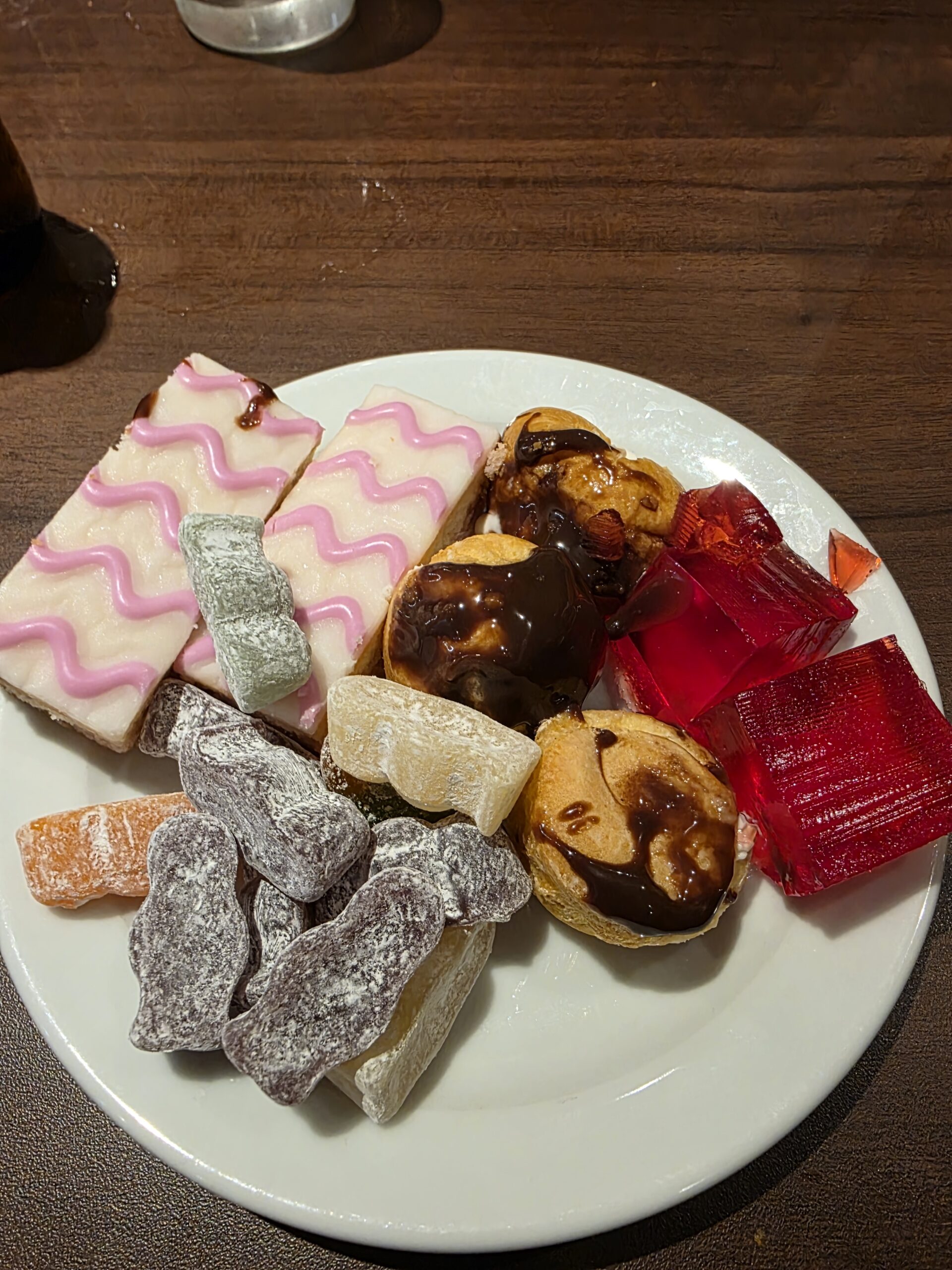
The desserts section.
There we go, there’s some green to add to the arrangement. It’s called seaweed, although I think this one was just salted fried cabbage. I ordered a Tiger to go with the meal, which was smooth, light and all that. The quality of the food was generally high, the meat was tender and everything was at the appropriate hot temperature.
The height of fine dining……
I’ve never quite understood why more restaurants don’t operate on this model as it makes it much easier for the kitchen to just bring out food when it’s done and there’s a reduced demand on waiting staff. I accept the huge cost of ingredients, but looking around, most people were relatively restrained. It’s obviously working for this restaurant given how long they’ve been here and seeing how busy it was on a Thursday evening. There’s a sign that the restaurant reserves the right to charge for food which is left, but I suspect that’s a warning shot rather than something that they actually try and do. The wastage must be challenging for the owners to deal with, I suspect it’s relatively high and perhaps one of the reasons that there aren’t more restaurant like this.
There’s the odd complaint such as:
“Cold food, chaotic experience and multiple things that could actually HARM PEOPLE! My wife is a Chef and she said there are multiple things that could be harmful, like the unrefrigerated profiteroles because of the warmed up cream.”
The venue is five star food hygiene rated and I’m more concerned that a chef thinks that profiteroles can’t stand in a cold refrigerated area and the speed in which they were eaten meant that they were hardly there for long. I didn’t see anything that harmed me at least….
The meal cost £16, which I thought was rather agreeable although I found that the portion sizes were too large but I can’t really blame the restaurant for that. The on-line reviews are very positive for a restaurant set-up like this, with the service being highly regarded as well as the value for money. Although we got lucky, I think it would be sensible to book a table in advance here given its popularity. All rather lovely.
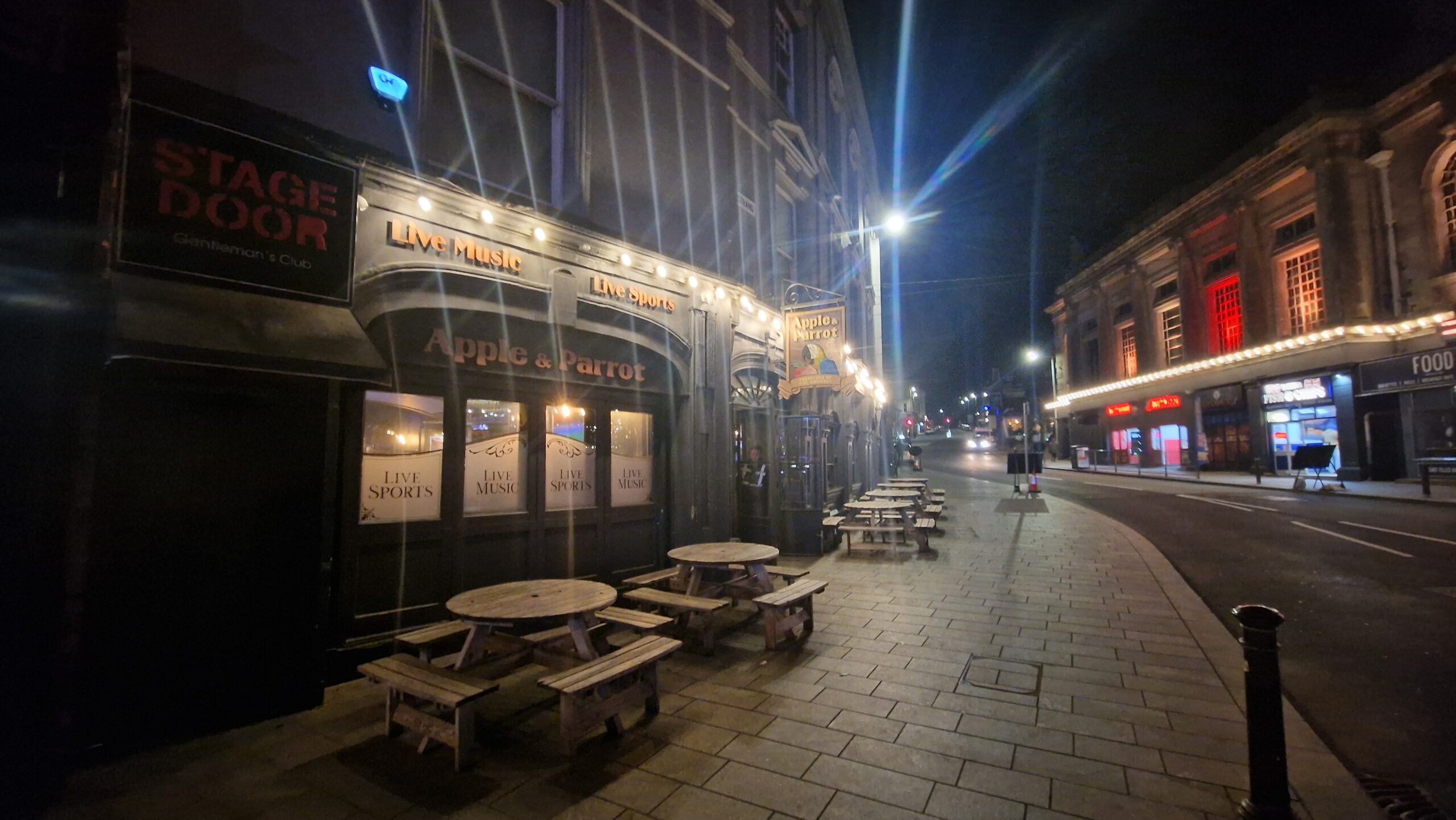
The outside of the Apple & Parrot, known for its live music and sports that are shown on the TV, which has been trading since 2010. The venue has door staff it seems on most evenings, but they’re open until 03:00 every day of the week which explains their frequent presence. The venue was previously known as the Royal Vic Lounge and then it became the rather decadent and fancy Cafe Royal in the 1980s.
I’m always happy with this, especially when there’s an orange slice in it. There aren’t any real ales available, but there’s been a sort of effort made to have a variety of keg beers on. The service was friendly and polite, with everything feeling clean and well managed.
The stage area where there’s a fair amount of live music played. There’s a pool table down the stairs and more space upstairs, so it felt quite spacious, although that was when it was a quiet weekday evening in February. They don’t offer food themselves, but they have an arrangement with a nearby third party which specialises in chicken related items, the same provider as the nearby Yates. The on-line reviews are a bit mixed, there seem to be a lot of issues with their door staff, although there are usually two sides to stories relating to those.
I rather liked this venue, it felt safe and had a certain amount of atmosphere without getting too vibrant. The drinks range was reasonable, the service was friendly and things felt generally clean and organised.
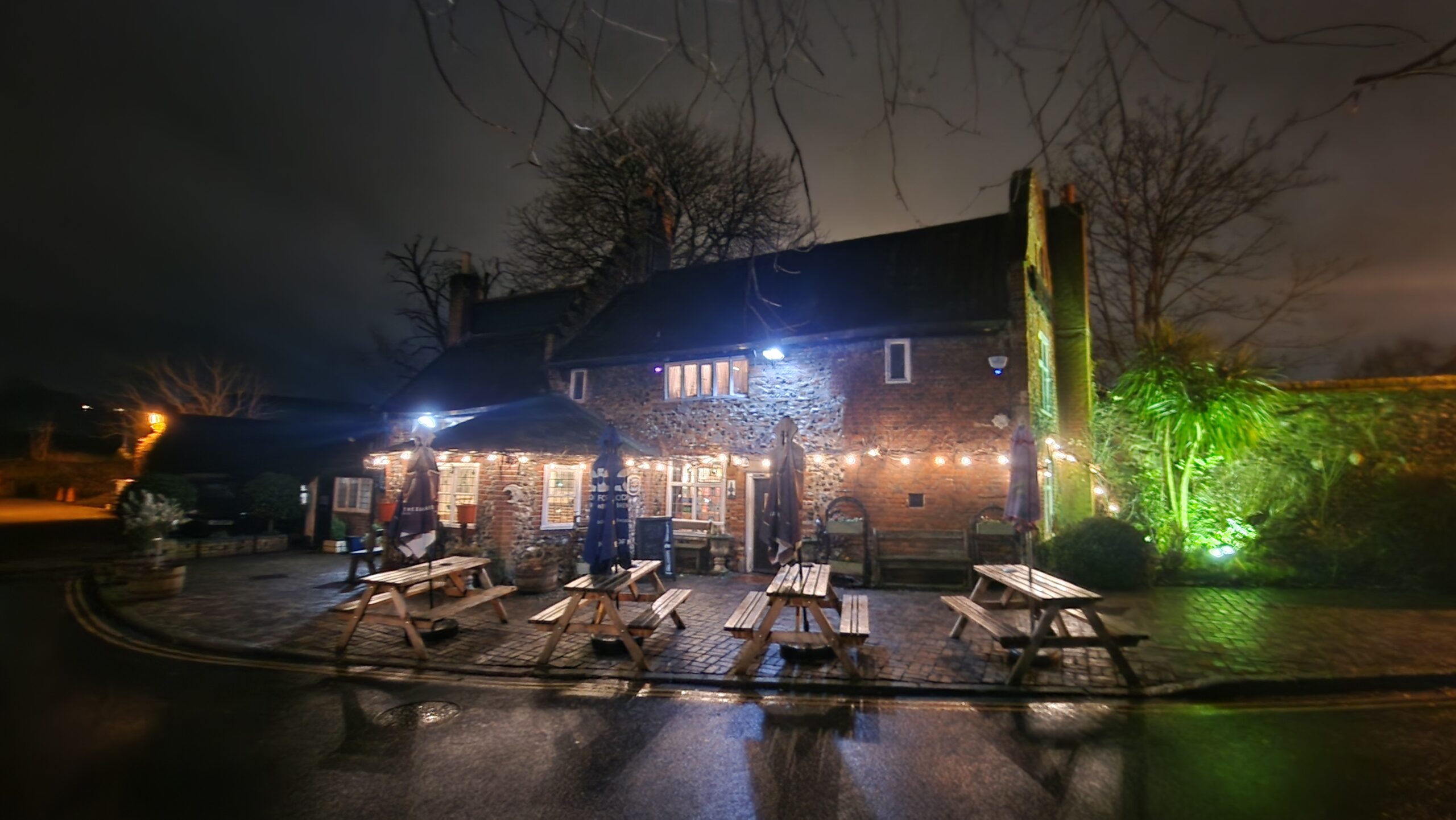
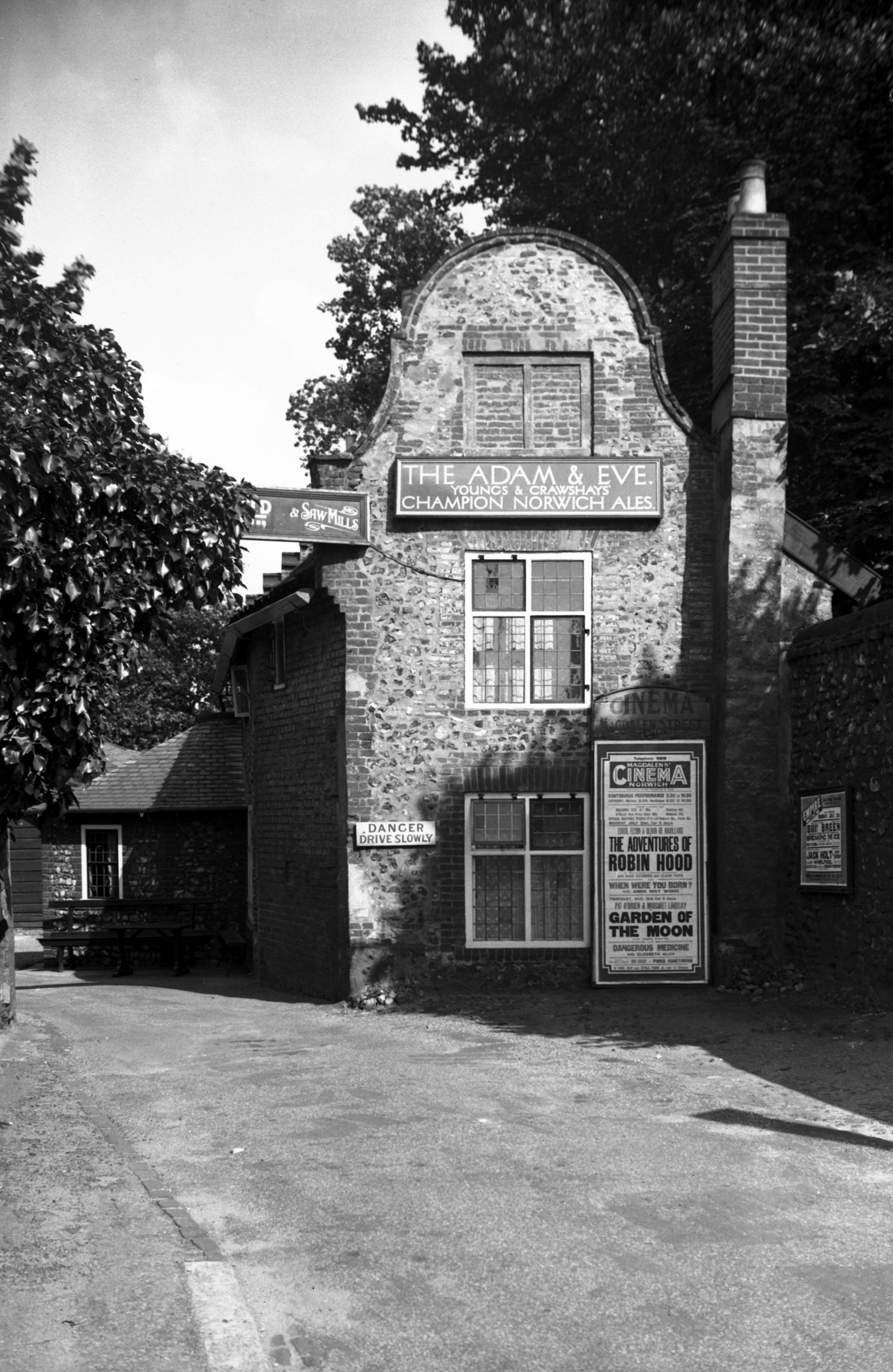
Apologies again for the quality of these photos, they were when my previous phone was having some difficulties…. Anyway, they’ll do. The Adam Eve is located near to Norwich Cathedral, it has a reputation for being an old pub and the owner Rita will have been there 25 years this year which is some going. This was part of our perambulations around Norwich pubs.
This pub is widely claimed to be the oldest in Norwich and there is evidence that there was a building here in the mid-thirteenth century and a suggestion that stonemasons building the nearby Norwich Cathedral would have been drinking here when there was a brewhouse on site. The current building is though seventeenth century, although altered quite substantially in the twentieth century. The pub was the last in Norwich to serve directly from the barrel until a bar was added in the early 1970s. The owners have been Youngs, then Bullards, then Watney Mann, then the Norwich Brewery and then Chef and Brewer before it came into private hands. In December 1902, Youngs, Crawshay & Youngs (to quote their full name) advertised the pub as available to let and they noted the full licence, good yard and stabling. They seem to struggle with this as they were still advertising the pub using the same terms in January 1904 and they then started again in 1906.
There are fewer newspaper articles than I would have expected about the pub, just quite a lot of inquests that were held here, which was commonplace in pubs. One is of note, a 14 year old boy called John Boltz who drowned in the River Wensum in a location very close to the pub. The landlord in 1814, Matthew Peacock, was declared bankrupt and it was noted that his furniture was for sale, “including a four-post bed, other bedsteads, feather beds and bedding, sheets, table linen, a panelled sliding partition, a thirty hour clock, kitchen range, bath stove, copper and furnace, liquor cases, hand lights and all manner of other stuff.”
As an aside, I had to ask Google Gemini about that clock and it noted:
“Thirty-hour clocks are clocks that need to be wound every 30 hours, as opposed to the more common eight-day clocks that only need to be wound once a week. They were most popular in the 18th and 19th centuries, and they are now considered to be antique clocks. Thirty-hour clocks are typically weight-driven, which means that they are powered by a weight that is suspended on a rope or chain. 1 The weight slowly descends as the clock runs, and it needs to be wound back up every 30 hours.”
This video is from 1984 and is worth a watch, with a customer saying they went there to get away from technology……
The bit of the pub we were able to sit in, which is the section near to the entrance which overlooks the road. It was a little chilly inside, although that had no negative impact on me. The toilets possibly needed a little attention, but all else seemed to be in order. There are some old photos of the pub on the walls as well to add a bit of character.
As Julian noted, the area down the steps was just for the chosen ones, so there was a bit of a pile up in the small bar section that was open. I’ve never actually got as far as going down those steps, I think all of my visits I’ve ended up in this section of the pub. The pub’s web-site isn’t available at the moment, but the old one mentions that the building is haunted, adding:
“The ghost of Lord Sheffield – hacked to death nearby on August 1st by rebels – is still reputed to haunt the building. So too are spectres of some of the French speaking medieval monks who lived and worked here. Somewhere below you, one monk is believed to be buried!”
The bar area, which is just a little cramped for the poor bar staff (not that there’s much anyone can do about that, they’ve done well to carve out what space they have), and I think it’s linked to the lower bar that I’ve never got to see. The on-line reviews are unusually mixed for a traditional pub and a couple have queried why they weren’t allowed to have a look in the lower bar area, especially as there’s apparently evidence of an old Saxon well down there. I kind of understand that, it’s one of the oldest pubs in Norwich and I think it’s inevitable that customers might want to have a little look around. I think I’d rather let others read reviews directly if they so wish rather than me pointing any out.
The quality of that photo, my apologies…. The beer is one of my favourites, Old Peculier from Theakston and it was malty and smooth, kept well. There are usually around three real ales available and I think the standard of beer keeping is very high.
It’s not really a pub I’ve ever much engaged with, but the service has always been polite and I’ve eaten outside a couple of times over the last decade as they have some external tables. It’s worth a visit for anyone interested in the history of Norwich pubs as it has played a large part in that story. It’s certainly not a pub for Julian as it closes at 21:00 (22:00 on Fridays and Saturdays, 18:00 on Sundays) and he’s normally not out until after then. Anyway, back to anyone running a pub for 25 years, that shows some considerable commitment and energy, so congratulations are clearly in order. And Julian and I were disappointed not to see the ghost of Lord Sheffield, as that might have put me off my beer.
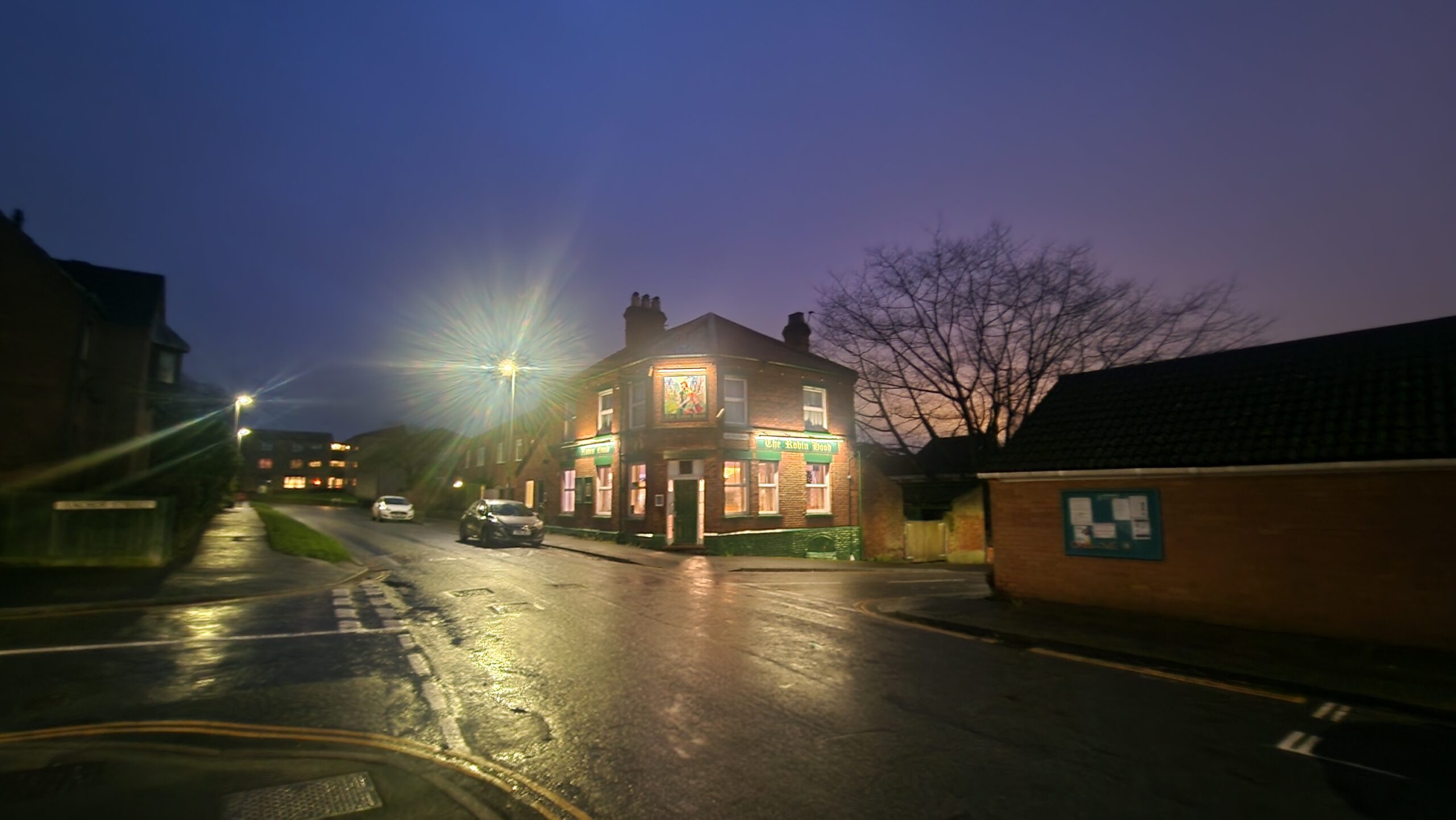
This visit was from a few weeks ago (as part of our Two Julians tour of Norwich since we’ve already straddled great chunks of the Waveney), when we meandered to the Robin Hood pub located near to the Cottage and also not far from Barrack Street.
There has been a pub with this name since the mid-eighteenth century, but it was in a different location. Here’s an early 1880s map of where it was, with the pub looking out onto Barrack Street and there was no shortage of other pubs along that street. Soon after this, the pub was moved to its current new purpose building which faces onto Mousehold Street. It then became a Watney Mann, then Courage and then Pubmaster pub. It’s somewhat of an unlikely survivor as it’s tucked away on a back street and indeed it has been closed for some short periods over the years.
In the Eastern Evening News in January 1884 it was reported that the landlord, Frederick Marcon, had gotten himself into some trouble.
“Frederick Marcon of the Robin Hood public-house, Pockthorpe, was summoned for assaulting Stephen Curl, Barrack Street, fish-hawker, on the 27th inst. Mr. Linay appeared for the prosecution, and Mr. Sparrow defended. The assault was committed on Sunday evening last at the Robin Hood public-house. It appeared that Curl, accompanied by his brother and a man named Hicks, went to the Robin Hood. Defendant’s brother was also present, and without any provocation whatever struck complainant’s brother, causing him to be thrown to the ground. On his getting up defendant continued the assault by seconding his brother’s efforts, and on complainant going to his brother’s assistance, he was struck on the cheek and nose. Complainant was also thrown to the ground, and while in that position both the Marcons kicked him. The two companions of complainant were also called and corroborated. For the defence, Mr. Sparrow called defendant’s brother who said that one of them ordered some ale, but this was refused by his brother on account of their being “half drunk.” Defendant then asked them if they had come in for a row, and they replied with an oath that they had come with that object. The three then commenced on witness, and when defendant tried to protect him he was also struck. Hicks it appeared remained neutral, for he took up his position in a corner and watched the proceedings. The two Curls were eventually removed by their father and mother.
William Curl, brother of complainant, now charged the defendant Marcon with assaulting him at the same time. Curl was thrown to the ground, and while in that position he was kicked by Maroon on the head. Stephen Curl, the first complainant, also preferred a charge of assault against Thomas Marcon. Defendant hit him once in the cheek, knocked him down, and kicked him in the ribs. William Curl also charged Thomas Maroon with a similar offence. Curl alleged that Maroon struck him on the lip, the result of which was that he fell to the ground. Mr. Sparrow now urged that it was positively absurd to suppose that a landlord and his assistant should on the appearance of three customers immediately strike them, especially when there was no provocation to warrant it. The Bench then retired and on their return into Court the Chairman said that after carefully weighing the evidence in their minds they had come to the conclusion that they ought to convict. The defendant Marcon would be fined for the assault upon Stephen Curl 10s. and 15s. costs; in default, fourteen days’ hard labour; and for the assault on William Curl, a fine of 5s. and 9s. costs would be inflicted; in default, fourteen days. Thomas Marcon, for assaulting Stephen Curl, would be mulcted to the amount of 10s. and 7s. costs, in default 14 days; and for the assault upon William Curl, his brother, a fine of 20s. and 7s. costs would be imposed; in default 14 days.”
Probably a little sub-optimal for the pub landlord…. Fortunately, the welcome when we arrived at the pub was much more engaging from the current staff member although the venue did get in the news around three years ago when there was some considerable controversy relating to charitygate, but I’ll let individuals Google that if they so desire as I don’t think it relates to the current owners.
Some of the beer selection.
I went for the John Smiths and it tasted as expected and was reasonably priced. I also always appreciate when a pub stocks Mini Cheddars.
The pool table rather dominates matters in the main room, meaning they have to sit carefully around the edges of the room as is visible from the above seating, and then there’s one other smaller room. There’s a strong community element to this venue and the darts and pool teams are important to them. There was a bucket to catch the drips from the leak upstairs, but the staff member did apologise for that arrangement.
Julian looks enthralled, but he’s not really a TV in pub type person. Indeed, nor am I, but it added some musical entertainment to our visit. There is karaoke every Sunday afternoon and although this is evidently not going to encourage me in, it looks like a popular event. The TV must be a recent addition as the then owners were telling the EDP in 2023 that they were proudly a TV free zone. Since I always have a little look at on-line reviews…
“Came here with the pool team just too find out that it’s not child friendly, the owners allowed our captains child in for this time (via phone call) fair enough. Then get told the child can’t just press buttons on the fruit machines (not actually gambling/playing) anything because of licensing, for your information review the licensing laws on gambling as you clearly don’t know the laws and it’s not against the law for kids to be in a pub after a certain time it’s just a in-house rule, get out of your 1920’s pothole and get with the times.”
There’s one quite, er, direct review that the pub probably quite rightly didn’t respond to. I recall long ago when getting my licence that the law is quite clear that children shouldn’t be using these AWP machines in any shape or form, so it’s not unreasonable for a landlord to ask children not to play on them even for fun. And it is against licensing law for kids to be in a pub after a certain time if that’s what their licence says. Anyway, nearly all of the other reviews are positive, so as to add some balance.
It’s a pub that is off the beaten track and so is very much a community pub, but the welcome was friendly and clean, although it did need something of a refurbishment in places. All rather lovely, it’s worth popping in for anyone nearby.
I can’t recall eating at a Harvester before and after checking, there aren’t any in Norfolk with the nearest being in Lowestoft and Ipswich. And, when I heard that every meal comes with a free all you can eat salad bar I was entirely sold and it didn’t much to persuade Ross who eats too much salad.
I had downloaded the app in advance of the visit and it was this offer that tempted us. It’s advertised in the venue itself, but they do need to see the app to be able to scan the code which I can imagine annoys a few people. Fortunately, I was prepared and ready…. We were seated promptly but our order wasn’t taken for over ten minutes, which seemed a lifetime when the thought of all you can eat lettuce was on my mind.
The salad bar and there was also bread, butter, dressings and most importantly of all, olives. Indeed, I managed to get through all the olives in the container which I was quite pleased with, I like to complete things. Now, if there were pickles as well then this might have gone up just another notch…..
My third salad bowl with some of the olives all covered in a Caesar dressing.
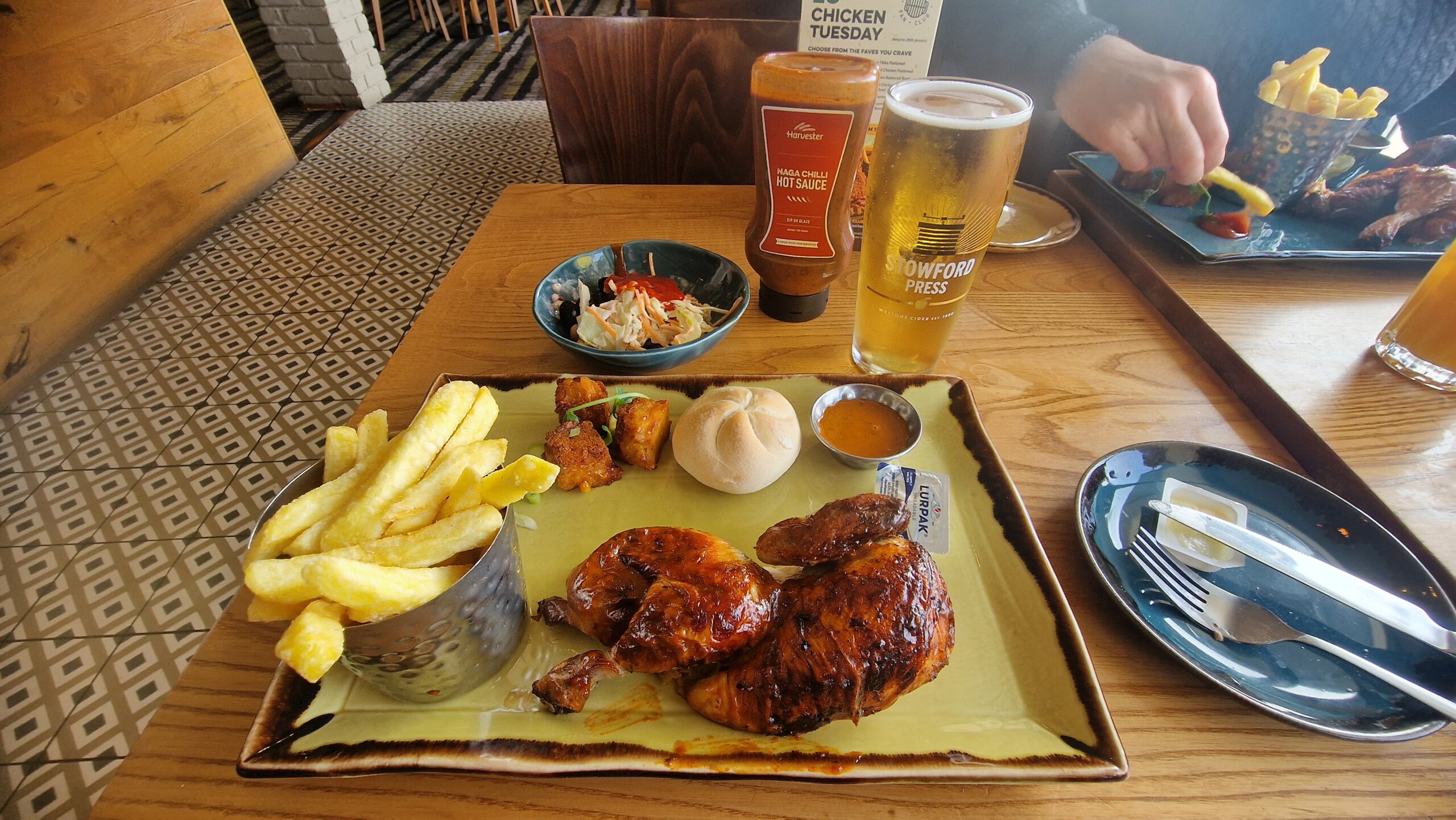
The main event, the half roast chicken with fries and sweetcorn fritter type things. I had the naga chilli dip as I like a bit of spice, but I also just brought the bottle over as well to add to the whole arrangement. The chicken was tender, moist and plentiful, with the fritter things adding texture to the meal. The chips were also firm on the exterior and fluffy on the inside, with everything at the appropriate temperature. I went for a pint of Stowford Press as some variety from having beer. It wasn’t the best cider I’ve had, but it was entirely drinkable.
Looking at the on-line reviews, they’re high for a chain restaurant, so it seems that most customers leave happy and content. I had a little look through the reviews and there was one customer that was apparently near to a panic attack because of the service…. Anyway, I liked the restaurant’s reply:
“I am very sorry to read that you did not enjoy your visit with us and even more sorry than you felt you couldn’t either ask to speak to the manager to discuss your concerns or contact us directly after leaving rather than posting your comments on, not just 1 but 2 social media platforms.”
They have a point….
“Today, after my family had dinner, Jamie started sorting out our plates. While he was stacking up the plates, he asked me if I could put my leftovers on top of the plates. And I was like, “Sorry?” He just repeated what he said and added “because I don’t want to touch it (pointing on my leftovers).” He already sorted out our used utensils, so I had no choice but to pick up my leftovers barehandedly… I just felt like it was rude”
That’s sub-optimal to be fair to the customer….
“Was greeted by a very stuffy, sarcastic member of staff who enquired as to whether I had booked. I said I hadn’t and did not realise that you needed too as I just walk in my local Harvester. With a snort, she retorted well Torquay is a major holiday destination in the summer and you can’t just walk in. No problem, I’ll walk right out again.”
I suspect the restaurant wasn’t too concerned….
“Told staff allergic to jalapenos make sure none on nachos still found one hiding under salsa brought it up with waitress she couldn’t have cared less complete joke !!!! Rest of food was of good quality. Maybe they should show an interest in customers food requitmrenents as eating this jalepeno would have put one of us in hospital”
Highly undesirable, although the restaurant was hugely apologetic.
The team member apologised that she forgot the checkback (pro-actively, I didn’t complain) but I think she was Polish, so I decided that she was inevitably forgiven for that as I’m just a bit pro-Polish. The surroundings were generally clean and the venue was surprisingly busy for a weekday lunchtime, so they’re clearly doing quite a lot right. And because the salad bar had all the olives I could eat, I was entirely happy. I’d go again, the whole set-up was actually better than I expected and it’s a much more popular venue than I had anticipated.
This was one of the highest on-line rated Indian (I’ve defined this as Indian, but I accept that they also describe themselves as a Bangladeshi restaurant) restaurants in Torquay, located in the Torre area of the town. We were welcomed warmly when arriving and although there’s limited seating inside, we were offered a larger table between the two of us, which I always think is a nice gesture. Although, other than the two diners already there when we arrived, there were no-one else dining inside for the rest of the evening and I had thought it might be a little busier, even on a drizzly Wednesday evening in February. In recent years, this has gone through all manner of name changes and it’s been Lucky Choice Chinese, the Hong Kong Express, the Thai Kitchen, Kim’s Kitchen, Thai Chef and then from early 2024, Biryani House.
The menu.
The poppadoms which met my expectations, I very much like pickles in the little selection of dips, exciting options such as lime pickle are missing from this line-up too often. So, as I’m easily distracted, I asked Google what dips and chutneys should be served in an Indian restaurant and it came back with:
“Mango Chutney: This sweet and tangy chutney is a classic pairing with poppadoms. Its fruity flavour balances the crispiness of the poppadoms. Mint Raita (or Mint Sauce): A cooling and refreshing dip made with yogurt, mint, and sometimes coriander. It provides a nice contrast to spicy dishes. Onion Chutney: This often features finely chopped red onions, and it can vary from sweet and tangy to spicy. It adds a sharp and flavourful element. Lime Pickle: This is a very strong and spicy pickle, that adds a very powerful sour and hot flavour to the poppadoms.”
This is effectively what this restaurant offered, hence my satisfaction.
It’s always handy to have vinegar to hand in an Indian restaurant. I fully understand their practical benefits, but I didn’t much like the plastic covering over the tablecloth. I had thought that this traditional look was because they’d been here for years, but this is all newly set out as they only relatively recently took over.
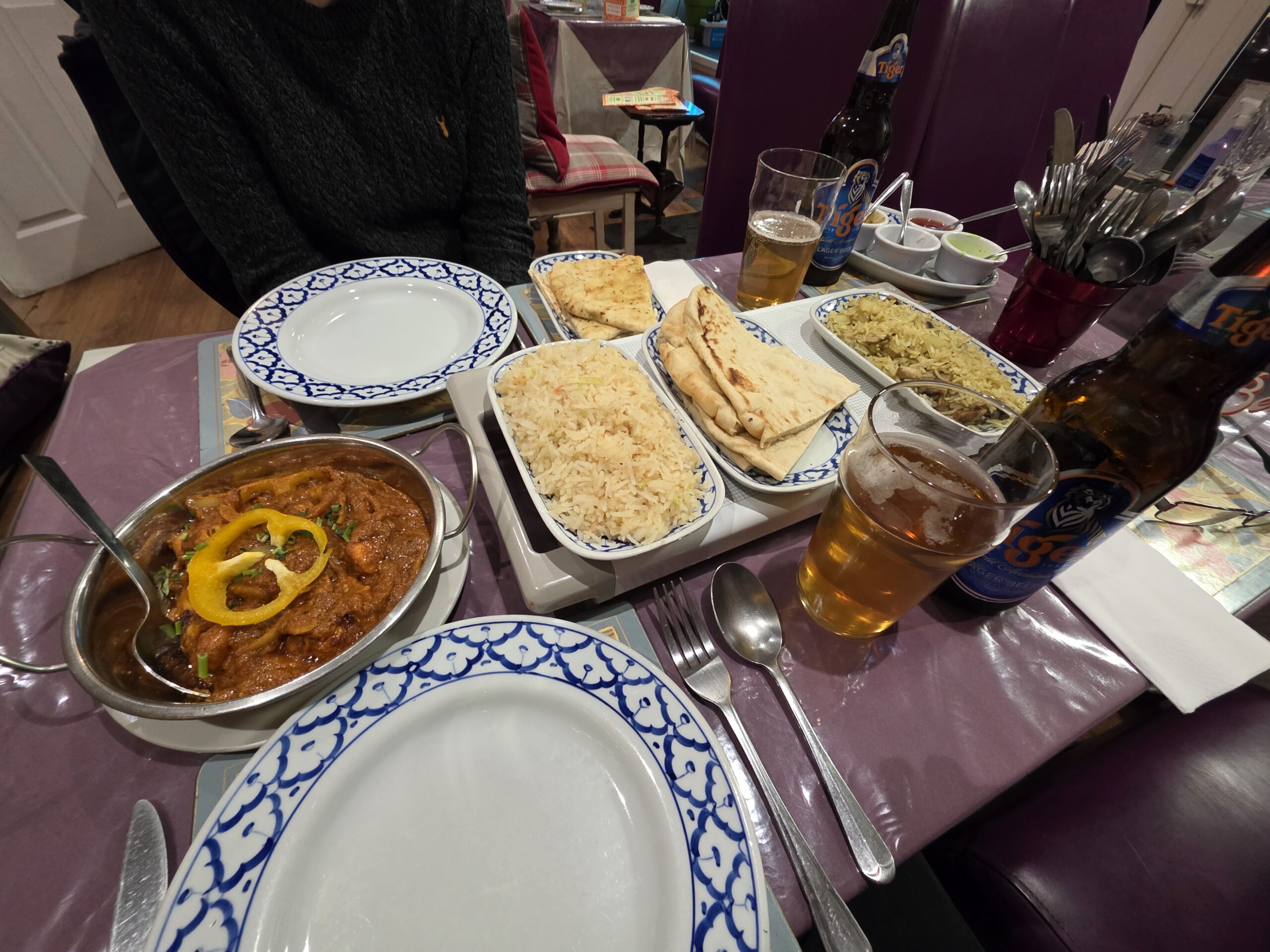
There was some Bollywood entertainment going on. The Tiger beer tasted as expected, it always feels more acceptable when having south Asian food.
I went for the chicken jalfrezi, coconut rice and plain naan. The portion size of the curry was generous, with plenty of tender pieces of chicken breast. There was some spice in it, although for my own taste I would have liked more, and it had a depth of flavour, a very serviceable curry. The rice was fluffy and coconuty, but the naan bread was a bit moist and seemed more microwaved than cooked in a traditional Tandoor oven. Not that I’m expecting a small restaurant in a Torquay suburb to have a large Tandoor oven going, but it should have perhaps been a bit firmer.
The interior of the restaurant and it’s fair to say that they haven’t aimed to be on-trend here. Although we hardly stretched the kitchen with our order, they did get a couple of delivery orders through when we were there.
There was a free Sambuca shot at the end, which I of course accepted, and I was surprised that Ross did as well rather willingly. The couple at the table next to us had struggled through theirs and I heard them comment privately it tasted cheap, but I thought it was quite smooth.
Anyway, I thought this was a competent restaurant and I very much liked the welcome which I thought was authentic and warm. Ross was less impressed when the owner tried to help him put his coat on, but I know other people who would have liked that very much. One other positive is that they open during lunchtimes, something that seems to be quite rare at Indian restaurants in the UK. Anyway, all rather lovely and I hope that they do well.