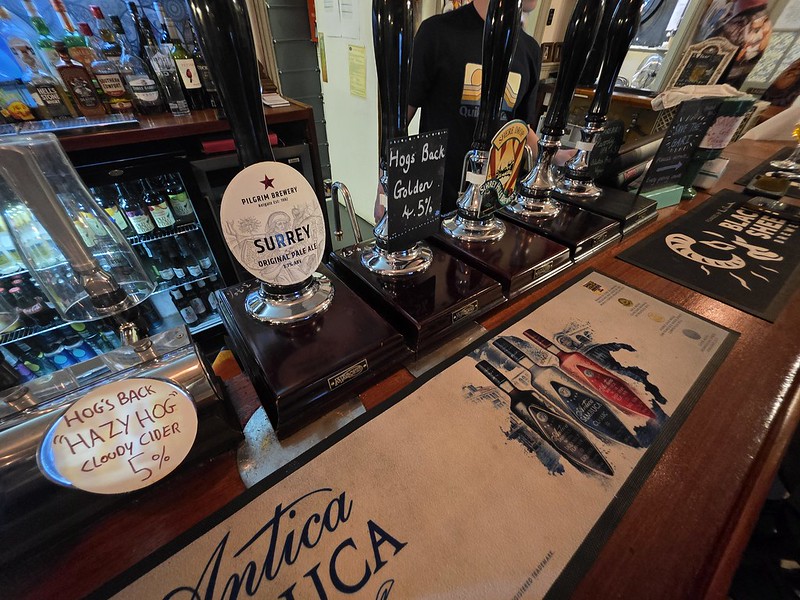
The Garibaldi is a Good Beer Guide listed community pub located on Mill Street in Redhill, with a bit of a walk up a hill required to get there.
What’s on at the pub and a few copies of the Good Beer Guides. This is a small Victorian pub and it was nearly demolished a few years ago, but the community took it on and have been running it on a not-for-profit basis. They have a large garden area which has views over the local area, which also gives them something of a boost in terms of the seating numbers given that they don’t have a vast number inside. The pub likely takes its name from Giuseppe Garibaldi, the Italian revolutionary who came to the UK on a few occasions and seems to have inspired quite a few people to name pubs after him.
There were four real ales available, mainly local options. The service was warm and friendly, with the pub being moderately busy when I visited albeit with one quite raucous group in.
There were also a few craft keg beer options.
I stuck with the real ale and my first half was the Surrey session bitter from Pilgrim Brewery, a well-kept, light, clean and rounded beer with a slight biscuit taste.
My second half was the Shere Drop from Surrey Hills Brewery, which was clean, light and had a slight fruit edge.
This is a well-reviewed pub online and it does have a rather welcoming community feel to it, something perhaps evident by their meat raffle. Since 2017, it has been run as a community project on a lease from the amenable owner, but they’re now trying to buy the freehold to ensure the venue’s long-term viability and the MP, Rebecca Paul, mentioned the purchase of the pub in the House of Commons. It might not be the most central of pubs in the town, but it’s worth a walk up the hill to visit.
Well, this is the total of the pubs that we visited in Torquay itself, the eleven isn’t the total number of pubs but it does include the Good Beer Guide ones and the more notable ones. There are a couple of pubs quite close to each other, the Printers Elbow II and the Fox and Firkin, which have both unfortunately closed. On that topic, there are concerns that the Good Beer Guide listed and likely the oldest pub in the town, the Hole in the Wall, might well close soon as well.
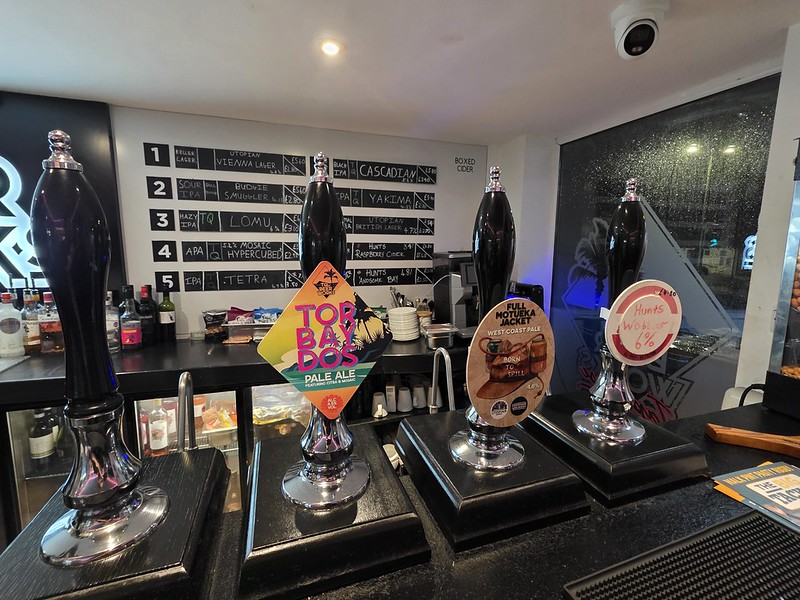
The Clocktower offered some really affordable drinks in a comfortable atmosphere, whilst the JD Wetherspoon had the most real ales and the lowest prices in the town. The Rabbit Hole is an attempt to do something different in a troubled part of the town, the owners have recently taken over a venue that had been shut down due to licensing concerns. But, my favourite of them all, TQ Beerworks Taphouse, which had the best craft beer selection and offered a friendly and engaging welcome. All very lovely.
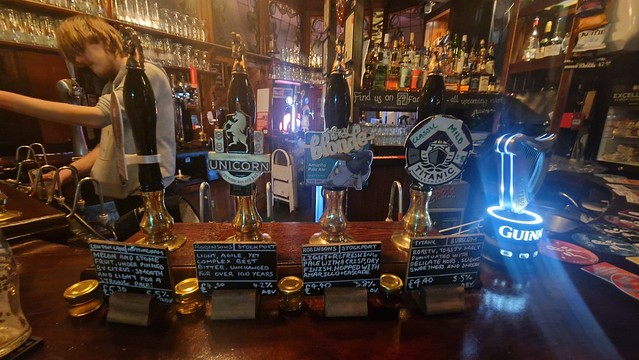
The next pub in my tour of Good Beer Guide pubs in Stockport was the Swan with Two Necks, owned by the local Robinsons Brewery. Robinsons started brewing at the Unicorn Inn in Stockport in 1849 and they’re still going, now owning over 260 pubs and inns in the north-west of England and north Wales.
It’s not common to see a pub now which still has outdoor toilets, but I thought it added to the authenticity of the place. Who needs expensive renovations? There has been a pub with this name since the late eighteenth century, but the brewery notes that it was rebuilt in 1926 which makes it an interesting inter-war survival. CAMRA are able to provide a useful background to the heritage of the pub:
“A long, narrow pub which has changed little since its rebuilding in 1926, just before it was bought by local brewers Robinsons. The interior is simply organised and the extensive use of wall panelling is typical of inter-war pubs. To the left of the tiled and panelled entrance lobby is the vault, with plentiful panelling, although much of it was actually added as recently as about 2009 (and now covers over a fireplace). The other door from the entrance leads into a drinking lobby, which is essentially an expansion of the corridor and faces the servery. Beyond this is the delightful smoke room which, with its Tudor-style fireplace and oak panelling, has a particularly warm and comfortable atmosphere. From the central lobby one can see the unusual feature of roller shutters which can be brought down to safeguard the contents of the bar-back shelves and, above the servery entrance, a notice saying ‘waiters’ from the days when waiter service was a regular feature in north-western pubs. A small room at the back came into pub use during the 1960s.”
As for the pub name, it’s all about swans. The historical significance of swans in England is closely tied to the monarchy and, for centuries, unmarked swans in open waters were considered the property of the King or Queen. This ownership was formalised through a practice called ‘swan upping’ where young swans were marked with notches on their beaks to indicate ownership. In the sixteenth century, Queen Elizabeth I granted ownership of some swans to two organisations, namely the Worshipful Company of Vintners and the Worshipful Company of Dyers. To keep track of ownership, these organisations marked the beaks of their swans. The Dyers’ Company marked their swans with one nick on the beak, while the Vintners’ Company used two nicks to identify their birds. Over time, the term ‘two nicks’ was misinterpreted and mispronounced as ‘two necks’. And that’s how a pub name was born…
The real ale selection. There were two staff members, both of whom were friendly and welcoming. A customer later on asked for a gluten free beer and there was rather a debate with the publican suggesting that the customer was wrong on numerous matters, it was an exciting conversation to listen to.
My first half was the Unicorn from Robinsons Brewery, which is better than the reviews on Untappd suggested. A traditional beer with a malty edge and some caramel flavour, actually rather decent.
My second half was the Old Tom Original, also from Robinsons Brewery. I liked this, a complex beer which was boozy, rich, slightly sweet and a chocolate edge. It had a fruit flavour that I couldn’t identify and it felt like a well-rounded beer.
The separate front bar has remained, a survivor of how pubs have been opened up over recent decades.
Wood panelling, I had this room to myself. There was another room at the rear with a couple of people in, but it was a quiet pub when I visited. Anyway, I enjoyed this pub and I liked how it hadn’t been knocked around and ‘modernised’. It feels old fashioned, but that’s to the good as not every pub needs to be modern and shiny.
Whilst in Stockport, I thought that I would have a little meander around some of the Good Beer Guide venues, with this being the first one.
The pub was opened in 1840 and was used as a coaching inn given its location to the Heaton Norris railway station, which closed in the 1960s. There’s a traditional feel to the decor and I like that there are numerous rooms with different seating and design styles. There’s an article in the newspaper from 1841 which notes:
“John Newton, of Stockport, will wrestle any person whose weight does not exceed his (5 and a half score) for £5 a side. He may be heard of at the Magnet Inn in Stockport.”
I suppose that was a handy guy to have as a doorman…. I have no idea what that weight means, the nearest that AI could get was that a northern measure of weight was a score which was 20 pounds, but that would make for a very light wrestler.
The Magnet is the ‘inn’ by Andrew Street, showing how near the railway station was. It has lost that railway station link now and it had some troubled years, being closed and starting to become derelict for a short while. However, it has been turned around over recent years and it has become something of a destination venue.
It was reasonably busy on the evening that I was there, with the service being friendly and welcoming.
The beer selection is substantial and they use Untappd for their beer menus. They have around 14 cask beers and 12 kegs to choose from, with the selection being well curated with most beer styles represented. The beer prices are also all towards the lower end of the scale.
My first beer was the Bright & Early from Wakey Wakey Brew Co and after trying it, I was surprised at its low rating on Untappd. Lots of toffee evident in the flavour, along with orange peel. The staff member pro-actively mentioned that they use lined glasses for their half pints, something which I personally think is a rather good policy.
Second beer was the Whiskey in the Jar from Liquid Light Brew Co. It was rather sweet and a little boozy with a taste of dark chocolate, really quite punchy.
I can absolutely see why this pub is in the Good Beer Guide as it’s welcoming, clean and has lots of beer which seems to be in very good condition. The reviews on-line are very positive and just about as high as a busy pub can reasonably get. They’ve never picked up a one star review on Google which is an achievement in itself. The food option is pizzas which are freshly made, with the non-beer drinks choice also being wide. The National Geographic also published an article last year, which I think is badly written for numerous reasons, but it mentions the pub as one of the twelve best pubs in the UK which must have been a pleasant little boost for them. And this was a positive start to my visit of pubs in Stockport, friendly and hospitable, so all rather lovely.
I’ve been to this pub before, but I felt that a revisit was needed as my last time here was before I decided to try and visit every Good Beer Guide pub in the country. There’s some rail heritage to the Lion, it’s named after the locomotive that worked the Liverpool to Manchester Railway. This locomotive was made in 1838 and it’s now on display at Liverpool Museum, with this pub opening in 1840.
Interesting even from the exterior and the pub is listed on the CAMRA Historic Interior register and they note that:
“This richly appointed pub has a layout very similar to others on Merseyside in this guide, namely the Stork Hotel, Birkenhead, and the Prince Arthur, Liverpool. It has an L-shaped corridor wrapping round the public bar on the street corner, and with spaces leading off it. A plan of 1903 shows the public bar as now, but in 1915 the Lion expanded into the building next door. The corridor was then created along with a news room (so-named in the window glass) in the newly acquired area, and a lounge beneath a skylight (the dividing walls were, sadly, taken down in 1967). The corridor has a mosaic floor and a lovely Art Nouveau tiled dado, above which is a timber and etched glass screen, with openings allowing service to drinkers in the corridor. The back fitting in the public bar seems to be Victorian: the dado tiling here is to the same design as in the corridor. There is a fine set of old carved screens in the front windows carrying advertising, something that is occasionally seen in Scotland but rarely in England.”
One of the entrances, I like pubs with character like this and there are plenty of them in Liverpool.
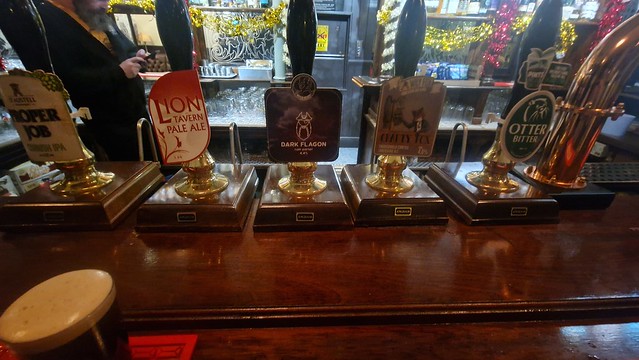
The beer range which I thought was reasonable with some quality ales there to choose from.
One of the two bars, I was surprised by the lack of customers although there were a couple in the other side.
I went for half a pint of the Dark Flagon from Wily Fox Brewery, which I’ve had a couple of times before and enjoyed. It’s an excellent cask beer, there’s an initial hit of chocolate and then a rum finish. It’s smooth, decadent and just a little sweet.
It’s a beautiful pub and although it was quieter than I expected, the atmosphere was welcoming and the member of bar staff was friendly and engaging. It’s very well reviewed on-line, although I always feel the need to have a little look at the negative reviews to see what excitement has taken place, but there’s not much other than one customer who said he reported the manager to the police for being rude to him. I can imagine that the police were thrilled. The pub prides itself on its free jukebox, but a couple of customers are irritated that their choices have been deleted, but other than that, plenty of happy customers.
The real ale range seemed reasonable and interesting, the pub had character, the service was friendly and the surroundings were comfortable. All rather lovely and I can see why it’s listed in the Good Beer Guide.
Well, this is always a most wonderful way to start a visit to a pub. I was actually here because it’s listed in the Good Beer Guide and I’m carefully working my way around all of the pubs in it that I can. For reference, the other three pubs remaining in the national pub of the year are the Three B’s in Bridlington, the Bailey Head in Oswestry and the Little Green Dragon in Winchmore Hill, London.
The exterior of the pub adorned with CAMRA awards, this is a proper looking Victorian pub and it’s a Grade II listed building. Located on Friargate, there has been a pub with the name of the Black Horse on this site since the late eighteenth century. It was opened in 1898 as a small hotel and designed by J A Seward of Preston for Kay’s Atlas Brewery Company of Manchester, one of just two of their pubs remaining. There’s original tiling on the bar which was added shortly after the hotel opened and there’s Robinson’s brewery memorabilia dotted about, as they’re the current owners.
One of the entrances, with the building once also being used as a hotel. I didn’t realise this at the time, but it’s noted that this is the only pub in the country that has entrances on three different streets.
One of the banks of pumps. I wasn’t quite sure what to make of that shiny Guinness tap, but it all looked inviting and interesting.
The second bank of pumps.
And another couple for good measure. The barman was helpful and engaging, I felt choosing just one beer was perhaps beyond me, so I had three half pints.
Decorative elements everywhere.
I chose this room to sit in. It was a bit dark, but it was cosy and it had a fire going which the barman attended to every now and then.
A bit of heritage in the toilets.
Anyway, back to the beer and I liked the Preston Ale Trail leaflet. This first beer was odd, it tasted a little of plum initially, it felt like Titanic had plum porter overflowing everywhere. It’s meant to be the Titanic Classic Mild and it had a dark smoothness to it.
Beer two was the Tell No Tales from the Bosun’s Brewing Company. A little thin, but there was lots of coffee flavour, some sweetness and a bit of a malt.
Beer three and this is as good as cask gets, the 6.5% Cherry Porter Grand Reserve from Titanic Brewery. Decadent, smooth and boozy, lots of cherry and Titanic at its best.
The pub was laid-back and comfortable, with the bar staff being attentive and I was thanked when leaving (I mean politely thanked for my custom, not thanked for finally leaving). I can’t say that it’s a surprise to discover that it’s rated as one of the best in the country, it was a really quite classy traditional pub.
Carrying on my meanderings around Good Beer Guide pubs in Preston, this is one of the few pubs that is Untappd verified and is also listed in the Good Beer Guide. I wasn’t able to get a photo of the beer board but their offerings are listed on Untappd and they had ten craft beers and four real ales. There’s also a large beer fridge with some interesting options available, as well as a choice of Belgian beers. The bar opened in June 2018 and they have a permanent line from the Rivington Brewery.
My photos in this venue aren’t very good unfortunately, but this is the Helio (10th Birthday Beer) from Track Brewing. Tropical with a very lingering flavour, it was heavy on the pineapple, being smooth and decadent.
Well, there’s fighting talk!
I love the Stoopid series from Vault City and these beers pour like smoothies, so the glass will be a nuisance to clean. Slightly tart, creamy with heaps of strawberry, some blackberry and it was generally just delicious. And yes, I think it’s a beer, although that’s kind of the point, these drinks are meant to question that entire matter.
The atmosphere was welcoming, although it was quiet, but everything felt modern and on-trend. The service was polite and friendly, with the bar staff seemingly knowledgeable about the beer options. The venue was clean with the high seating that I personally prefer. The on-line reviews are nearly all positive, just a couple of grumbles about the prices, although I thought they were comparable with similar venues. Definitely yet another bar which I think is justifiably in the Good Beer Guide.
Continuing my never-ending quest to visit every Good Beer Guide pub in the country, the Goat & Tricycle is an intriguing building which is formed of two different pubs. The one on the left (which has a beautiful green tile frontage which is pretty much impossible to make out on my photo) was known as the Pembroke Arms and this half of the pub is listed, so they go crazy in the other half I can imagine. This venue is from 12:00 until 23:00 every day of the week, other than on Fridays and Saturdays when it opens until 23:30. They serve food on Mondays to Saturdays, with around ten real ales usually available.
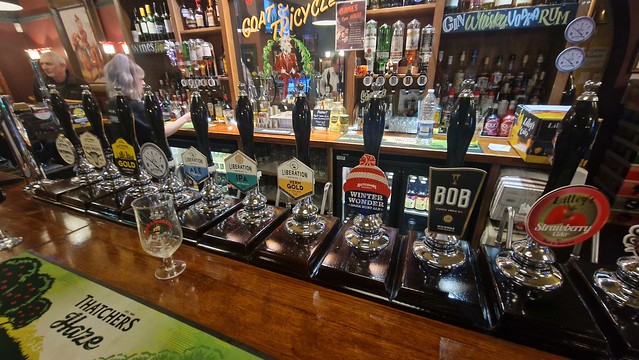
There’s the real ale range and there’s a strong presence from the Liberation Brewing Co who are based in the Channel Islands and I remember that they dominated the pub scene when I went to Jersey. Anyway, the selection was broad and it’s evident why it’s listed in the Good Beer Guide.
The beer list on the chalkboard and also a collection of implements that hopefully will never fall on a patron’s head. The service was friendly and welcoming, although there weren’t any seats available as it was busy. The pub was clean and I liked that they kept the front bar clean and dry.
This is the BOB from Wickwar Wessex Brewing Company. A sessionable beer which was malty with flavours of toffee and biscuit. I like drinking a liquid Twix though, so no complaints there.
This is listed as a Winter Ale on Untappd, but I’m not entirely sure what they actually are, I just thought it’s be something stronger in terms of the ABV but this little number was 4.1% which is hardly going to lead to much falling over. Decent beer though, very malty and I got a taste of cinnamon, but I decided that I was probably an idiot on that as no-one else seemed to be.
The on-line reviews are mostly positive and the negative ones are mostly ridiculous by the looks of it. One customer wrote:
“Worst pub in Bournemouth by some distance! Rubbish selection of ales all from Butcombe. Inferior nonlocal Westons cider available at £6 pint. Bright lights and a dreadful environment. Avoid like the plague!”.
I mention this as I liked the pub’s response to the review:
“Just to be warned everyone, this gentleman spent 30 minutes in our pub, he bought a Liberation IPA, drank half of it then tipped half an Old Rosie into the same glass, drank it and then left. Was extremely rude whilst at the bar, complaining we weren’t a Wetherspoons. Walking into a Butcombe pub complaining its full of Butcombe beer. 0 stars for you Greg”.
I think that’s a humorous response personally, I liked that they noted the rather dreadful sounding Snake Bite type drink. And there’s a nasty review which gave them 1 out of 5 because they were honouring their licensing conditions by not allowing under 18s in and the customer noted “this was inconvenient as we had agreed to meet a friend there”. I feel their pain.
The atmosphere in the pub was relaxed and laid-back, it was a comfortable place to be even without a seat to sit at. The service was efficient and customers were served in turn, with what felt like a genuine welcome offered to all. The pub is owned by Butcombe Brewery and there are apparently a couple of function rooms available, which isn’t entirely surprising since they’ve formed this venue from two separate premises. Anyway, all rather lovely and I’d merrily recommend this pub to others given the range of real ales and the ones I had were well-kept.
I’m slowly, but steadily, working on my project to visit every pub in the Good Beer Guide. This building, located on Carey Street near to the Hunterian Museum, is thought to have been built in 1602 although the bar is mostly Victorian. There’s no shortage of history to the pub, which was originally called the The League of Seven Stars in a nod towards Dutch geography (the Seven United Provinces of the Netherlands). I didn’t go up to the toilets in the pub, but they are noted for their steep stairs and a sign which requests customers not to swing on the rail. It’s located near to the Royal Courts of Justice so they are treated to a considerable amount of trade from the legal profession.
A range of Greene King and Adnams beers is not what I was hoping for as they’re so common in East Anglia, but it’s something perhaps slightly different for London. I went for a pint of Broadside which cost £6 and was well kept and tasted as expected. There are some reviews which mention, quite grumpily, that the pub doesn’t offer tasters and that is highly unusual. Anyway, the service was friendly and engaging, so the atmosphere felt inviting.
The slightly infamous pub cat visible in the background. It’s said that Shakespeare might have visited the building given that his plays were performed at Middle Temple, although that’s perhaps a little fanciful. More likely is that the pub was used as the inspiration for The Magpie & Stump featured in Pickwick Papers. The building is listed in CAMRA’s list of outstanding interiors of national historic importance and they note:
“The frontage bears the date 1602 but the building itself probably dates from “only” the 1680s, and was extended into the building on the right in 1878. The core of the pub is the part with doors embellished with etched and gilded glass, declaring ‘private counter’ (on the left) and ‘general counter’ (right). These names are probably unique, certainly in the experience of the writers, and correspond to the more commonly used ‘private bar’ and ‘public bar’. So there were evidently two separate areas fronting on to a common servery and divided, no doubt, by a timber screen. The counter (a plain affair) and bar-back are Victorian and the coloured advertising panels in the head of the latter are typical of the period around 1870-1890. The pub further expanded into the building on the left hand side in relatively recent years to form a cosy drinking area called the ‘Wig Box’.”
A rather better cat photo than my efforts.
I did try though.
I couldn’t quite understand these chairs, as one customer tried to sit on them and nearly fell off before meandering to one of the tables. The tables have table-clothes on so it wasn’t entirely clear to me whether drinkers were allowed to sit at them. The pub is primarily food led and there’s a blackboard which is chalked up with the daily menu. I must admit, the whole arrangement felt a little uncomfortable so I wouldn’t want to linger, but it’s a popular venue. Most surfaces were sticky which made it a little challenging to find somewhere to stand and not stick to something, but the food is very well reviewed and I’m sure it’s marvellous. Anyway, another Good Beer Guide venue ticked off.
The next pub on our evening meander around Hereford was the Good Beer Guide listed Beer in Hand. It’s got the atmosphere and ambience of a micropub and it has won numerous CAMRA awards over the years.
There were real ales available as well (although apparently the number of these has been reduced from previous years), with this being the keg and cans list. I like nicely presented boards which make things simple for me to understand rather than some rickety board that I can hardly read perched precariously behind the bar. The beer list was well curated with a range of beer styles to choose from, as well as an up-to-date can list by using printed versions of it. The service at the bar was friendly and timely, all suitably relaxed.
Bottles, cans, real ciders and all rather exciting. I liked the inviting atmosphere of the pub and the atmosphere felt comfortable, informal and safe. They don’t sell food, but they are proud of not just their beer and cider but also their craft spirits.
I went for the Dream House from Left Handed Giant brewery from Bristol. I like this brewery, I’ve been to their brewpub in Bristol and they make some particularly decadent stouts. This beer was a NEIPA, with a decent fruity and hoppy flavour.
Julian, who is a natural sporting sceptic (despite my attempts to get him to play football), was convinced to play Jenga. Just wait, I think he might move onto bar billiards before you know it.
Then, for reasons unknown, Jonathan brought over some Russian dolls. What was also evident was that there was an element of community about the venue with that micropub tendency to have plenty of events going on even though the opening hours might be a little limited compared to traditional pubs. There’s a debate about that in the latest CAMRA magazine, but I won’t go down that rabbit hole at the moment.
Anyway, sport aside, I very much liked this pub and am pleased that it’s listed in the Good Beer Guide. The choice of beers is impressive, the pub was clean, the service was friendly and they had a number of different pub games. The on-line reviews are positive and I’d merrily recommend a visit here.